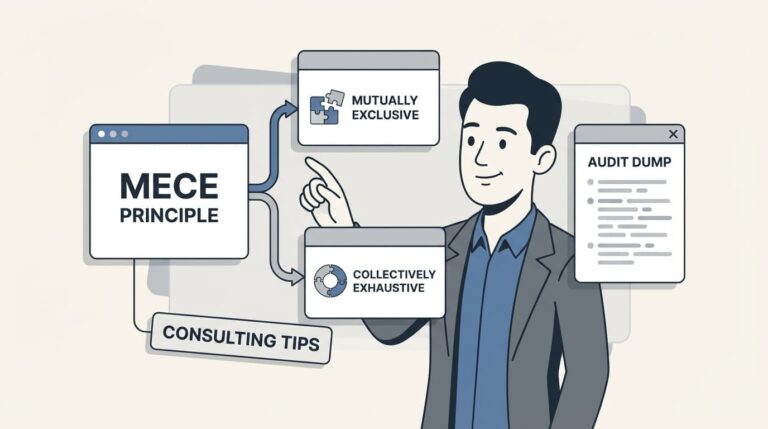
If you’re a Chartered Accountant, you have some serious skills. You’re meticulous, deeply analytical, and have a strong eye for detail. You can spot a rounding error in a spreadsheet from a mile away and probably dream about financial statements. These strengths are your superpowers.
However, in a consulting case interview, those same strengths can sometimes present a challenge. The skills that make you a top-notch auditor, like focusing on comprehensive, bottom-up accuracy, are not exactly what top firms are looking for. They do not just want the right answer; they want to see how you got there, and that “how” needs to be structured and top-down.
Failing to structure your thoughts is a significant hurdle. According to consulting experts, you “will fail your interviews (100% guarantee)” if you can’t demonstrate structured thinking. It’s really that important.
So, how do you bridge the gap? The answer is a simple but powerful framework called MECE. This guide is built for CAs like you. We will break down the MECE principle and give you actionable steps to move past the “audit dump” and start communicating with the kind of structured clarity that firms like McKinsey and BCG expect.
What is the MECE principle?
Let’s start with a quick history lesson. The MECE principle was developed by a consulting legend named Barbara Minto at McKinsey way back in the 1960s. She realized that the biggest problem with unclear business writing was not the words themselves, but the messy thinking behind them. Her book, The Pyramid Principle, introduced MECE as a way to organize your thoughts before you even try to explain them.
So, what is it? MECE (pronounced “mee-see”) stands for Mutually Exclusive, Collectively Exhaustive. It’s a method for breaking down a complex problem into smaller pieces that do not overlap and, when you put them all together, cover all the possibilities.
Think of it like sorting laundry. You make separate piles for whites, colors, and delicates. Each piece of clothing fits into only one pile (mutually exclusive), and when you’re done, every single dirty sock and shirt is in a pile (collectively exhaustive). Nothing has been left on the floor.
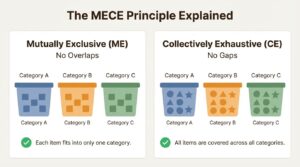
Mutually exclusive (ME): Every item fits in only one bucket
This part is all about making sure your categories are completely distinct. There are no gray areas or overlaps. When you roll a standard six-sided die, the outcome can be a ‘three’ or a ‘six’, but it cannot be both at the same time. Those outcomes are mutually exclusive.
In a business setting, imagine you’re doing a market study on the U.S. population. If you segment your audience by age using brackets like 0-15, 16-30, and 31-45, you have created mutually exclusive categories. Any given person can only fall into one of those buckets.
Collectively exhaustive (CE): All items are covered
This is the other half of the equation. It means that when you combine all your buckets, you have covered every single possibility. There are no gaps in your logic.
Using our age bracket example, the categories 0-15, 16-30, and 31-45 are not collectively exhaustive because they leave out everyone over 45. To make it exhaustive, you would need to add more brackets, like 46-60 and 61+. Now, you have accounted for every possible age in the population.
From comprehensive auditor to consultant
As a CA, you are trained to find discrepancies, and this is a valuable skill. Your job is to dive into the details and find every single discrepancy, no matter how small. This is a huge advantage when it comes to understanding a business from the ground up.
In consulting, though, the game is different. They do not want you to just list everything you have found. They want you to organize that knowledge into a prioritized, logical structure that tells a clear story. An auditor finds what’s wrong; a consultant figures out how to fix it.
Why your CA training is both an advantage and a challenge
Your background is a massive leg up, do not get me wrong.
- The advantage: You have a deep, intuitive grasp of financial statements, business processes, and compliance. When you look at a company’s numbers, you see a story. You already know what to look for and where problems might be hiding. This is an incredible head start.
- The challenge: Your default instinct might be to present a comprehensive list of all your findings. We call this the “audit dump.” In an audit, this is a sign of thoroughness. In a case interview, it just sounds unstructured. Interviewers want to see the “Pyramid Principle” approach: state your main point or hypothesis first, then support it with a few MECE arguments.
The “audit dump” vs. the “consulting pyramid”
Let’s make this more concrete. Imagine the interviewer asks: “Our client, a beverage company, has seen its profits decline over the last year. How would you investigate this?”
The “audit dump” approach might sound like this: “Okay, profits could be down for lots of reasons. Maybe there are new competitors, or maybe their Diet Coke sales are down in the US. It could also be supply chain issues raising costs, or maybe they’re spending too much on marketing. Their sales team might not be performing well either…”
You see the problem, right? It’s a laundry list of good ideas, but it’s unstructured, overlapping, and tough to follow.
Now, let’s try the “consulting pyramid” approach: “To understand this profit decline, I’d like to structure my analysis around the two primary drivers of profit: Revenues and Costs. These are mutually exclusive and collectively exhaustive. Under Revenues, we can then look closer at Price and Quantity. On the Costs side, we can examine Fixed and Variable costs. Does that sound like a reasonable place to start?”
This approach is clean, logical, and immediately shows the interviewer you know how to think in a structured way.
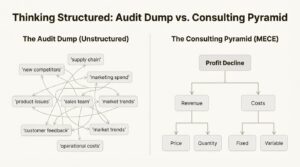
Here’s a quick comparison:
| Audit Dump Approach (Non-MECE) | Consulting Pyramid Approach (MECE) |
|---|---|
| Lists random potential causes: new competitors, product line issues, problems in the US market, sales team performance. | Starts with a high-level structure: Profit = Revenue – Costs. |
| Overlaps are common (e.g., analyzing Diet Coke in the US market overlaps with analyzing the US market as a whole). | Each branch is distinct. Revenue is separate from Costs. |
| May miss key areas (e.g., forgetting about fixed overheads if you only focus on product-related issues). | All possibilities are covered, ensuring a comprehensive analysis. |
| Hard for the interviewer to follow the logic. | Creates a clear, logical path that is easy for the interviewer to follow. |
Building your MECE toolkit
Here’s a little secret: the best case interview candidates do not just have a bunch of static frameworks memorized from a textbook (like Porter’s Five Forces or the 4 Ps). The real skill is building a custom, dynamic MECE structure on the fly that perfectly fits the problem you’re given. This shows you’re not just reciting information, but actively solving the problem. As a CA, you’re in a great position to do this.
Technique 1: Use arithmetic equations
This is your home turf. Simple mathematical formulas are naturally MECE, which makes them a fantastic starting point for almost any business problem.
For example, the classic Profitability Framework is built on a basic equation: Profit = Revenue – Costs. This is the perfect MECE starting point. From there, you can break it down even further:
- Revenue = Price x Quantity
- Costs = Fixed Costs + Variable Costs
Each piece of these equations is distinct (ME), and together they give you the complete picture (CE). This isn’t just a framework; it’s a logical map for solving any case that involves profitability, which, let’s face it, is most of them.
Technique 2: Break down a process
Another great way to create a MECE structure is to map out a business process from start to finish. This creates a sequential framework where each step is a distinct bucket for your analysis.
For instance, if you’re asked to analyze a manufacturer’s rising costs, you could use their value chain as your framework:
Sourcing Raw Materials -> Manufacturing -> Distribution -> Sales & Marketing -> After-Sales Service.
By investigating costs at each of these stages, you can systematically figure out where the problem is. Each stage is a separate area of focus, and together they cover the entire operational flow.
Technique 3: Segment a population
This technique involves breaking a large, messy group into smaller, well-defined, and non-overlapping segments. You can segment almost anything: customers, products, geographic markets, or sales channels.
Let’s say you’re asked to analyze why a company’s customer retention is falling. You could segment their customer base into:
- New Customers (in their first 3 months)
- Active Repeat Customers (purchased in the last year)
- Churned Customers (haven’t purchased in over a year)
This MECE structure lets you analyze each group’s behavior separately. Are you failing to turn new customers into repeat ones? Or are your loyal customers suddenly leaving? Segmentation gets you to the root cause much faster.
Applying the MECE principle
Alright, you get the theory. Now, how do you actually use this stuff when you’re sitting across from an interviewer, heart pounding, with a complex business problem staring you in the face?
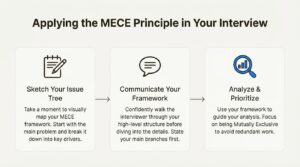
Start your case with an issue tree
An issue tree is just a fancy name for a visual diagram of your MECE framework. It’s a simple sketch that shows how you’re breaking down the problem.
When the interviewer gives you the case, take a minute of silence. It might feel a bit awkward, but it shows you’re being thoughtful. Use that time to grab your notepad and sketch out a quick issue tree. For the profitability problem, you’d write “Decline in Profit” at the top and draw two branches out to “Revenue” and “Costs.” Then, you’d add sub-branches for “Price,” “Volume,” “Fixed,” and “Variable.”
This does two things: it helps you organize your own thoughts, and it visually shows your structured thinking to the interviewer before you even say a word.
Communicate your framework with confidence
Once you have your structure, you need to present it clearly and confidently. Do not just dive into the data. Walk the interviewer through your logic first.
Here’s a simple script you can adapt:
“Thank you, that’s a really interesting problem. To diagnose this profitability issue, I’d like to structure my analysis into two key areas: Revenues and Costs. First, looking at Revenues, I’ll investigate the drivers of Price and Volume. Second, on the Costs side, I’ll explore both Fixed and Variable costs. I believe breaking the problem down this way will give us a comprehensive view of the situation and help us isolate the root cause.”
This sounds professional, structured, and gives the interviewer a clear roadmap of where you’re headed.
Prioritize being mutually exclusive over collectively exhaustive
Let’s be real: creating a perfectly, 100% MECE framework in 90 seconds under pressure is nearly impossible. And that’s okay. Interviewers know this.
The most important thing is to avoid redundant work. A top consulting tip is to focus on being Mutually Exclusive first. It’s much better to have a few clear, non-overlapping buckets that cover the most important drivers than a perfectly exhaustive list that’s confusing and makes you analyze the same thing twice.
If you’re worried you might have missed something, you can always add an “Other” category at the end of your branches. This is a simple trick to make your framework collectively exhaustive without getting bogged down in tiny details right at the start.
Build your MECE muscle memory
Reading this article and understanding the MECE principle is a great first step. But it’s just that, a first step. The real skill that separates candidates who get offers from those who do not is the ability to apply these concepts fluidly and automatically under pressure.
As one experienced case prep coach mentioned, it’s “extremely rare” for someone to master frameworking just by reading about it. Practice is absolutely non-negotiable.
You need to build muscle memory. Through consistent practice, structuring your thoughts becomes second nature. This frees up your mental energy to focus on the more creative parts of problem-solving, generating sharp insights, asking smart questions, and nailing the case math.
Knowing the framework is theory; speaking it out loud is practice. This is where tools designed for active practice can make all the difference. For instance, CA Monk’s Interview Bot is built specifically for this. You can practice structuring and delivering your answers using the MECE principle over and over, getting instant, detailed feedback on your communication and logic. It helps you refine your delivery until it’s second nature, so you can walk into your real interview with confidence.
Key takeaways
Mastering the MECE principle isn’t just about learning a new buzzword for your interview. It’s about fundamentally shifting your mindset from a CA’s detail-first approach to a consultant’s structure-first approach.
This does not mean you should throw away your incredible CA skills. Far from it. It’s about layering a powerful problem-solving and communication framework on top of the deep analytical expertise you already have.
This structured way of thinking will do more than just help you land offers from top consulting firms. It will become the foundation of a successful and impactful career in strategy, allowing you to tackle any complex business problem with clarity, confidence, and precision.
Also read: Investment Banking vs. Statutory Audit: Salary & Growth Reality Check
Frequently Asked Questions
Q.1 What is the best way to practice the MECE principle for a case interview?
A: The best way is through active practice. Do not just read about it. Use tools like CA Monk’s AI Interview Bot to verbally structure your answers, get feedback, and build muscle memory so it becomes second nature under pressure.
Q.2 How can I quickly create a MECE framework during an interview?
A: Start with simple, naturally MECE structures. Arithmetic equations (like Profit = Revenue – Costs) or business processes (like a value chain) are great starting points. Sketch a quick issue tree on your notepad to organize your thoughts before you speak.
Q.3 What are common mistakes to avoid when applying the MECE principle?
A: A big mistake is creating segments that are not truly mutually exclusive, like “mobile users” and “website users” (people can be both). Also, do not get so hung up on being 100% collectively exhaustive that you freeze. It’s better to cover the main drivers clearly than to list every single possibility.
Q. 4 Why is the MECE principle critical for Chartered Accountants moving into consulting?
A: CAs are trained for deep, comprehensive analysis, which can lead to an “audit dump” of information. Consulting requires a top-down, structured approach. MECE provides the framework to organize your deep knowledge into a clear, logical story that interviewers want to see.
Q.5 What is an advanced tip for using the MECE principle?
A: An advanced tip is to prioritize being mutually exclusive over being collectively exhaustive. Avoiding overlap in your analysis is more critical than covering every tiny detail. You can always add an “Other” category to catch miscellaneous items without cluttering your main structure.