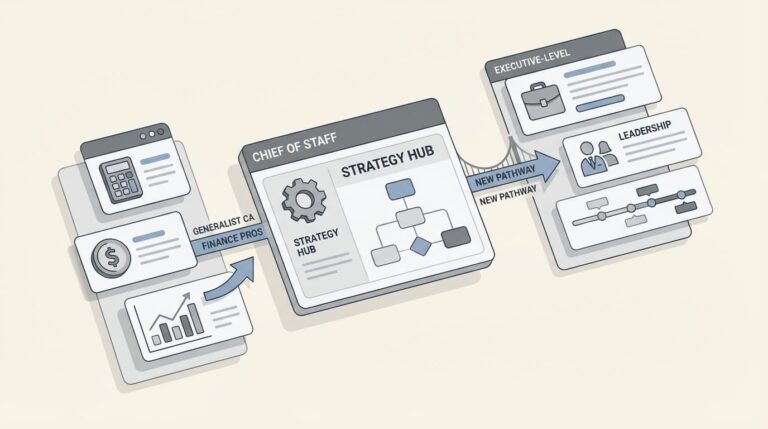
The Chief of Staff role has quietly become one of the fastest-growing positions in business. Since 2019, the number of these roles has jumped nearly 30%, according to data from the Chief of Staff Network. In an era of hiring freezes and layoffs, companies are actively recruiting for a role that many people still can’t quite define.
So what does a Chief of Staff actually do? And more importantly, why are finance professionals (CAs, CPAs, VPs of Finance) increasingly making this their next career move?

Let’s break it down.
A Chief of Staff is not an Executive Assistant (though the titles sometimes get conflated). An EA manages calendars, travel, and correspondence. A Chief of Staff thinks strategically, operates cross-functionally, and often serves as a CEO’s proxy in meetings and decisions. They’re part operator, part strategist, and part confidant.
The average tenure? Just 2.3 years, according to McKinsey research. That’s by design. Most Chiefs of Staff use the role as a springboard, not a destination. Two-thirds get promoted afterward, advancing more than one level in their organization on average.
Here’s where it gets interesting for finance professionals: 64% of Chief of Staff hires come from outside the organization. Companies aren’t just promoting from within. They’re actively seeking fresh perspectives, often from entirely different industries. And increasingly, those perspectives include deep financial acumen.
Why your finance background is a secret weapon
Traditionally, Chiefs of Staff have come from strategy and operations backgrounds. McKinsey’s analysis found that roughly half of all Chiefs of Staff have roots in these functions. Consulting firms like McKinsey, BCG, and Bain are well-represented in the talent pipeline.
But the landscape is shifting.
As companies move from “growth at all costs” to sustainable profitability, financially literate leaders are becoming indispensable at the executive level. A Chief of Staff with a CA or CPA background brings something that pure strategists often lack: the ability to model scenarios, assess risk, and understand how decisions flow through to the bottom line.
Let’s map the skill transfer:
- Financial modeling becomes strategic scenario planning
- Risk assessment translates to executive decision support
- Regulatory and compliance knowledge feeds directly into governance and board preparation
- Forecasting and budgeting maps to resource allocation and OKR implementation
- Data analysis becomes information synthesis for executive decisions
The overlap is striking. Many senior finance roles already involve board presentations, cross-functional project oversight, and strategic planning. The Chief of Staff role just formalizes these responsibilities and expands their scope.
Forbes contributor Yolanda Lau puts it bluntly: “Your chief of staff should be a generalist who can go from one project to the next without missing a beat.” For finance professionals who’ve spent years developing deep expertise, the transition to generalist leadership can feel counterintuitive. But in the Chief of Staff role, that breadth becomes the asset.
What does a Chief of Staff actually do?
The responsibilities vary by company size and industry, but certain themes emerge consistently. Based on McKinsey’s research into approximately 250 Chiefs of Staff, the role typically encompasses:
- Budget management and resource allocation
- Board meeting preparation and governance support
- Strategic planning and OKR implementation
- Cross-functional project oversight
- Special projects and operational improvements
- Acting as the principal’s proxy in discussions and decisions
Notice how many of these already sit within the typical VP Finance or Finance Director purview.
McKinsey identified three archetypes of Chief of Staff roles based on experience level:
The Operator (5-10 years experience): Focuses on administrative tasks, governance support, KPI tracking, and managing projects from the principal’s office. This is often an internal promotion for high-potential mid-level managers.
The Proxy (10-20 years experience): Serves as the principal’s representative in meetings and decisions. These Chiefs of Staff often have significant leadership responsibilities and may “double hat” with other senior roles.
The Strategist (15+ years experience): Drives transformational initiatives and major organizational changes. These are typically seasoned executives who’ve already run significant functions or business units.
The key difference from a traditional CFO track? Scope. While a VP Finance might own the financial planning function, a Chief of Staff touches everything: product, sales, marketing, operations, and yes, finance. It’s a deliberate expansion beyond functional expertise into general management.
The career acceleration factor
Here’s the data that should get every ambitious finance professional’s attention: two-thirds of Chiefs of Staff are promoted after serving in the role, and they advance more than one level on average. That’s significant upward mobility in a typical 2-3 year tenure.
The exit paths are varied. According to McKinsey’s analysis, common destinations include:
- Functional executive roles (COO, VP Operations, etc.)
- CEO or founder positions (particularly at smaller companies)
- Lateral moves to different industries (18% of Chiefs of Staff)
- Direct advancement within the same organization
The short tenure isn’t a bug. It’s a feature. The role is designed to be intense, high-impact, and transitional. As one Chief of Staff Network analysis notes, “The highest learning curve in a chief of staff role typically happens within the first two years.”
But what about the “generalist fear”? Many finance professionals worry that moving into a Chief of Staff role means abandoning their specialized expertise for a vague “generalist” label with unclear career prospects.
Sequoia Capital’s VP of Talent Zoe Hewitt addresses this directly: “There’s a natural pressure in career-building to specialise early, but broad experience can be just as valuable as functional expertise.” The Chief of Staff role gives you a front-row seat to multiple functions (strategy, operations, finance, product, go-to-market) before you choose where to go deep.
For finance professionals specifically, this can be a path out of the “back office” and into strategic leadership. Rather than being the person who reports the numbers, you become the person who helps shape what the numbers should be.
Check if your resume is ATS-friendly with our Resume Scorer.
Where are the opportunities
Chief of Staff roles are concentrated in specific industries and geographies. Understanding these patterns helps target your search effectively.
Industry breakdown (from Chief of Staff Network data):
- Tech: 25.7% of all Chief of Staff roles
- Banking and Investment: 17.6%
- Consulting, non-profits, and defense: significant representation
The tech concentration makes sense. Fast-moving companies need leaders who can navigate complexity without getting bogged down in bureaucracy. The banking and investment figure is particularly relevant for finance professionals considering this pivot; these are industries where your existing expertise is highly valued.
Company size trends tell an interesting story. The 30% growth in Chief of Staff roles since 2019 has been driven primarily by smaller companies, particularly those with fewer than 100 employees. Startups and scale-ups increasingly view the Chief of Staff as a “secret weapon” for getting the business ready for growth.
This creates a specific opportunity for finance-background Chiefs of Staff. Smaller companies preparing for Series B or C funding need leaders who can build financial infrastructure, manage investor relationships, and operationalize growth strategies. A CA or CPA who can also handle strategic projects and cross-functional coordination is uniquely valuable in this environment.
Geographic concentration follows economic hubs:
- New York City: 16.1% of active Chiefs of Staff
- Bay Area: 7.7%
- Los Angeles: 4.7%
- Washington D.C.: 4.1%
- Boston: 3.8%
These numbers reflect where the role is most established, not where all opportunities exist. As remote work normalizes and companies distribute their leadership teams, expect to see Chief of Staff roles emerging in secondary markets as well.
Making the transition: A roadmap for finance pros
If you’re considering the Chief of Staff path, here’s how to position yourself effectively.
Reframe your experience. Don’t lead with “accounting” or “financial reporting.” Lead with “business operations,” “governance,” and “strategic planning.” The skills are the same; the framing matters.
Highlight cross-functional work. Have you partnered with sales on pricing strategy? Worked with product on unit economics? Supported HR on compensation planning? These experiences demonstrate the breadth that Chief of Staff roles require.
Emphasize board exposure. If you’ve prepared board materials, presented to directors, or supported governance processes, make this prominent. It’s a core Chief of Staff responsibility.
Showcase special projects. The best Chief of Staff candidates have a track record of initiative beyond their formal job description. What have you built, fixed, or improved that wasn’t strictly required?
Before making the pivot, consider developing these complementary skills:
- Stakeholder management and influencing without authority
- Project management methodologies (Agile, Scrum, etc.)
- Executive communication and presentation
- Strategic planning frameworks (OKRs, balanced scorecard, etc.)
Practical steps to get there:
- Seek special projects that stretch beyond pure finance. Volunteer for cross-functional initiatives. Raise your hand for the messy, ambiguous problems.
- Build relationships across functions, especially with the CEO’s office or executive team. Internal networking matters; 36% of Chief of Staff roles are filled through internal promotion.
- Consider internal opportunities first. If your organization has or is considering a Chief of Staff role, make your interest known. It’s often easier to pivot internally than break in from outside.
- Target companies where your industry expertise is valuable. If you’ve spent a decade in fintech, fintech startups preparing for growth should be your first stop.
Is the Chief of Staff path right for your finance career?
Not every finance professional should pursue the Chief of Staff route. It’s a specific fit for a specific type of career goal.
Consider this path if:
- You enjoy variety and cross-functional work more than deep specialization
- You want strategic influence that extends beyond the finance function
- You’re interested in eventually running a business unit, becoming COO, or starting your own company
- You thrive in ambiguous, high-intensity environments where the playbook isn’t written yet
Stay on the traditional CFO track if:
- You prefer developing deep expertise in finance over general management
- You want predictable career progression with clear milestones
- You value stability and work-life balance over rapid advancement
- The “generalist” work of coordinating across functions doesn’t energize you
The Chief of Staff role represents a unique inflection point for finance professionals. With 30% growth in the role and companies increasingly valuing financial acumen at the executive level, there’s never been a better time for CAs to consider this pivot.
Whether you’re looking to accelerate toward the C-suite, position yourself for a COO role, or simply expand your strategic toolkit, the Chief of Staff path offers something rare: a deliberate bridge from functional expert to general manager. For the right person at the right career stage, it might just be your best move yet.
Create an ATS-friendly resume with our Resume Builder.
Also read: Treasury management: The hidden strategic role in corporates
Frequently Asked Questions
Q1 Is Chief of Staff a good career move for finance professionals?
A1: For many finance professionals, yes. The role offers accelerated advancement (two-thirds of Chiefs of Staff are promoted after serving), exposure to multiple business functions, and a path to general management. However, it depends on your career goals. If you prefer deep specialization in finance, the traditional CFO track may be a better fit.
Q2 What does a Chief of Staff in finance do?
A2: A Chief of Staff with a finance background handles budget management, strategic planning, board preparation, cross-functional project oversight, and special initiatives. They often serve as the CEO’s proxy in meetings and decisions, bringing financial acumen to operational and strategic challenges across the business.
Q3 How much experience do I need to become a Chief of Staff?
A3: According to McKinsey research, the average Chief of Staff has just over 12 years of experience. However, there are two common entry points: 5-10 years for operational-focused roles, and 10-20 years for more strategic positions where you might serve as the principal’s proxy.
Q4 What is the average tenure for a Chief of Staff?
A4: The median tenure is 2.3 years. The role is designed to be transitional, serving as a springboard to more senior leadership positions. Most Chiefs of Staff view the position as a 2-3 year investment in their career acceleration.
Q5 Which industries hire the most Chiefs of Staff?
A5: Tech leads with 25.7% of Chief of Staff roles, followed by banking and investment at 17.6%. Consulting, non-profits, and defense also have significant representation. The role is increasingly common in smaller companies and startups as well.