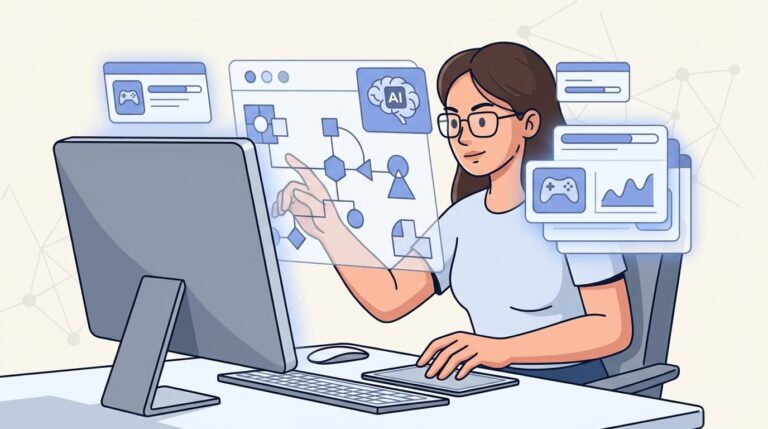
Remember the last time you sat down for a traditional job assessment? The sterile interface, the ticking clock, the multiple-choice questions that felt completely disconnected from the actual job? That experience is rapidly becoming obsolete.
Today, companies from Unilever to McKinsey are replacing those outdated tests with something far more engaging (and challenging): AI-powered gamified assessments. These aren’t just fancy quizzes. They’re sophisticated logic games that measure how you think, decide, and adapt in real-time. And here’s the catch: the AI is watching everything. Not just whether you get the right answer, but how you approach problems, how you handle pressure, and how quickly you pivot when things change.
The good news? You can prepare for these assessments. This guide breaks down exactly how AI recruitment games work, what they’re really measuring, and the strategies that will help you perform at your best.

What are gamified assessments?
Gamified assessments are interactive evaluations that use game mechanics (points, levels, time limits, instant feedback) to measure your skills, cognitive abilities, and behavioral traits. Instead of answering static questions, you’re solving dynamic challenges that simulate real work scenarios.
Companies have embraced these tools for several compelling reasons. First, they reduce unconscious bias. Traditional resumes and interviews favor candidates with certain backgrounds or presentation skills. Games measure what you actually do, not where you went to school or how polished your LinkedIn profile looks.
Second, they capture authentic behavior. When you’re engaged in a game, you’re less likely to overthink your responses or try to give the “right” answer. The AI sees your natural problem-solving style, decision-making speed, and how you handle unexpected challenges.
The data backs this up. According to TalentLMS research, 78% of job seekers prefer gamified applications over traditional ones. Companies like Unilever, Google, PwC, and McKinsey now use these assessments as standard parts of their hiring process.
Understanding the recruitment games
Here’s where it gets interesting. The AI isn’t just scoring right and wrong answers. It’s building a detailed behavioral profile based on dozens of micro-interactions throughout the assessment.
What the AI actually measures:
- Decision speed: How quickly you process information and act on it
- Accuracy patterns: Whether you maintain quality under time pressure
- Adaptability: How you respond when the game suddenly changes difficulty or rules
- Strategic thinking: Whether you plan ahead or react moment-to-moment
- Resilience: How you handle failure and whether you adjust your approach
The AI uses adaptive algorithms that adjust the game’s difficulty in real-time based on your performance. Answer correctly and quickly? The next challenge gets harder. Struggle with a particular type of puzzle? You might see more of those to test your limits.
This is fundamentally different from traditional tests where everyone gets the same questions. The AI is trying to find your ceiling: the point where your skills are genuinely challenged. That means the experience varies for every candidate, and the system learns about you as you play.
The main types of logic games
Not all gamified assessments are the same. Different roles require different skills, and the games reflect that. Here are the four main categories you’re likely to face:
Pattern recognition and spatial reasoning games
These test your analytical thinking and visual processing abilities. You might see sequences where you need to identify the next item, matrices where you spot the underlying rule, or spatial puzzles that require mental rotation.
What they measure: Abstract reasoning, attention to detail, ability to identify rules from examples
Example: Raven’s Progressive Matrices style challenges where you complete visual patterns
Ecosystem and resource management simulations
Popularized by consulting firms, these games place you in complex systems where you must balance competing priorities. You might manage a virtual ecosystem, allocate limited resources, or optimize a production process.
What they measure: Systems thinking, strategic planning, resource allocation, long-term vs. short-term tradeoffs
Example: McKinsey’s Problem-Solving Game includes ecosystem scenarios where you balance predator/prey relationships
Timed decision-making challenges
These put you under pressure to make rapid, accurate decisions. The clock is ticking, and you need to process information quickly without sacrificing quality.
What they measure: Processing speed, accuracy under pressure, prioritization
Example: The PICA (Progressive Insight Cognitive Assessment) consists of 50 questions with a 12-minute time limit
Situational judgment and behavioral games
These present workplace scenarios and measure how you navigate them. You might handle customer complaints, resolve team conflicts, or make ethical decisions.
What they measure: Emotional intelligence, decision-making style, cultural fit, communication approach
Example: Customer service simulations where you choose responses to frustrated customers
Proven strategies for logic games
Now let’s get tactical. These strategies come from analyzing what successful candidates do differently, combined with insights from how AI evaluation systems actually work.
Before the assessment
Research the company and role. Different roles prioritize different competencies. A consulting firm values structured problem-solving. A startup might prioritize adaptability and risk tolerance. Understand what they’re looking for and you’ll know which strengths to emphasize.
Practice with similar games. The skills these assessments measure can be developed. Play logic puzzles like Sudoku, strategy games like Civilization or Mini Metro, or resource management games like Factorio. These build the underlying cognitive muscles you’ll need.
Get your setup right. Technical issues can ruin your performance. Use a stable internet connection, find a quiet environment, and test your device beforehand. Some assessments track if you switch tabs or get distracted, so give yourself the best conditions to focus.
Check if your resume is ATS-friendly using our Resume Scorer.
During the assessment
Read instructions carefully. The AI tracks engagement metrics, and rushing through tutorials can count against you. Take the time to understand the mechanics. The practice round isn’t just warm-up; it’s often part of the evaluation.
Treat it like a case study. Ask yourself: What’s the objective? What constraints exist? What resources do I have? This structured approach shows the AI that you think systematically, not just reactively.
Balance speed and accuracy. The AI evaluates both. Going too fast with lots of errors suggests impulsivity. Going too slow suggests perfectionism or indecision. Find the rhythm that lets you maintain quality without overthinking.
Stay flexible. If a strategy isn’t working, pivot quickly. The AI specifically tracks adaptability. Candidates who stubbornly stick to failing approaches score lower than those who recognize problems and adjust.
The mindset that wins
Develop structured curiosity. Be methodical but adaptable. Have a plan, but don’t be rigid about it.
Embrace the game frame. Research shows that viewing assessments as challenges rather than tests reduces anxiety and improves performance. The playful framing is there for a reason. Use it.
Focus on the process, not perfection. The AI often cares more about how you approach problems than whether you solve them perfectly. A thoughtful attempt that shows good reasoning can score higher than a lucky correct answer.
Stay calm when difficulty spikes. If the game suddenly gets harder, that’s not a sign you’re failing. It’s the adaptive algorithm finding your limits. Expect this and don’t let it rattle you.
Common mistakes that hurt your scores
Knowing what not to do is just as important as knowing what to do. Here are the most common pitfalls that drag down scores:
Overthinking simple patterns. The AI tracks decision time. Spending 30 seconds on a pattern that should take 5 suggests either poor pattern recognition or excessive caution. Trust your instincts on straightforward challenges.
Ignoring instructions or tutorials. Skipping the tutorial might save a minute, but it signals low engagement and can lead to preventable errors. The AI notices this.
Getting stuck on one challenge. If you’ve been struggling with the same puzzle for a while, move on. The AI tracks persistence, but there’s a difference between healthy persistence and counterproductive stubbornness.
Playing too conservatively or too riskily. Both extremes hurt you. Never taking risks suggests lack of confidence. Always taking risks suggests poor judgment. Balance is key.
Letting frustration show. Erratic clicking, random guessing, or abandoning attempts mid-way are all tracked. The AI evaluates emotional stability and resilience. Stay composed even when things get tough.
Trying to “game” the system. The AI has seen every trick. Obvious patterns like always choosing the middle option or alternating responses get flagged. Just focus on doing your best.
What happens after the assessment
Once you finish, the AI generates a comprehensive candidate profile. This isn’t just a score. It’s a detailed breakdown of your cognitive abilities, behavioral traits, and decision-making patterns.
Recruiters see metrics like:
- Processing speed and accuracy ratios
- Adaptability scores (how you handled difficulty changes)
- Strategic thinking indicators (planning vs. reactive behavior)
- Resilience metrics (performance under pressure)
- Learning agility (how quickly you picked up new mechanics)
Here’s something important: candidates with lower overall scores sometimes get hired over higher scorers. Why? Because the AI also evaluates cultural fit and growth potential. Someone who scores moderately but shows high adaptability and learning agility might be preferred over a high scorer who was rigid and risk-averse.
Most companies respond within one to two weeks. Some platforms provide immediate feedback reports showing your strengths and development areas. If you don’t advance, don’t be discouraged. Many companies allow retakes after a cooling-off period, and the skills you build practicing for these assessments transfer to future opportunities.
Practice resources to sharpen skills
You can train for these assessments. Here are the best resources:
- Sudoku and BrainBashers for pattern recognition
- Lumosity (free tier) for cognitive training
- Use our Aptitude Test to improve your reasoning speed and accuracy.
- Lumosity (free tier) for cognitive training
Start by identifying the types of games your target companies use. Practice with similar logic puzzles and strategy games. Focus on building the underlying cognitive skills: pattern recognition, systems thinking, decision-making under pressure, and adaptability.
Most importantly, approach the assessment as a challenge to enjoy rather than a test to fear. The AI can detect anxiety and disengagement. Bring your best problem-solving self to the game, and let your natural abilities shine through.
Prepare for your interview using our Interview Bot.
Also read: Articleship transfer rules in 2026: A data-driven guide
Frequently Asked Questions
Q.1 How can I beat the AI logic games in recruitment if I have no gaming experience?
A1: You don’t need gaming experience to succeed. These assessments measure cognitive abilities and decision-making styles, not gaming skill. Focus on practicing logic puzzles and strategy games to build the underlying mental skills. The interface is usually intuitive, and most include tutorials. What matters is your thinking process, not how quickly you can click.
Q.2 What is the best way to beat the AI logic games in recruitment for consulting firms?
A2: Consulting firms typically use ecosystem simulations and problem-solving games. Practice systems thinking by playing resource management games like Mini Metro or studying ecosystem dynamics. Focus on balancing competing priorities and thinking several steps ahead. McKinsey and BCG both offer practice materials on their careers pages that closely mirror their actual assessments.
Q.3 Can you beat the AI logic games in recruitment by practicing specific patterns?
A3: While you can practice general logic and reasoning skills, trying to memorize specific patterns rarely works. The AI uses adaptive algorithms that change based on your performance, and companies regularly update their assessments. Instead of looking for shortcuts, focus on developing genuine cognitive flexibility, pattern recognition ability, and decision-making speed.
Q.4 How do I beat the AI logic games in recruitment when I’m not good at timed tests?
A4: Time pressure is a deliberate part of the assessment, but accuracy still matters. Practice with timed puzzles to build comfort with the pressure. During the assessment, don’t let the clock panic you. The AI evaluates your ability to maintain performance under stress. Start with easier questions to build momentum, and don’t spend too long on any single challenge.
Q.5 What mistakes should I avoid to beat the AI logic games in recruitment?
A5: The biggest mistakes are overthinking simple problems, getting stuck on difficult challenges instead of moving forward, and letting frustration affect your performance. The AI tracks engagement and emotional stability, so staying composed is crucial. Also avoid trying to ‘trick’ the system with obvious patterns. The algorithms are sophisticated and flag gaming attempts.
Q.6 How long does it take to prepare to beat the AI logic games in recruitment?
A6: Most candidates benefit from 1-2 weeks of regular practice. Spend 20-30 minutes daily on logic puzzles, pattern recognition games, or strategy games. If you’re targeting consulting firms or technical roles, allow more time for the specific game types they use. The skills you build will also help with interviews and on-the-job problem solving.