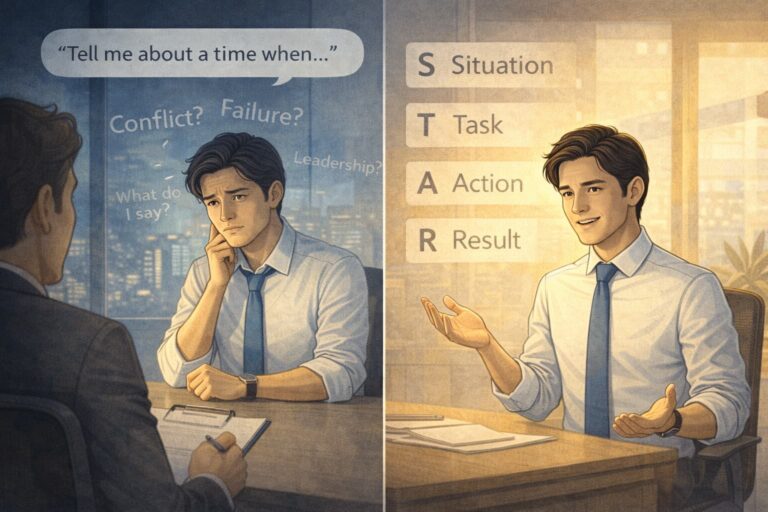
You’ve memorized the technical answers. You can explain your skills on paper. But then the interviewer asks, “Tell me about a time when you had to handle a difficult situation,” and your mind goes blank.
You’re not alone. Behavioral interview questions trip up even the most qualified candidates, not because they lack good experiences to share, but because answering them well requires a different kind of preparation. The good news? With the right framework and practice, you can walk into your next interview with answers that feel natural and stories that actually land.
This guide covers 33 behavioral interview questions organized by category, the STAR method for structuring your answers, sample responses you can adapt, and practical strategies for overcoming the anxiety that makes candidates freeze.
What are behavioral interview questions?
Behavioral interview questions ask you to describe specific situations from your past work experience. Instead of asking what you would do in a hypothetical scenario, interviewers want to know what you actually did when faced with challenges.
The logic behind this approach is straightforward: past behavior predicts future performance. If you’ve successfully navigated conflict with a coworker before, you’re more likely to do it again. If you’ve demonstrated leadership under pressure, that pattern will probably continue.
You’ll recognize these questions by their opening phrases:
- “Tell me about a time when…”
- “Describe a situation where…”
- “Give me an example of…”
- “Walk me through how you handled…”
Companies across industries rely on behavioral questions because they reveal what textbooks and technical assessments can’t: your soft skills, emotional intelligence, and problem-solving instincts. According to career experts at Indeed, recruiters use this technique to “judge candidates based on their past behavior” rather than accepting polished hypotheticals.
The shift from “what would you do?” to “what did you do?” changes everything about how you need to prepare.
Why do candidates freeze during interview
Here’s something career advice articles rarely mention: candidates don’t freeze because they lack good experiences to share. They freeze because of how anxiety affects recall and delivery under pressure.
The psychology of interview anxiety
There’s a gap between knowing an answer in your head and delivering it out loud while someone evaluates you. That gap is where interview anxiety lives.
When you’re stressed, your brain’s fight-or-flight response activates. This is useful if you need to run from danger, but not so useful when you’re trying to articulate a nuanced story about conflict resolution. Stress hormones impair the prefrontal cortex, the part of your brain responsible for retrieving memories and organizing thoughts into coherent narratives.
This explains why you can think of perfect examples while driving home from the interview but couldn’t access them when it mattered. The experiences were always there. Anxiety just blocked the retrieval pathway.
Technical interview prep doesn’t solve this problem. You can memorize accounting standards or coding syntax, but behavioral questions require you to tell a story from memory, and storytelling under pressure is a skill that requires specific practice.
Common mental blocks
Beyond general anxiety, candidates face specific psychological barriers:
Fear of sounding rehearsed vs. fear of rambling. You want to sound natural, but you also don’t want to meander. This tension creates paralysis.
Imposter syndrome. “My examples aren’t impressive enough compared to other candidates” leads to second-guessing every story you consider sharing.
Perfectionism. Trying to craft the “perfect” answer in real-time causes overthinking and awkward pauses.
Blank mind syndrome. You know you have relevant experiences, but under pressure, you can’t access any of them. Everything feels either too small or too hard to explain quickly.
The solution isn’t more reading. It’s safe, judgment-free practice where you can stumble, retry, and build the muscle memory that makes delivery feel natural.
The STAR method for interview questions
The STAR method is the universal framework for structuring behavioral answers. Every major career resource teaches it because it works: it keeps your answer focused, prevents rambling, and ensures you actually answer what was asked.
What STAR stands for
Situation: Set the context. Where were you working? What was happening? Give enough background for the interviewer to understand the challenge, but don’t spend more than a few sentences here.
Task: What was your specific responsibility? What were you accountable for in this situation? This clarifies your role and what success looked like.
Action: What did YOU do? This is the heart of your answer. Use first-person, active voice (“I scheduled,” “I proposed,” “I decided”), not passive constructions or team-wide “we” statements that obscure your individual contribution.
Result: What was the outcome? Quantify it if possible (percentages, dollars, time saved). Then extract the learning: what principle do you now apply because of this experience?
How to use STAR without sounding robotic
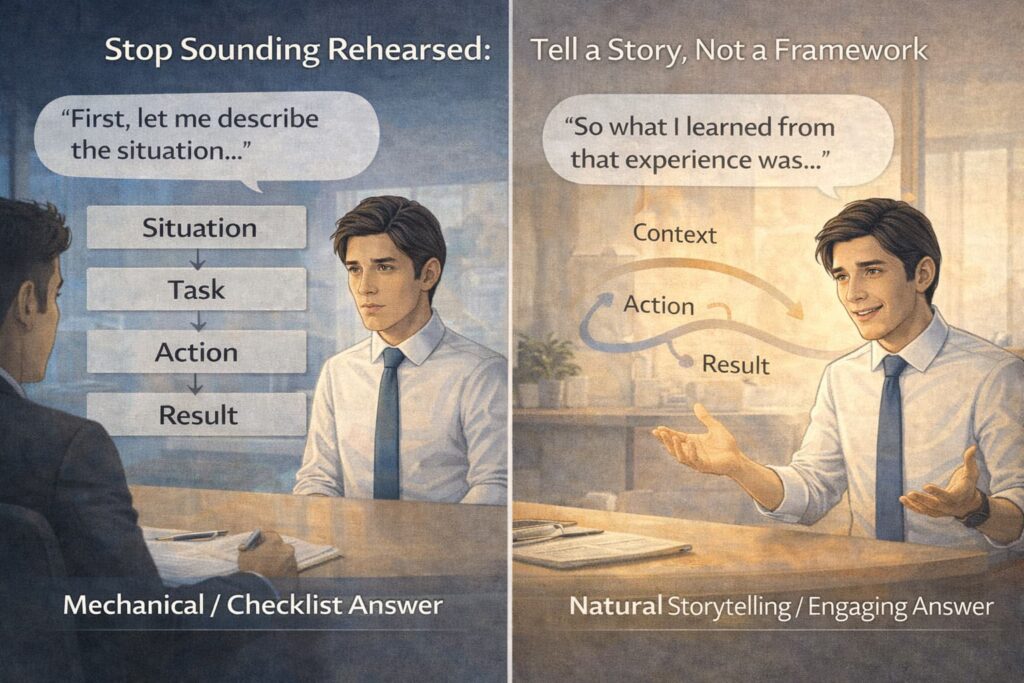
The biggest mistake candidates make is announcing the framework while they use it. “First, let me describe the situation…” sounds rehearsed and mechanical.
Instead, weave the components into a natural narrative. Transition smoothly from context to action to result without signposting each section. Your answer should feel like a story with a beginning, middle, and end, not a checklist.
Keep your total answer under two minutes. Interviewers will ask follow-up questions if they want more detail. A concise answer that lands is better than an exhaustive one that loses attention.
End with a principle or takeaway. What did this experience teach you that you now apply broadly? This signals reflection and growth, which is often what interviewers care about most.
STAR method example
Here’s how a conflict resolution answer maps to the STAR structure:
Question: “Tell me about a time you had a conflict with a coworker.”
Answer: “Last year, I was leading a content migration project with a tight deadline. One of the developers on my team kept missing his deliverables, which was putting the whole timeline at risk. (Situation)
My responsibility was to keep the project on track while maintaining a good working relationship since we’d be collaborating for months. (Task)
Instead of escalating to his manager immediately, I asked him to grab coffee and just listened. It turned out he was juggling three other priorities his manager had assigned, and he didn’t feel comfortable pushing back. We mapped out his workload together, identified which tasks actually needed his expertise versus what I could reassign, and I offered to help him communicate the bandwidth issue to his manager. (Action)
We hit our deadline, and more importantly, he started flagging capacity issues earlier in future projects. I learned that what looks like poor performance is often a communication or prioritization problem in disguise. (Result + Learning)“
Notice the answer includes specifics (last year, content migration, coffee meeting), acknowledges the other person’s perspective, uses active “I” statements, and ends with a transferable principle.
Ace your next interview with our Interview Bot and real-time performance feedback.
33 behavioral interview questions by category
The following questions cover the core competencies that behavioral interviews assess. For each category, you’ll find the questions interviewers ask, what they’re actually evaluating, a sample answer, and common pitfalls to avoid.
1. Teamwork and collaboration questions
What interviewers assess: Emotional intelligence, conflict resolution, ability to share credit, working across differences
Questions:
- Tell me about a time you had a conflict with a coworker. How did you handle it?
- Describe a situation where you had to work with someone whose personality was very different from yours.
- Give an example of a successful team project you contributed to. What was your role?
- Tell me about a time you had to give difficult feedback to a team member.
- Describe when you had to rely on others to complete a project.
- Tell me about a time you had a conflict with a coworker. How did you handle it?
Sample answer:
“In my last role, I disagreed with a colleague about how to structure a client presentation. She wanted to lead with our methodology; I thought we should lead with their specific pain points. The meeting was two days away, and we’d already spent hours on different approaches. (S/T)
I suggested we each prepare a three-minute version of our opening and present them to each other without interruption. After hearing her approach in full, I understood she was worried the client would dismiss us as generalists if we didn’t establish credibility first. That was a valid concern I hadn’t considered. (A)
We ended up combining both: a brief credential slide, then immediately into their challenges. The client commented that we clearly understood their situation. More importantly, my colleague and I developed a ‘mini-pitch’ approach we used for future disagreements. (R)“
Common pitfall: Blaming the other person or positioning yourself as the hero who “fixed” them. Interviewers want to see perspective-taking, not victory over a difficult colleague.
2. Problem-solving and critical thinking questions
What interviewers assess: Methodology, analytical thinking, resourcefulness, learning ability
Questions:
- Describe your approach to solving a complex problem.
- Tell me about a time you had to make a decision with incomplete information.
- Give an example of when you identified a problem before it became urgent.
- Describe a creative solution you developed for a work challenge.
- Tell me about a time you had to learn something new quickly to solve a problem.
Sample answer:
“Our team was losing deals at the proposal stage, and leadership wanted to know why. We had opinions, but no data. (S/T)
I started by pulling our CRM records from the last six months and categorized lost deals by industry, deal size, and the objection our sales team recorded. Then I called five prospects who had declined and asked if they’d share what influenced their decision. I mapped their feedback against our internal assumptions. (A)
It turned out pricing wasn’t the issue, which is what we’d assumed. Prospects were concerned about implementation timelines. We revised our proposal template to include a detailed onboarding schedule with milestones, and our close rate improved by 18% the following quarter. (R)“
Common pitfall: Focusing too much on the problem without clearly articulating YOUR specific actions. The interviewer wants to know what you did, not just what the challenge was.
3. Leadership and initiative questions
What interviewers assess: Proactivity, ownership, ability to motivate others, decision-making courage
Questions:
Tell me about a time you took initiative without being asked.
- Describe a situation where you had to lead a project or team.
- Give an example of when you motivated others during a difficult time.
- Tell me about a time you had to make an unpopular decision.
- Describe when you went above and beyond your job description.
Sample answer:
“I noticed our customer support team was answering the same onboarding questions repeatedly, probably 30% of their tickets. Nobody had asked me to address this since I was in product, not support. (S/T)
I pulled the most common questions from our ticket system, wrote draft answers, and created a simple FAQ document. Then I shared it with the support lead to refine and eventually built it into our product as an in-app help center. The support lead and I presented the impact together at our monthly all-hands. (A)
Support ticket volume for onboarding questions dropped by 40%, and the initiative led to my company creating a formal process for product and support collaboration. I learned that sometimes the most impactful work isn’t in your job description. (R)“
Common pitfall: Claiming credit for team efforts or not showing how you influenced others. If you led, show what leadership looked like in practice.
4. Adaptability and resilience questions
What interviewers assess: Flexibility, stress management, growth mindset, accountability
Questions:
- Tell me about a time you had to adapt to a major change at work.
- Describe a situation where you failed or made a significant mistake. What happened?
- Give an example of working effectively under pressure or tight deadlines.
- Tell me about a time your priorities shifted suddenly. How did you respond?
- Describe when you received critical feedback. How did you handle it?
Sample answer:
“Early in my career, I sent a client deliverable without having someone else review it. The report had a calculation error that the client caught before I did. It was embarrassing and damaged their confidence in our work. (S/T)
I called the client immediately, owned the mistake without excuses, and told them I’d re-run all the numbers and have a corrected version by end of day. Then I stayed late, triple-checked every figure, and added a methodology note explaining my calculations so they could verify them. I also asked my manager to implement a peer review requirement for all client-facing materials. (A)
The client appreciated the transparency and stayed with us. I learned that speed without accuracy creates more work than it saves, and that processes exist to catch human error before it reaches clients. (R)“
Common pitfall: Choosing a “fake” failure that’s really a humble-brag (“I worked too hard and burned out”), or blaming external factors rather than taking ownership.
5. Communication questions
What interviewers assess: Clarity, listening skills, persuasion, handling difficult conversations
Questions:
- Tell me about a time you had to explain something complex to someone unfamiliar with the topic.
- Describe a situation where you had to persuade someone to see your point of view.
- Give an example of a difficult conversation you had at work.
- Tell me about a time you had to deliver bad news.
- Describe when miscommunication caused a problem. How did you address it?
Sample answer:
“I was presenting our data security protocols to the board, and most members didn’t have a technical background. They needed to understand the risks to make a budget decision, but they didn’t need a tutorial on encryption. (S/T)
I translated technical concepts into business outcomes. Instead of explaining how our firewall worked, I explained what data would be at risk if we didn’t upgrade and what the potential regulatory fines looked like. I used a simple analogy comparing our current setup to a house with good locks but no alarm system. I also prepared a one-page summary with three options at different price points. (A)
The board approved the mid-tier option with minimal questions, and several members thanked me afterward for making it accessible. I learned that communicating up isn’t about showing expertise. It’s about making decisions easy. (R)“
Common pitfall: Focusing on what you said without demonstrating that you listened or adapted to your audience.
6. Customer and stakeholder management questions
What interviewers assess: Empathy, service orientation, managing expectations, saying no professionally
Questions:
- Tell me about a time you dealt with a difficult customer or client.
- Describe a situation where you exceeded a customer’s expectations.
- Give an example of when you had to manage conflicting stakeholder demands.
- Tell me about a time you turned a negative customer experience into a positive one.
- Describe when you had to say “no” to a client or stakeholder request.
Sample answer:
“A client called furious because their website went down during a product launch they’d spent months preparing. They were yelling, threatening to cancel their contract, the whole situation was escalated. (S/T)
First, I let them vent without interrupting. Once they’d said their piece, I acknowledged how frustrating this was and told them I understood the stakes. Then I explained exactly what happened (a server configuration issue on our end), what we were doing to fix it, and gave them a timeline: 90 minutes to full restoration. I stayed on the phone with them for the first 20 minutes while our engineers worked, then called them back at the 60-minute mark with an update and again when the site was live. (A)
They didn’t cancel. In fact, they renewed their contract the following year and mentioned in the renewal conversation that our handling of that incident was part of why they stayed. I learned that angry customers often just want to be heard and kept informed. (R)“
Common pitfall: Making the customer sound unreasonable instead of demonstrating empathy and resolution.
Bonus: Self-awareness and motivation questions
Questions:
- What’s your biggest professional weakness and how are you addressing it?
- Tell me about a time your values were challenged at work.
- Describe your proudest professional achievement and why it matters to you.
Sample answer:
“I tend to say yes to too many projects because I want to be helpful and I’m genuinely interested in most things. This has led to overcommitment and, at times, work that wasn’t my best because I was stretched thin. (S/T)
I’ve built systems to counteract this. Before agreeing to anything new, I ask myself three questions: Is this aligned with my core responsibilities? Do I have the capacity to do this well? What would I have to deprioritize? I also started blocking ‘focus time’ on my calendar that’s protected from meetings. (A)
I still struggle with this, especially when interesting projects come up. But I’ve gotten better at honest capacity conversations with managers, and my work quality has improved since I’m not constantly context-switching. (R)“
Common pitfall: The “I’m a perfectionist” non-answer. Interviewers see through scripted weaknesses immediately. Choose something real, show how you’re addressing it, and acknowledge it’s ongoing work.
Red flags and mistakes in interviews
Knowing what TO do is only half the battle. You also need to recognize the patterns that raise red flags for interviewers.
Answer mistakes that raise red flags
Blame-shifting language. “My manager didn’t communicate the deadline clearly” vs. “I should have confirmed the timeline upfront.” The first deflects responsibility; the second shows ownership.
Victim mentality. Making yourself the hero in a story that’s really about other people’s failures. Interviewers want to see how you contributed, not how you survived incompetence.
Vague generalities. “I always handle conflict well” without a specific example. This tells the interviewer nothing and suggests you can’t recall concrete experiences.
Over-explaining the problem. Spending 80% of your answer on context and only 20% on what you actually did. Interviewers care most about your actions and results.
The humble-brag failure. “My weakness is that I care too much about quality.” This signals inauthenticity and a lack of self-awareness.
Not answering the question asked. Delivering a prepared answer that doesn’t match the prompt. Interviewers notice when you’re forcing a rehearsed story into an unrelated question.
How to recover when you freeze or stumble
Freezing happens to everyone. What matters is how you handle it.
Buy time without apologizing excessively. “Let me take a moment to think of a good example for that.” Interviewers expect you to think. A brief pause is professional, not awkward.
Reset if needed. “Actually, let me start that again with a clearer example.” This shows self-awareness and confidence.
Redirect mid-answer. “I realize I’m going into too much detail here. The key point is…” This demonstrates you’re monitoring how your answer is landing.
Acknowledge if you don’t have a direct example. “I don’t have a direct example of that exact situation, but here’s a related experience that shows similar skills…” Authenticity beats forcing a weak story.
Re-anchor to STAR. If you’re rambling, pause and ask yourself: have I covered the situation? The task? My specific actions? The result? Jump to whatever piece is missing.
The interviewer wants to see you succeed. A composed recovery from a stumble can actually be more impressive than a perfect answer, because it shows how you handle pressure in real-time.
How to practice interview questions
Reading sample answers builds awareness, but it doesn’t build the skill of delivering your own answers under pressure. That requires practice, and not just any practice.
Why reading examples isn’t enough
There’s a difference between knowing what a good answer looks like and being able to produce one when someone is staring at you expectantly.
Interview performance is a speaking skill, not a reading skill. The neural pathways for processing text and producing speech are different. Reading about the STAR method activates one part of your brain; using it out loud activates another.
This is why candidates who “know” the right answers still freeze. They’ve done the mental preparation but not the verbal practice. Solo reading creates false confidence because it feels like preparation without testing delivery.
The deliberate practice framework
Effective interview practice follows a specific structure:
1. Build your story bank. Write down 8-10 professional experiences that cover the major categories: teamwork, problem-solving, leadership, adaptability, communication, and customer management. You don’t need 33 separate stories. One strong experience can often answer multiple questions.
2. Practice out loud. Say your answers to yourself, not in your head. Speaking engages different memory systems than silent reading. It reveals filler words, awkward transitions, and timing issues that only surface when you vocalize.
3. Record yourself. Listen back for rambling, missing STAR components, and opportunities to be more concise. Hearing your own answers exposes patterns you can’t detect while speaking.
4. Get feedback. Self-assessment has limits. External input reveals blind spots, from nervous habits you don’t notice to story choices that don’t land the way you intended.
5. Iterate. Refine your answers based on what sounds awkward or unclear. Practice isn’t about memorizing a script. It’s about building flexibility so you can adapt your stories to different questions.
The problem with traditional practice methods
Most candidates know they should practice but struggle with how:
Practicing in a mirror feels awkward. You’re performing for yourself while also trying to assess yourself. It’s cognitively taxing and doesn’t simulate a real conversation.
Friends and family aren’t trained interviewers. They give encouraging feedback (“That sounded great!”) rather than actionable critique. And practicing in front of people you know brings its own anxiety.
Mock interviews are expensive and hard to schedule. Professional coaching can cost hundreds of dollars per session, and coordinating schedules adds friction that prevents consistent practice.
Without feedback loops, you can’t identify what’s wrong. You might be making the same mistakes repeatedly without realizing it.
The solution is a judgment-free practice environment where you can fail safely, get instant feedback, and build confidence before the real interview.
That’s why tools like AI Interview Bot exist. You can practice your answers as many times as you need, in private, without feeling self-conscious about stumbling or rambling. The AI provides feedback on structure and clarity, not judgment on your worthiness. It’s a space to rehearse until your stories feel natural, so that when you’re sitting across from an actual interviewer, you’re not doing this for the first time.
Build confidence for next behavioral interview
Behavioral interview questions assess something resumes and technical tests can’t measure: how you actually work with others, handle pressure, and learn from experience. The candidates who perform well aren’t necessarily the most accomplished. They’re the most prepared for this specific format.
Key takeaways
- Behavioral questions ask what you DID, not what you WOULD DO. The shift from hypothetical to concrete changes how you need to prepare.
- The STAR method (Situation, Task, Action, Result) structures your answer and prevents rambling. Use it as a framework, not a script.
- Candidates freeze because of anxiety, not ignorance. The experiences are there; stress blocks retrieval. The antidote is practice.
- Avoid red flags like blame-shifting, vague generalities, and fake weaknesses. Interviewers are trained to spot these patterns.
- Practice speaking your answers out loud, not just reading examples. Reading isn’t rehearsal.
Your next step
You have the questions and the framework. You have sample answers to learn from. Now you need repetition in a low-stakes environment.
The difference between candidates who freeze and candidates who impress isn’t intelligence or experience. It’s that one group practiced delivering their stories out loud until it felt natural. You can do that in front of a mirror, but it’s awkward. You can ask friends, but they’re not interviewers.
AI Interview Bot gives you a judgment-free space to rehearse behavioral answers as many times as you need. Practice the STAR method, get feedback on structure, stumble without embarrassment, and build the confidence that shows up when it counts.
Ace your next interview with our Interview Bot and real-time performance feedback.
Also read: LinkedIn for CAs: 5 profile tweaks to get headhunted by Big 4 recruiters
Frequently Asked Questions
Q.1 What are the 10 most common behavioral interview questions?
A1: The most frequently asked behavioral interview questions cover conflict resolution (‘Tell me about a time you disagreed with a coworker’), failure and accountability (‘Describe a mistake you made’), leadership (‘Give an example of taking initiative’), adaptability (‘How did you handle a major change?’), and communication (‘Tell me about explaining something complex’). These five themes appear across nearly every behavioral interview, with variations depending on the role.
Q.2 What is the STAR method for answering behavioral interview questions?
A2: The STAR method is a framework for structuring behavioral interview answers: Situation (set the context), Task (explain your responsibility), Action (describe what you specifically did), and Result (share the outcome and what you learned). This structure keeps answers focused and ensures you actually answer what was asked rather than rambling through background information.
Q.3 What are red flags in behavioral interview questions answers?
A3: Red flags in behavioral interview answers include blame-shifting language (‘My manager didn’t tell me’), vague generalities without specific examples, spending most of the answer on the problem rather than your actions, choosing ‘fake’ weaknesses like perfectionism, and forcing rehearsed stories into questions they don’t fit. Interviewers are trained to spot these patterns.
Q.4 How do you ace behavioral interview questions?
A4: To ace behavioral interview questions, prepare 8-10 professional stories that cover common categories (teamwork, problem-solving, leadership, adaptability, communication). Practice delivering them out loud using the STAR method until they feel natural, not memorized. Focus on YOUR specific actions, quantify results when possible, and end with a learning or principle you now apply.
Q.5 How long should behavioral interview question answers be?
A5: Behavioral interview answers should be 90 seconds to 2 minutes, roughly 150-200 words when written out. This length provides enough detail to demonstrate your skills without losing the interviewer’s attention. If they want more detail, they’ll ask follow-up questions.
Q.6 What behavioral interview questions should I prepare for?
A6: Prepare for behavioral interview questions across six categories: teamwork and conflict, problem-solving and critical thinking, leadership and initiative, adaptability and resilience, communication, and customer or stakeholder management. Having 2-3 strong stories per category, with flexibility to adapt them to different phrasings, will cover most questions you’ll encounter.
Q.7 How do I answer behavioral interview questions with no experience?
A7: If you lack professional experience for behavioral interview questions, draw from academic projects, volunteer work, part-time jobs, or extracurricular leadership. The skills transfer: managing a group project demonstrates teamwork, organizing an event shows leadership, and handling a difficult customer at a retail job demonstrates conflict resolution. Focus on the transferable skill, not the prestige of the setting.