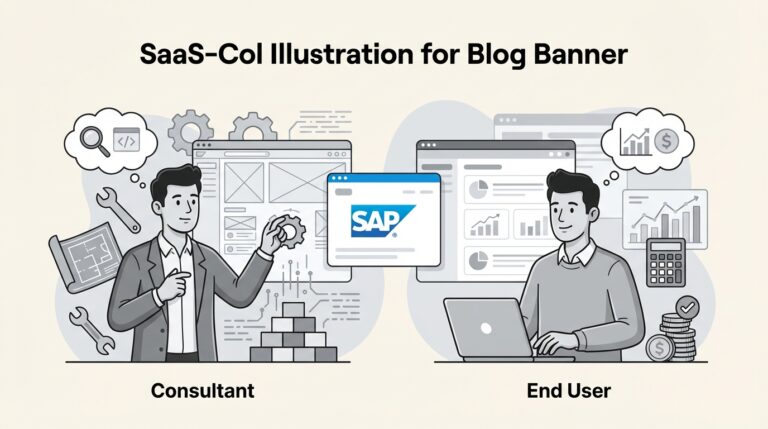
So, you’re a finance pro. You know your debits from your credits, can probably close the books in your sleep, and you’re starting to wonder what’s next for your career. That’s when you hit the big question in corporate finance tech: should you become an SAP FICO Consultant or an End User? It’s a classic fork in the road. Do you want to join an IT firm and build the financial systems that companies run on, or work in a corporate finance department and be the one using that system every day?
Think of it like this: the consultant is the architect who designs and builds a high-performance car (the SAP system). The end user is the expert driver who knows exactly how to push that car to its limits on the racetrack (the day-to-day business). Both jobs are essential, but they call for completely different mindsets and skills. This visual breaks down the core difference:

This guide is here to clear things up. We’ll break down what each role is really about, what your day would look like, the skills you need, and the career paths and salaries you can expect. By the end, you should have a much better idea of which driver’s seat has your name on it.
Understanding the consultant role
An SAP FICO Consultant is an expert who designs and implements SAP solutions to fit a client’s specific business needs. They’re the problem-solvers who turn complex financial processes into a smooth, functional system.
A day in the life: From blueprinting to go-live support
Life as a consultant is always on the move and project-based. Forget the typical 9-to-5 in the same office. You’re often traveling to different client sites, getting a crash course in new industries, and tackling fresh challenges with every project. Your day-to-day work changes a lot depending on where you are in the project lifecycle.
During an implementation, before the system goes live, your days are full of workshops. You’ll be talking to the client’s finance teams to understand their current processes (the “As-Is”) and helping them map out their future, more efficient ones (the “To-Be”). Then, you roll up your sleeves and dive into the system’s backend, using transaction codes like SPRO to set up everything from the chart of accounts to automatic payment runs. You’re also the one leading testing cycles to make sure it all works as planned.
Once the system is live, your role shifts to support. As you can see in common post-installation workflows, you’ll be troubleshooting issues that users report, figuring out why a report isn’t balancing, or why a certain transaction is failing. You’ll also work on smaller enhancements and get ready for system upgrades. The role is very collaborative. The career journey at IBM shows this well. You’re constantly talking with clients, project managers, and other tech teams to keep the project on track.
Core skills and responsibilities of a consultant
Being a great consultant isn’t just about memorizing T-codes. It’s about being a translator, a problem-solver, and a project leader all rolled into one.
Your main responsibilities include creating the business process blueprint (the master plan for the implementation), customizing the system to fit what the client needs, managing User Acceptance Testing (UAT), and training the end users who will take over the system.
To do all that, you need a unique mix of skills. Sharp analytical and problem-solving abilities are a must. You have to be able to listen to a business problem and figure out how to solve it inside the SAP framework. Communication is just as important; you need to explain complex tech stuff to non-technical finance people and translate their business needs into technical requirements for developers. And of course, you need deep, specialized knowledge of the SAP FICO modules and how they connect with other areas like Sales and Distribution (SD) and Materials Management (MM), as these integration points are key.
Understanding the end user role
An SAP FICO End User is a professional in a company’s finance or accounting department who uses the SAP system to get their daily work done. They are the experts on the company’s own financial processes.
A day in the life: Transactions, reporting, and the month-end close
If the consultant’s life is about variety and travel, the end user’s life is about stability and mastery. You’re usually based in one place, working for one company, and becoming a true expert in its specific financial operations. Your work is driven by process, with a rhythm that centers on daily tasks, weekly reports, and the infamous month-end close.
A typical day involves handling the core financial transactions that keep the business running. You might be posting vendor invoices using T-code FB60, applying cash from customers with F-28, running an Accounts Receivable aging report with FBL5N to see who owes money, or running the depreciation at the end of the month with AFAB.
The focus here is almost entirely on finance. Your success isn’t measured by how well you can configure a system, but by the accuracy of your data, how well you follow company policies, and your ability to get financial reports out on time. The pressure can be high, especially during the last few days of the month, but this role puts you right at the financial heart of the company.
Core skills and responsibilities of an end user
As an end user, your main job is to operate the finely tuned machine the consultants built. You’re on the front lines, making sure the company’s financial data is clean, accurate, and processed the right way.
According to experts at AGT Infotech, your core responsibilities are all about accurate data entry and transaction processing. You’re the one generating standard reports for management, and you’re often the first to notice if something in the system seems off. When you find an error, your job is to report it clearly to the IT support team (which might include internal or external consultants) so they can fix it.
The skills you need to succeed are different from a consultant’s. You need deep knowledge of your specific business area, whether that’s Accounts Payable, General Ledger, or Treasury. Attention to detail is everything—one wrong number can mess up the entire month-end close. Finally, you need to be a pro at navigating the specific SAP transaction codes or Fiori apps that your company uses every single day.
Check if your resume is ATS-friendly with our Resume Scorer.
SAP FICO consultant vs end user
When you get right down to it, the difference is pretty simple. The end user is the consumer of the SAP system, while the consultant is the creator and maintainer. One role focuses on doing business tasks within the system, while the other focuses on designing the system itself to make those tasks possible.
| Feature | SAP FICO End User | SAP FICO Consultant |
|---|---|---|
| Primary Role | Uses the system for daily business operations. | Designs, configures, and supports the system. |
| Main Focus | Operational efficiency, data accuracy, reporting. | System functionality, process optimization, problem-solving. |
| Typical Tasks | Postings (FB60, FB70), payments (F-28), reporting (FBL1N). | Blueprinting, SPRO configuration, UAT, ticket resolution. |
| System Interaction | Interacts with the finished front-end (GUI/Fiori). | Works in the back-end configuration (IMG/SPRO). |
| Core Skillset | Deep business domain knowledge (accounting), attention to detail. | Analytical, technical, communication, and project management skills. |
| Success Metrics | Accurate and on-time month-end close, low error rates. | On-time project go-live, system adoption, process improvements. |
Charting your career path
Choosing between these two paths really comes down to your personality, your long-term goals, and, let’s be real, your salary expectations. Let’s break down the key factors to help you decide.
Comparing salary and career growth
Let’s talk money. Generally, consulting roles offer higher salaries and have a steeper pay curve, especially in the first few years. That’s because the skills are highly specialized, the work is demanding, and you’re often solving big-ticket problems for clients. For example, the average salary for an SAP FICO Consultant in India is around ₹17.0 lakhs per year.
That doesn’t mean end-user roles aren’t well-paid. A senior end user, like a Finance Manager or a designated “Power User” at a large multinational, can earn a very competitive salary and have a lot of responsibility. The growth path is just different. An end user might move up to become a team lead, a Super User who trains others, or a Business Analyst who acts as the link to the IT team. A consultant, on the other hand, might grow into a Solution Architect, a Project Manager, or a Practice Lead.
Here’s a rough look at how salaries can compare in the Indian market:
| Role Level | End-User (India LPA) | Consultant (India LPA) |
|---|---|---|
| Junior (0-3 Yrs) | 3.5 – 7 Lakhs | 4.5 – 9 Lakhs |
| Mid-Level (4-8 Yrs) | 7 – 12 Lakhs | 9 – 18 Lakhs |
| Senior/Lead (8+ Yrs) | 12 – 20 Lakhs | 18 – 32+ Lakhs |
Aligning the role with your personality
Beyond the paycheck, think about what kind of work environment makes you tick. What gets you excited to start your day?
The consultant path might be for you if you:
- Love solving complex puzzles and aren’t afraid to build something from the ground up.
- Get bored easily and enjoy fast-paced, ever-changing project environments.
- Like the idea of traveling and seeing how different companies work from the inside.
- Are more passionate about technology and how it can make business processes better.
The end user path might be for you if you:
- Value stability, structure, and a predictable daily routine.
- Want to become a deep subject matter expert in the financial operations of one company or industry.
- Are meticulous and detail-oriented, and get a lot of satisfaction from executing processes perfectly.
- See yourself leading a corporate finance or accounting team one day.
The bridge: How to transition
Here’s the great news: you don’t have to pick a lane and stay in it forever. In fact, one of the best ways to become a great consultant is to start as an end user. Why? Because you’ll gain real-world business knowledge that you just can’t learn from a textbook. You’ll understand why the business needs certain things, which makes you much more effective when you’re the one building the system.
Based on advice from pros, a successful transition usually involves a few key steps:
- Get solid domain experience. Spend at least 2-3 years as an end user. Master your area, whether it’s AP, AR, or GL.
- Get involved in internal projects. If your company is upgrading SAP or rolling out a new module, raise your hand. Volunteer for testing. This is your first look behind the configuration curtain.
- Get formal training and certification. Once you have the business context, it’s time to learn the “how.” This is where you need to learn FICO configuration.
This final step is the most important one. To make the leap, you need to prove you can do more than just use SAP. The best way to do that is with practical, hands-on training. Look for a program that lets you build a mini-implementation portfolio, where you complete core configurations, write test scripts, and get familiar with modern S/4HANA concepts like the Universal Journal. This tangible experience is what turns your operational expertise as an end user into a powerful asset that consulting firms are looking for.
Two essential roles in the SAP ecosystem
In the end, there’s no “better” role between an SAP FICO Consultant and an End User. They are two sides of the same coin, the architect and the operator, and they need each other to succeed. A brilliant system is useless without skilled users to run the business on it, and those users can’t do their jobs without a well-built system.
Both paths offer exciting and rewarding careers where finance and technology meet. SAP’s solutions are the backbone of how the world’s best companies manage everything from their financial operations to their global supply chains.
The right choice for you depends on your personality, your strengths, and your long-term goals. Take some time to think about the day-to-day realities we’ve described. Do you see yourself designing the blueprint or driving the machine? Answering that question is the first step on an amazing journey in the SAP ecosystem.
Check out our masterclass on SAP FICO.
Also read: Top 7 R2R Interview Questions for 2026 (And How They Lead to an Sap FICO Career)
Frequently Asked Questions
Q.1 What is the main difference in the SAP FICO Consultant vs End User roles?
A: The primary difference is creation versus operation. A consultant designs, builds, and configures the SAP system, often working on a project basis for different clients. An end user works within a single company to operate that system for daily financial tasks like posting invoices and running reports.
Q.2 Which path pays more in the SAP FICO Consultant vs End User debate?
A: Generally, consultants have higher starting salaries and a faster potential for salary growth due to the specialized, high-demand nature of their skills. However, senior end users, such as finance managers or controllers, can also earn very competitive salaries with great benefits and stability.
Q.3 How do I decide between being an SAP FICO Consultant vs End User based on my personality?
A: If you enjoy problem-solving, variety, travel, and a fast-paced, tech-focused environment, the consultant path is likely a good fit. If you prefer stability, a predictable routine, and becoming a deep subject matter expert in one company’s financial processes, you’ll probably be happier as an end user.
Q.4 Is it possible to switch careers in the SAP FICO Consultant vs End User landscape?
A: Yes, and it’s very common. Many of the best consultants start as end users. This path allows them to gain invaluable real-world business knowledge, which makes them far more effective when they learn the technical configuration side of SAP.
Q.5 What are the core skills needed when comparing an SAP FICO Consultant vs End User?
A: A consultant needs a blend of technical SAP knowledge, analytical problem-solving, project management, and strong communication skills. An end user needs deep knowledge of accounting and finance principles, meticulous attention to detail, and proficiency in the specific SAP transactions their company uses daily.
Q.6 For a finance professional, what’s the better starting point: SAP FICO Consultant vs End User?
A: Many experts recommend starting as an end user for a couple of years. This builds a strong foundation in how business processes actually work, which provides critical context that is highly valuable if you later decide to transition into a consulting role.