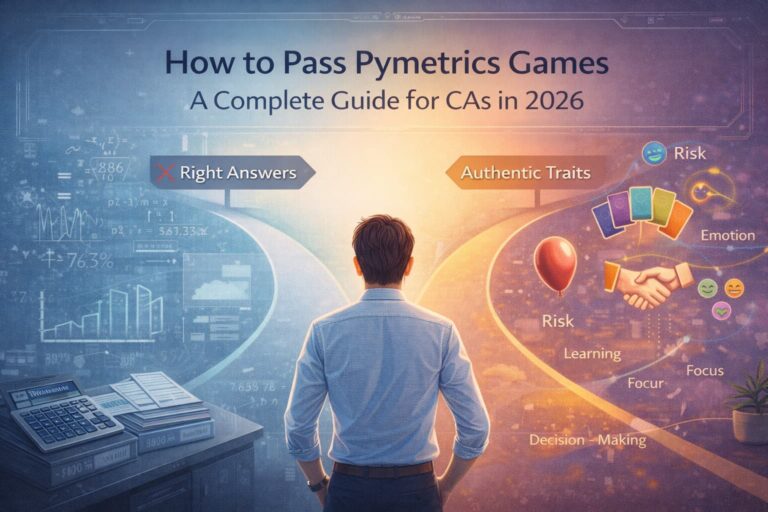
You have spent years perfecting the art of finding the right answer. Through countless exams, you have trained your brain to calculate, analyze, and optimize. You see a problem, you find the solution, you move on. That approach has served you well.
But Pymetrics games are different. And that difference is exactly why so many Chartered Accountants struggle with them.
The instinct to calculate the “optimal” response backfires spectacularly in Pymetrics assessments. When you try to mathematically determine how many times to pump the balloon or which deck to draw from, you are missing the point entirely. Pymetrics does not measure your ability to calculate. It measures who you are.
This is the fundamental shift you need to make: from a test with right and wrong answers to an assessment that captures your personality traits through behavior. The games monitor how you actually respond under pressure, not what you claim about yourself in a questionnaire.
The good news? Once you understand this paradigm, you can approach Pymetrics strategically. This guide will walk you through what Pymetrics actually measures, how to align your approach with your target employer’s needs, and most importantly, how to ensure your test personality matches the persona you present in interviews. We call this the Consistency Principle, and it is the key to passing not just the games, but the entire assessment process.
What Pymetrics actually measures?
The trait-based paradigm shift
Traditional psychometric tests ask you to rate yourself on scales. Are you detail-oriented? Rate 1-5. Do you work well under pressure? Rate 1-5. These self-reported measures are easy to game. You simply figure out what the employer wants and adjust your answers accordingly.
Pymetrics takes a completely different approach. Instead of asking what you think about yourself, it watches what you actually do. The 12 games are designed to elicit genuine behavioral responses that reveal nine core trait categories:
- Attention – Your ability to focus and avoid errors
- Decision Making – How you approach choices under uncertainty
- Effort – Your motivation and drive for challenging tasks
- Emotion – Your emotional intelligence and regulation
- Fairness – Your sense of justice in social exchanges
- Focus – Your capacity to maintain concentration
- Generosity – Your willingness to act altruistically
- Learning – How quickly you adapt to new rules and patterns
- Risk Tolerance – Your comfort with uncertainty and potential loss
The Oxford University Careers Service explains it clearly: “While traditional personality profiling tests measuring these traits are based on self-report, Pymetrics games monitor your behaviour during the test, making it impossible to ‘trick the system.'” You cannot fake these traits because you are not reporting them. You are demonstrating them through every click, every decision, every hesitation.
How Pymetrics creates company-specific benchmarks
Here is what makes Pymetrics particularly sophisticated: there is no universal “good” score. Each company defines success differently.
The process works like this. High-performing employees at your target company play the same games you will play. Their responses create a “success profile” that represents the trait combinations that thrive in that specific organization. When you take the assessment, your behavioral patterns are compared against this benchmark.
The result places you in one of three fit bands:
- Highly Recommended – Your trait profile closely matches successful employees
- Recommended – You show promise but may have some mismatches
- Not Recommended – Your profile diverges significantly from the company benchmark
This is why understanding your target employer matters so much. A trait profile that gets you “Highly Recommended” at a startup might get “Not Recommended” at a Big 4 firm. The same behavior reads differently depending on context.
The 12 Pymetrics games explained
You will face 12 games during your assessment, each designed to measure specific combinations of the nine trait categories. Understanding what each game evaluates helps you approach them with the right mindset.
| Game | Measures | CA-Relevant Insight |
|---|---|---|
| Balloon Game | Risk tolerance, decision-making | Audit vs. Advisory mindset |
| Tower Game | Planning ability | Methodical problem-solving |
| Money Exchange #1 | Trust, fairness | Client relationship building |
| Money Exchange #2 | Generosity, altruism | Team collaboration |
| Keypress Game | Processing speed, attention | Deadline pressure handling |
| Easy or Hard Task | Effort, motivation | Drive for high-impact work |
| Digits Memory Game | Memory, learning | Technical information retention |
| Stop Game | Attention, focus | Error prevention in reviews |
| Arrows Game | Adaptivity, learning | Rule changes and new standards |
| Lengths Game | Attention to detail | Financial statement scrutiny |
| Cards Game | Risk tolerance, pattern recognition | Investment decision simulation |
| Faces Game | Emotional intelligence | Client and stakeholder management |
Key games for CAs to understand
Balloon Game: This is the classic risk assessment scenario. You pump a virtual balloon to earn money, but each pump increases the chance it will burst and you will lose everything. Do you bank early and often, or push for higher rewards? There is no right answer. An audit role might value the cautious approach. An advisory role might prefer calculated risk-taking.
Cards Game: You draw from different decks to maximize earnings. Some decks offer high rewards but occasional heavy losses. Others provide steady, modest returns. The game also tests your ability to learn patterns as you play. Your deck preference reveals your risk tolerance and learning speed.
Money Exchange Games: These assess your sense of fairness and trust in social transactions. You send and receive money with an AI partner, then rate the fairness of exchanges. These games tap into your instincts about collaboration and generosity, traits essential for team-based client work.
Faces Game: You identify emotions from facial expressions paired with contextual scenarios. This measures emotional intelligence, a critical skill for client-facing roles where reading stakeholders matters as much as reading financial statements.
The Risk vs. Caution framework
Understanding the spectrum
The single most important strategic concept in Pymetrics is the Risk vs. Caution spectrum. This framework appears across multiple games and often determines whether your profile matches what employers seek.
Risk-takers tend to:
- Draw from high-value decks in the Cards Game
- Pump balloons aggressively before banking
- Choose hard tasks over easy ones
- Accept uncertainty for potential higher rewards
Cautious types tend to:
- Prefer consistent, predictable rewards
- Bank earnings early to avoid losses
- Choose easier, guaranteed tasks
- Minimize uncertainty even at the cost of lower returns
Here is the critical insight: neither approach is inherently better. What matters is alignment with role requirements. A trader needs different traits than an auditor. A consultant needs different traits than a compliance officer.
How CAs get this wrong
The calculator mindset strikes hardest here. Many CAs try to mathematically optimize their approach. They research “optimal balloon pumping strategies” or calculate expected values for different decks. This completely misses the point.
When you try to find the “mathematically optimal” strategy, you are demonstrating calculation skills, not authentic risk tolerance. The assessment captures your hesitation, your second-guessing, your attempt to game the system. These behaviors create an inconsistent profile that reads as inauthentic.
The same applies to over-analyzing. Spending too long on decisions in timed games signals uncertainty or excessive deliberation. Your first instinctive responses often reveal your true traits more accurately than carefully considered choices.
Matching your approach to your target role
Consider what your target role actually requires:
Audit/Assurance roles typically value moderate caution, high attention to detail, and methodical approaches. These roles involve verifying information and catching errors. Excessive risk-taking here is a liability.
Advisory/Consulting roles often favor calculated risk-taking, adaptability, and client-focused emotional intelligence. These roles require making recommendations under uncertainty and building client trust.
Leadership programs generally seek balanced approaches with strong learning agility. They want candidates who can adapt their risk tolerance to context, showing caution where appropriate and boldness when needed.
Company-specific trait profiles
Unilever (Future Leaders Program)
Unilever’s Future Leaders Program is one of the most competitive graduate schemes, and they use Pymetrics to identify candidates who align with their culture.
Values alignment: Unilever emphasizes six core values: Integrity, Positive Impact, Commitment, Respect, Responsibility, and Pioneering. These translate into specific trait preferences in their Pymetrics benchmark.
Key traits assessed: Adaptability, leadership initiative, and balanced risk-taking feature prominently. Unilever operates in rapidly changing markets and wants leaders who can navigate uncertainty while maintaining ethical standards.
What they want: Unilever explicitly values diverse cognitive profiles. They are not looking for clones of current employees. Authenticity matters more than fitting a rigid mold. This is good news for CAs with varied backgrounds and approaches.
The CA angle: If you are applying to Unilever, emphasize your sustainability awareness, long-term business thinking, and stakeholder management capabilities. These align with Unilever’s corporate mission and show up in trait assessments.
Big 4 firms (PwC, EY)
Among the Big 4, PwC and EY have adopted Pymetrics for certain programs. Understanding their specific trait preferences gives you an edge.
PwC traits: PwC typically seeks high attention to detail, strong decision-making capabilities, moderate risk tolerance, and client-facing emotional intelligence. Their client service model requires professionals who can deliver error-free work while building relationships.
EY traits: EY emphasizes learning agility, adaptability, and collaborative mindset. Their “Better Working World” values translate into preferences for candidates who show growth potential and teamwork orientation.
Common Big 4 profile: Both firms generally favor methodical yet adaptable candidates who combine detail orientation with big-picture thinking. The ability to move between rigorous analysis and strategic insight is highly valued.
The CA angle: Professional skepticism, ethical judgment, and continuous learning are core CA competencies that align well with Big 4 trait profiles. Your training has prepared you for these assessments more than you might realize.
Important note on P&G
Procter & Gamble does NOT use Pymetrics. If you are applying to P&G, you will face their proprietary Aon assessments instead, specifically the PEAK Performance Assessment and Interactive Games. These include the Switch Challenge, Grid Challenge, and Digit Challenge.
Do not prepare for Pymetrics if your target is P&G. The formats, strategies, and trait measurements are completely different. Always verify which assessment platform your target employer uses before investing preparation time.
Create an ATS-friendly resume with our Resume Builder.
Common mistakes CAs make
The top 5 CA-specific errors
1. The Calculator Mindset
The mistake: Treating Pymetrics like a numerical reasoning test and trying to calculate optimal strategies.
Why it hurts: You create an inconsistent profile that shows calculation attempts rather than authentic traits. The system detects your hesitation and second-guessing.
The solution: Respond naturally. Let your genuine tendencies emerge. Trust that your authentic profile will match roles where you will actually thrive.
2. Over-Analysis Paralysis
The mistake: Spending too long deliberating decisions in timed games.
Why it hurts: Timed games measure instinctive responses. Excessive deliberation signals uncertainty or overthinking, which may not match the decisiveness some roles require.
The solution: Trust your instincts. Your first response often reveals your true traits more accurately than a considered choice.
3. Inconsistent Risk Profile
The mistake: Being cautious in the Balloon Game but reckless in the Cards Game.
Why it hurts: Inconsistency across games suggests you are trying to game the system rather than showing authentic traits. Employers want predictable, consistent behavior.
The solution: Maintain authentic consistency. Your risk tolerance should feel similar across different game contexts.
4. Ignoring the Instructions
The mistake: Assuming you know how a game works without reading carefully.
Why it hurts: Games that look similar may have different rules. Assumptions lead to errors that distort your trait measurements.
The solution: Read instructions carefully for each game. Even familiar-looking games may have variations.
5. Taking It When Exhausted
The mistake: Attempting the assessment after a long day of work or studying.
Why it hurts: Fatigue impairs attention, decision-making, and emotional regulation. You will not perform at your best.
The solution: Schedule your assessment for the morning when you are mentally fresh. Ensure a quiet environment with no distractions.
Technical mistakes to avoid
- Attempting to restart: Pymetrics does not allow restarts. You get one attempt in most cases. Take it seriously the first time.
- Using the wrong browser: Use Chrome, Firefox, Safari, or Edge on a PC. Avoid mobile devices and unsupported browsers.
- Skipping company research: Without understanding your target employer’s culture, you cannot contextualize your approach.

Aligning test and interview personalities
Why consistency matters
Here is something most candidates do not realize: employers compare your Pymetrics results with your interview behavior. They are looking for alignment between your test-measured traits and your spoken personality.
If your Pymetrics profile shows high risk tolerance but you present as extremely cautious in interviews, that discrepancy raises red flags. Interviewers wonder: “Is this candidate being authentic? Which version is the real them?”
The Consistency Principle is simple: your spoken personality should match your test-measured traits. This alignment signals authenticity and predictability, two qualities employers highly value.
How to maintain alignment
If you showed high risk tolerance in games: Demonstrate calculated risk-taking in your interview examples. Share stories where you made bold decisions under uncertainty and achieved positive outcomes.
If you showed high fairness and generosity: Emphasize collaborative achievements and team-oriented examples. Show how you have built trust and contributed to collective success.
If you demonstrated strong learning ability: Highlight adaptability stories. Discuss times you quickly mastered new skills, adapted to changing circumstances, or learned from setbacks.
Practical preparation strategy
Step 1 – Before Pymetrics: Reflect on your natural tendencies. Are you naturally cautious or risk-tolerant? Collaborative or independent? Self-aware candidates perform better because they respond authentically.
Step 2 – During Pymetrics: Respond authentically. Do not try to fake traits you think employers want. The system is designed to detect inauthenticity.
Step 3 – After Pymetrics: Review your likely trait profile based on how you approached the games. What did your balloon strategy reveal about risk tolerance? What did your money exchange behavior show about fairness?
Step 4 – Before Interview: Prepare stories that demonstrate the same traits your games likely revealed. This creates the consistency that impresses employers.
Practice with AI Interview Bot
This is where AI Interview Bot becomes invaluable. After completing Pymetrics, use the bot to practice articulating your personality traits in interview responses. Get feedback on whether your interview persona matches your natural style.
The bot helps you ensure consistency between what Pymetrics measured and what interviewers see. You can test different ways of describing your risk tolerance, collaboration style, or decision-making approach until you find language that feels authentic and compelling.
Align your personality for interview success
Pymetrics represents a fundamental shift in how employers assess candidates. Instead of asking what you know, it reveals who you are. For CAs trained to find the right answer, this can feel uncomfortable. But it is also an opportunity.
Your analytical training gives you advantages in attention to detail, methodical thinking, and professional judgment. The key is showing your personality alongside these technical abilities. Pymetrics measures traits, not knowledge. There are no “right” answers, only authentic ones.
The Consistency Principle ties everything together. Your test personality and interview persona must align. When they do, you demonstrate the authenticity and predictability that top employers seek.
Ready to ensure your interview performance matches your natural traits? Use AI Interview Bot to practice personality-aligned responses. Get feedback on your consistency, refine your storytelling, and walk into your next interview with confidence.
Your technical skills got you this far. Let your authentic personality take you the rest of the way.
Prepare for your interview with our Getting Interview Ready Workshop.
Also read: Head Office vs Plant Finance: Best Career Path?
Frequently Asked Questions
Q.1 What is the strategy for Pymetrics card game?
A1: There is no universal strategy. Your approach should align with the role you are targeting. Cautious behavior suits audit and compliance roles. Calculated risk-taking fits advisory and consulting positions. The key is consistency with your overall trait profile.
Q.2 Can you practice Pymetrics games?
A2: Yes, platforms like JobTestPrep and GraduatesFirst offer practice simulations. One game (Easy or Hard) can be previewed before the actual assessment. However, remember that practice helps you understand the format, not ‘study’ for specific answers.
Q.3 Is Pymetrics hard?
A3: It is not hard in the traditional sense. The games are intuitive and do not require prior knowledge. The challenge is mental: accepting that there are no ‘right’ answers and responding authentically instead of trying to optimize.
Q.4 How long does Pymetrics take?
A4: Approximately 25-35 minutes for the 12 core games. Plan for 45 minutes including setup, instructions, and any breaks between games.
Q.5 Do Big 4 firms use Pymetrics?
A5: PwC and EY use Pymetrics for certain programs. Deloitte and KPMG use other assessment methods. Always check the specific requirements for the role you are applying to.