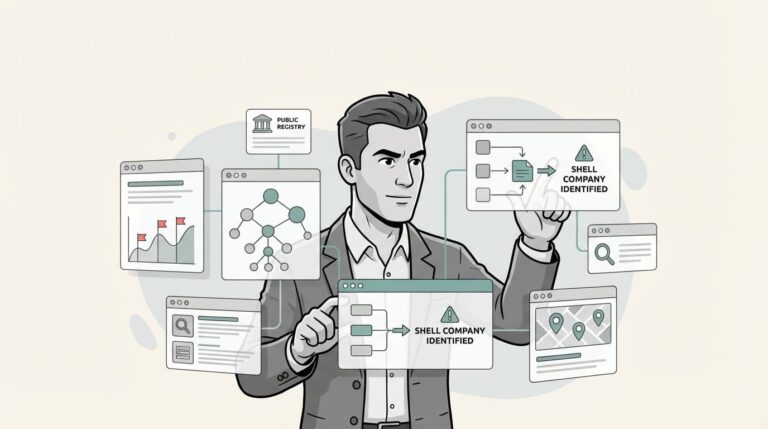
Ever wonder how large amounts of money seem to simply disappear? It is not a magic trick. It is usually a complex web of deception, and in the middle, you will almost always find a shell company. The scale is significant: an estimated $1.6 trillion is laundered annually through the global financial system. Large-scale data leaks like the Panama Papers have revealed how these empty corporate “shells” are used to hide money, dodge taxes, and get around sanctions.
But these entities are not ghosts. They have tells, patterns, and red flags that give them away if you know what you are looking for.
This guide is your starting point. We are going to break down what shell companies really are, the key warning signs that should make you suspicious, and how you can start using publicly available data to connect the dots like a seasoned forensic investigator. Let’s dive in.
What is a shell company?
What is a shell company? The name itself can sound suspicious, and in many cases, for good reason. It has no physical office beyond maybe a mailing address and generates little to no real economic value. It is a legal entity on paper, but that is about it.
Not all shell companies are created for crime. They have legitimate uses, such as holding assets during a merger and acquisition, or acting as a holding company for a larger corporate structure. A business might set one up to manage financing for a specific project without mixing it in with its main operations.
The trouble is, the features that make them useful for legitimate business, such as privacy and simplicity, are also what make them a tool for criminals. Their whole purpose is often to create a layer of secrecy, making it incredibly difficult to figure out who the ultimate beneficial owner (UBO) really is. For anyone looking to launder money, evade taxes, or bust sanctions, that anonymity is a key component.
7 key red flags for identifying shell companies
Shell companies are designed to appear legitimate, but closer inspection often reveals inconsistencies. They tend to have unusual or illogical characteristics that do not withstand scrutiny. Industry research has identified several common indicators, patterns and pinpointed seven key indicators that can signal shell company risk. Consider these as key signs for an investigation. Visually, these red flags make it easier to understand how to identify shell companies.

Outlier directorships
This occurs when one individual holds an unusually high number of director positions. It is generally not feasible for one person to genuinely oversee thousands of companies. For example, the data found one individual holding 5,751 roles across 2,883 different companies. This pattern suggests the individual is not a genuine director but a nominee, or “straw man,” used to obscure the identities of the true controllers.
Jurisdictional risk
This indicator arises when there is a mismatch between where a director is from and where the company is registered, especially if that country is a known tax haven or secrecy jurisdiction. A director living in Germany but running a company in the Cayman Islands might be perfectly fine, but the discrepancy warrants closer examination. This indicator saw a big jump after 2022, mostly due to new corporate structures created to navigate post-invasion sanctions.
Financial anomalies
This involves financial data that appears inconsistent or illogical. For instance, a company with only a few employees reporting tens of millions of dollars in revenue raises questions about the source of that value. If a company’s financial activity is completely out of sync with its size and stated purpose, it is a strong sign the company may be acting as a pass-through entity rather than a genuine business.
Dormancy
A common tactic is to register a company and just let it sit inactive for years. This “aging” process makes it look more established and less suspicious than a brand-new company. Then, out of nowhere, it suddenly becomes active with a huge spike in revenue or a bunch of transactions. This sudden change after a long quiet period is a classic warning sign the company may be activated for illicit purposes.
Circular ownership
This structure is intentionally complex. Circular ownership is when Company A owns Company B, which owns Company C, which owns Company A. This creates a closed loop where tracing ownership becomes nearly impossible, which effectively hides the true UBO. It is a deliberate tactic used to consolidate control or obfuscate ownership, and these companies almost never have a real website or any digital footprint.
Outlier ages
In some cases, the registered data is factually impossible. Investigators have found company records listing beneficial owners who are literal infants or people who would be older than the longest-living person on record. The data found examples of owners listed as young as 0 or older than 122. This can result from either data entry errors, deliberate fraud, or automated schemes creating synthetic identities. In any case, it is an immediate red flag.
Here’s a quick summary of these indicators to keep handy:
| Indicator | Description | Example from Moody’s Data |
|---|---|---|
| Outlier Directorships | An individual holds an impractical number of company roles. | One person holding 5,751 roles in 2,883 companies. |
| Mass Registration | Numerous companies registered at the same unusual address. | 61,000 businesses registered to a single strip mall. |
| Jurisdictional Risk | Director’s nationality and company registration are in different, high-risk countries. | Over 1.2 million individual-company combinations flagged. |
| Financial Anomalies | Revenue is drastically out of line with the number of employees. | 3.4 million companies flagged for financial anomalies. |
| Dormancy | A company is inactive for years before a sudden spike in activity. | Over 655,000 companies identified as dormant. |
| Circular Ownership | A network of companies where ownership forms a confusing, closed loop. | Over 60,000 companies flagged for circular ownership. |
| Outlier Ages | The listed beneficial owner is an impossible age (too young or too old). | Beneficial owners listed as young as 0 or older than 122. |
Identify shell companies using public data
Knowing the red flags is the first step; finding them requires investigation. Much of the initial research can be done without specialized tools or security clearance. A massive amount of corporate data is publicly available.
The following steps provide a primer on using public information for forensic auditing. Corporate registries, which are official lists of companies registered in a jurisdiction, are a primary resource. In India, for example, the Ministry of Corporate Affairs (MCA) has its MCA-21 portal, which is a goldmine of data for investigators. Let’s walk through the steps.
Investigate the registered office address
The first and easiest check is the company’s address. Pull up its registration documents from a corporate registry, find the official address, and then check it using Google Maps and its Street View feature.
Determine if the address corresponds to a legitimate corporate office or if it is a residential building, a P.O. box, or one of the mass registration addresses we talked about. If the “global headquarters” of a multi-million dollar company turns out to be a small apartment in a residential complex, this is a potential red flag.
Forensic Audit Masterclass, turning you into a true financial detective.
Verify Directors Using MCA and Basic Online Checks
After checking the company’s address, review the directors using the MCA21 Portal.
Start by identifying the directors and their DIN. Check how many companies they are associated with. If one individual is linked to a large number of companies, it may indicate a nominee or “straw” director.
Look for simple patterns:
- Same directors across multiple unrelated companies
- Frequent director changes
- No logical connection between businesses
Also, do a quick Google or LinkedIn search. Genuine professionals usually have some digital presence. A complete lack of online footprint can be a red flag.
Finally, review MCA filings for sudden director changes or unusual activity. These patterns often indicate attempts to hide the real ownership (UBO).
For most Indian CAs, MCA data and basic online checks are enough to identify early warning signs.
Look for shared data points and straw directors
A common pattern is the reuse of contact information across multiple entities. When setting up dozens of shell companies, the same contact details might be used across multiple, supposedly unrelated businesses. Look closely at the registration documents. Is the same email address or phone number listed for 50 different companies in completely different industries? This suggests a connection between the companies that warrants further investigation.
In India, similar patterns are often seen where the same contact details—such as phone numbers, email IDs, or even consultant/CA addresses—are reused across multiple companies. This can indicate a network of linked entities rather than independent businesses.
Analyze the company’s financial and filing history
Corporate registries also provide access to a company’s filing history and, in many cases, its financial statements. This is where you can spot the “dormancy” red flag.
Look at the dates on the documents. Was the company registered in 2019 but filed almost nothing until 2025, when it suddenly reports a significant, unexplained jump in revenue? Or do you see a sudden flurry of filings changing directors or ownership immediately preceding a large transaction? This kind of activity suggests the company may have been a dormant shell activated for a specific purpose.
Growing role of AI in identifying shell companies
Historically, identifying these companies was a slow, manual process, but technology is changing this. Today, AI and machine learning are becoming essential tools for investigators.
Instead of just looking for individual red flags, AI systems analyze massive datasets to find patterns and anomalies that a human investigator might never catch. These are often referred to in the industry as “AI-powered observables,” which are data points that AI algorithms flag as suspicious.
These AI systems perform several key functions: Platforms like QuantaVerse illustrate the capabilities in financial crime detection:
- Pattern Recognition: AI can scan millions of transactions and corporate filings in seconds. It might flag a company in the construction industry that’s making regular, large payments to a company in the textile business. The AI sees this as an illogical transaction that lacks a clear “Economic purpose” and flags it for human review.
- Risk Scoring: Instead of a simple “yes” or “no,” AI can assign a dynamic risk score to a company. It looks at dozens of factors at once—jurisdictional risk, common addresses, director history, lack of a web presence—and calculates a score that tells investigators where to focus their attention first.
- Network Analysis: AI tools can instantly visualize these complex corporate structures. They create graphs that map out relationships between companies and directors, making it easier to identify closed loops or single “straw directors” connecting large networks of suspicious entities.
From red flags to real investigations
Determining if a company is a shell is not about a single discovery. It is a process of assembling evidence from various red flags and inconsistencies.
We’ve covered the fundamentals: shell companies are defined by their lack of real substance, they often show clear warning signs like the seven indicators, and these signs can often be uncovered using public data. As we’ve seen, technology like AI is making this process faster and more effective than ever, enabling investigators to analyze complex corporate structures.
Identifying shell companies is more than just a technical exercise; it’s a critical skill for anyone in finance, compliance, or auditing. The process blends traditional investigative techniques with modern data analysis. Understanding the theory is the first step, but the real learning begins when you start your first full investigation.
In India, regulators like the Ministry of Corporate Affairs have taken strict action against shell companies in recent years, making it even more important for Chartered Accountants to identify suspicious entities early.
Our Forensic Audit Masterclass provides the hands-on training and expert insights you need to excel in the field of financial crime detection. Check out the course to start your journey.
Frequently Asked Questions
Q1 What’s the simplest first step to identify a shell company?
A1: The easiest place to start is the company’s registered address. Look it up on a corporate registry, then use Google Maps Street View to see if it’s a legitimate office or something suspicious like a residential home or a mail-forwarding service.
Q2 What are common red flags of a shell company?
A2: Key red flags include one person serving as a director for an impossible number of companies, thousands of businesses registered to a single address, financial numbers that don’t match the company’s size, and circular ownership structures where companies own each other.
Q3 Can public data be used to identify shell companies?
A3: Yes, public data is a powerful tool. Corporate registries, like the MCA-21 portal in India, offer access to registration documents, director names, and financial histories. This information is often enough to spot major inconsistencies.
Q4 Are all shell companies illegal?
A4: Not all shell companies are illegal. They have legitimate uses, like holding assets during a merger. However, the same features that make them useful for business (privacy and simplicity) also make them ideal for financial crimes like money laundering and tax evasion. The goal is to identify those being used for illicit purposes