
Career breaks happen. Whether you stepped away for health reasons, cared for a family member, or took time to recover from burnout, that gap on your resume can feel like a weight you’re carrying into every job application. You’re not alone in feeling this way, and you’re certainly not alone in having a gap.
According to recent data, 40% of professionals experience career gaps longer than six months. Even more encouraging: 73% of hiring managers are more understanding of employment gaps now than they were before 2020. The world has shifted. Career paths are no longer expected to be linear, and smart employers recognize that breaks often build the exact qualities they want: resilience, self-awareness, and the ability to prioritize what matters.
This guide will give you practical scripts, resume strategies, and interview techniques to explain your gap with confidence. Not apologies. Not over-explaining. Just clear, professional communication that positions your break as part of your growth.
Why career gaps happen
Let’s start with some perspective. Career breaks happen for countless legitimate reasons:
- Health issues, both physical and mental
- Caregiving for children, parents, or family members
- Maternity leave that extended longer than planned
- Burnout recovery and wellness prioritization
- Relocation or family transitions
- Personal development or further education
LinkedIn reported a 39% increase in users adding career breaks to their profiles over the past two years. That’s not a coincidence. People are being more transparent about non-linear career paths, and employers are responding.
The shift in attitudes post-2020 can’t be overstated. When the entire global workforce experienced disruption simultaneously, the stigma around gaps began to dissolve. Hiring managers now understand that life happens, health happens, and family happens. What they care about is whether you’re ready to contribute now.
Here’s a reframe that helps: your gap demonstrates self-awareness and responsibility. You recognized what you needed, you took action, and now you’re returning with clarity. Those aren’t liabilities. They’re evidence of maturity.
The Americans with Disabilities Act also provides protections. Employers cannot discriminate based on medical history or disability status. You’re not required to disclose specific medical information during interviews, and there are clear limits on what they can ask. Knowing your rights helps you navigate these conversations with confidence.
The 3-part framework for explaining any gap
When it comes to explaining your career break, you have options. Different situations call for different approaches. Here are three frameworks that work, depending on your comfort level and the context.
Part 1: The honest but brief approach
This is your go-to for most situations. It’s direct, professional, and doesn’t invite follow-up questions.
The script: “I took time to address a health matter that required my full attention. I’m now fully committed to returning to work and contributing to your team.”
Or for caregiving: “I stepped away to provide full-time care for a family member. That situation has now stabilized, and I’m eager to return to my career.”
The key elements: acknowledge the gap without apology, keep it under 30 seconds, and immediately pivot to your readiness. You’re not asking for sympathy. You’re stating facts and moving forward.
Part 2: The skill-focused approach
Use this when you want to highlight growth during your break. It works especially well if you completed courses, volunteered, or developed new capabilities.
The script: “During my career break, I developed stronger problem-solving skills, improved my stress management techniques, and gained valuable perspective that I’m excited to bring to this role. I also completed certifications in [specific skills] to ensure I stayed current.”
This approach reframes the gap as a development period. You’re not hiding anything, but you’re controlling the narrative by emphasizing what you gained rather than what you paused.
Part 3: The forward-looking approach
This is your confidence play. It works best when you want to project energy and enthusiasm.
The script: “I’m refreshed, focused, and eager to apply my experience and renewed energy to meaningful work in this field. I’m fully committed to contributing to your team’s success.”
Notice what’s missing? Any detailed explanation of the gap itself. Sometimes the best approach is to acknowledge it briefly and immediately redirect to your value proposition.
Resume strategies that work
Your resume is often the first place a gap appears, so let’s address it strategically.
Format options
If your gap is significant (18+ months), consider a functional or skills-based resume. This format leads with your competencies and achievements rather than your chronological work history. It helps recruiters see your value upfront before they notice the timeline.
For those with 15+ years of experience, a combination format works well. It highlights key skills at the top while still maintaining a condensed work history section.
If your gap is shorter or you prefer traditional formats, a chronological resume is fine. Just be strategic about how you label the gap.
How to label gaps professionally
Don’t leave the time blank. That creates more questions than it answers. Instead, add a brief entry that provides context:
- “Career Sabbatical | 2022-2023 – Focused on health recovery and professional development through online coursework”
- “Family Caregiver | 2020-2021 – Provided full-time care for an immediate family member while maintaining industry knowledge”
- “Professional Pause | 2021-2022 – Completed project management certification and volunteer consulting for nonprofits”
The formula is simple: label the period, add the dates, and include one line about productive activities during that time. Keep it factual. No apologies needed.
What to include during gap periods
Even if you weren’t employed, you likely weren’t stagnant. Consider including:
- Online courses or certifications completed
- Volunteer work or community involvement
- Freelance or consulting projects
- Professional associations joined
- Industry conferences attended
- Skills maintained through self-study
Quantify where possible: “Completed 120 hours of training in data analytics” or “Managed volunteer logistics for events with 80+ participants.”
What not to do
- Don’t hide the gap with formatting tricks (tiny fonts, confusing layouts)
- Don’t over-explain with medical details or personal drama
- Don’t apologize or use language that sounds defensive
- Don’t fabricate employment that didn’t happen
Recruiters value honesty. An explained gap is far better than an unexplained one that raises suspicions.
Interview scripts for different scenarios
Once your resume gets you through the door, you need to be ready to discuss your gap in person. Here are scripts for the most common scenarios.
Create an ATS-friendly resume with our Resume Scorer.
Scenario 1: Health issues (physical)
The script: “I took time to recover from a health issue that required my full attention. I’m now fully recovered and excited to bring my skills and experience to this role.”
Keep it brief. Don’t share medical details, diagnosis, or treatment specifics. The interviewer doesn’t need to know, and legally, they shouldn’t ask. Practice until you can deliver this in under 30 seconds, then immediately redirect to your qualifications.
Scenario 2: Mental health or burnout
The script: “I took time to focus on my wellness and reassess my career direction. That period gave me clarity about what I want from my next role, and I’m now more focused and energized than ever.”
Frame this as personal development. Mental health breaks are increasingly understood, especially post-2020. The National Institute of Mental Health estimates that more than one in five U.S. adults experiences mental illness. You’re in good company, and taking time to address it shows responsibility.
Scenario 3: Caregiving and women returnship
The script: “I stepped away to care for a family member during a critical period. During that time, I maintained my professional skills through [courses/volunteering/self-study], and I’m now fully prepared to return to a full-time role.”
Caregiving is universally understood. As one HR professional noted on Quora: “Family leave can’t be challenged, and is understandable. Everyone has a family.” Highlight any professional development you maintained during the break.
Scenario 4: Maternity plus extended break
The script: “I took time to focus on my family. Now that my children are older and my home situation is stable, I’m eager to return to my career and contribute my [X years] of experience in [field].”
Don’t apologize for prioritizing family. Many employers value the maturity and time-management skills that parents develop. Focus on your readiness and the experience you bring.
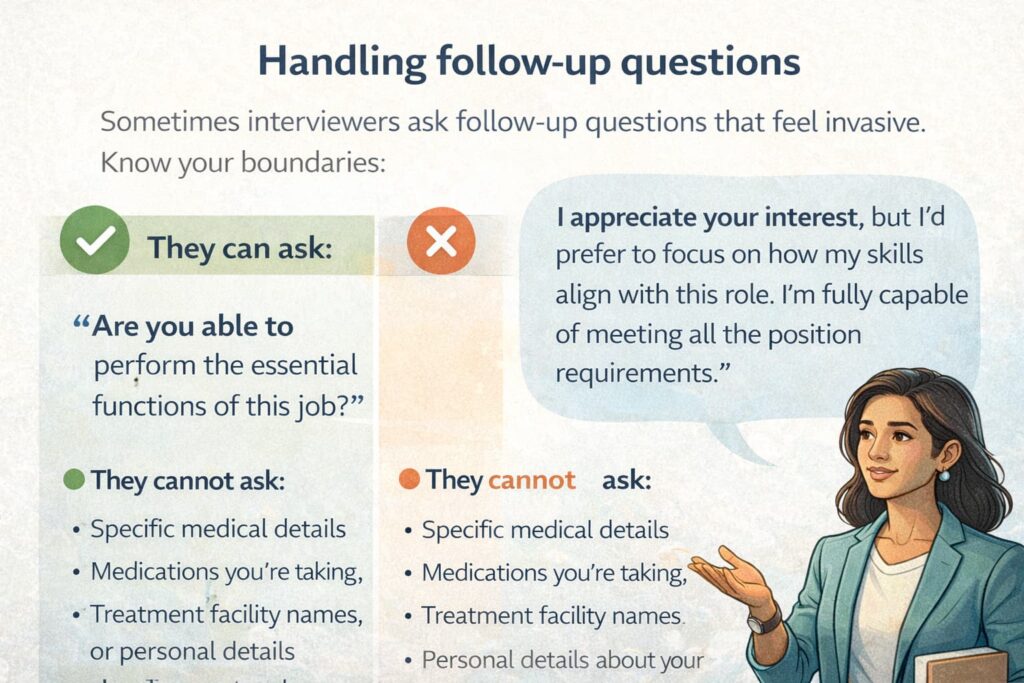
Handling follow-up questions
Sometimes interviewers ask follow-up questions that feel invasive. Know your boundaries:
- They can ask: “Are you able to perform the essential functions of this job?”
- They cannot ask: Specific medical details, medications you’re taking, treatment facility names, or personal details about your recovery
If someone pushes too far, you can politely deflect: “I appreciate your interest, but I’d prefer to focus on how my skills align with this role. I’m fully capable of meeting all the position requirements.”
Building confidence after a long break
Scripts and strategies help, but confidence comes from mindset. Let’s address the internal dialogue that might be holding you back.
Reframe your narrative
Stop saying: “I stopped working.”
Start saying: “I grew, I adapted, and now I’m ready for what’s next.”
Your skills don’t have expiration dates. Your experience doesn’t vanish because you paused. One successful returner on StackExchange shared this perspective after a 4.5-year gap: “No person on this Earth can demotivate me from returning to the industry. No one owns this industry.”
That’s the mindset that gets you hired.
Practical confidence builders
Confidence grows through action. Here are concrete steps:
- Update your LinkedIn with recent activities, even if they’re courses or volunteer work
- Complete 1-2 relevant certifications to demonstrate current knowledge
- Practice mock interviews with a friend or career coach
- Join a returnship program like TCS iON or SAP’s Back-to-Work initiative
- Reconnect with former colleagues for networking and references
Each small action builds momentum. You don’t need to feel fully confident to start. You just need to start.
Dealing with rejection
Not every employer will understand your gap. That’s okay. As one successful returner noted: “If an HR or interviewer is trying to demean me, I was glad that I have dodged a bullet right at the beginning.”
The right employer values your experience, not just your timeline. Rejection from the wrong company moves you closer to acceptance at the right one.
Your comeback action plan
Ready to move from planning to action? Here’s a three-month roadmap.
1st Month: Foundation
- Update your resume with a skills-based or strategic format
- Practice your 30-second gap explanation until it’s natural
- Research target companies with family-friendly or health-inclusive policies
- Reactivate your LinkedIn with a post about your return to the field
- Reach out to 3-5 former colleagues for networking
2nd Month: Active search
- Apply to 5-10 positions weekly
- Attend one industry networking event or virtual conference
- Complete one relevant certification or course
- Schedule one informational interview with someone in your target field
3rd Month: Interview mode
- Practice interview responses with a friend or coach
- Prepare specific examples of past achievements and skills
- Research company cultures and values before each interview
- Build confidence through mock interviews
Remember: the right opportunity values your experience, not just your timeline. Your gap is part of your story, not the whole story.
Create an ATS-friendly resume with our Resume Builder.
Also read: 7 Salary Negotiation Tips for Chartered Accountants in 2026
Frequently Asked Questions
Q.1 How do I explain a gap year justification for health issues without oversharing?
A: Keep it brief and factual. Try: ‘I took time to address a health matter that required my full attention. I’m now fully recovered and ready to contribute.’ You don’t owe anyone medical details. Practice delivering this in under 30 seconds, then pivot to your qualifications.
Q.2 What’s the best way to handle women returnship after a long career break?
A: Frame your break as a period of growth. Highlight any skills you maintained or developed during your time away. Consider returnship programs like TCS iON or SAP Back-to-Work. Most importantly, own your experience without apology. Your perspective as a returner often brings valuable maturity and focus.
Q.3 Should I mention my career gap in my cover letter or wait for the interview?
A: Generally, address it briefly in your cover letter with one confident sentence, then focus on your qualifications. For example: ‘After a career pause focused on family care, I’m eager to apply my 10 years of marketing experience to your team.’ This shows transparency without making it the centerpiece.
Q.4 How do I explain a mental health-related career break to potential employers?
A: Frame it as personal development and wellness prioritization. Try: ‘I took time to focus on my wellness and reassess my career direction. That clarity has made me more focused and energized.’ Remember that 1 in 5 U.S. adults experiences mental health challenges. Taking time to address it responsibly demonstrates maturity.
Q.5 Can I get a job after a 3+ year employment gap?
A: Absolutely. Many successful professionals have returned after extended breaks. One StackExchange user shared their success after a 4.5-year gap, noting: ‘There is a job for everyone in this world.’ Focus on what you can do now, not how long you were away.
Q.6 How do I list a career break on my resume without it looking bad?
A: Label it professionally with dates and a brief explanation of productive activities. For example: ‘Professional Development | 2022-2023 – Completed data analytics certification and volunteer consulting for local nonprofits.’ This shows intentionality rather than empty time. Avoid apologetic language or excessive detail.