As a Chartered Accountant, you possess strong technical skills. You can spot a discrepancy in a balance sheet from a mile away and navigate IFRS standards proficiently. You have likely succeeded in every technical round of interviews for a position at a Big 4 firm.
However, when it comes to group discussions or client-facing partner rounds, articulating these insights can be a challenge. The perfect answer or critical insight may feel stuck. You might observe others speaking fluently, perhaps without your technical depth, but with a confidence that commands attention. This experience can be frustrating when you know the answer but find it difficult to express.
This is a common challenge for many talented CAs, especially from Tier-2 and Tier-3 cities. The issue is not a lack of knowledge but a communication confidence gap. This can stem from what is known as “Mother Tongue Influence” (MTI) and can be intensified by the pressure to speak flawless corporate English.
This guide focuses on a practical framework with specific “business scripts” rather than complex grammar rules, helping you communicate your expertise with clarity.
Why clarity matters more than grammar
Many believe you need a specific accent to succeed in global finance. In reality, clear communication matters far more. Managers care about understanding your audit findings—not perfect grammar. This shift is key to improving English for Chartered Accountants.
Global teams include diverse accents and backgrounds. The real skill is explaining complex financial concepts clearly to colleagues and clients. Focusing on accent adds pressure; focusing on clarity builds confidence.
General English courses often miss this need. Instead of revising grammar, finance professionals should master job-specific vocabulary to discuss financial statements, tax issues, and audit queries effectively.
Demonstrate Your Proficiency with the Versant Test.
Essential business scripts in English
This section provides frameworks, or “scripts,” that can be adapted to your style and situation. Having these prepared can help reduce the anxiety of a high-pressure client call or interview, allowing your technical knowledge to be the focus.
Disagreeing politely: A key skill in English for Chartered Accountants
This can be one of the more stressful situations. You have found an error or hold a different opinion, but you need to challenge someone, often a client or a superior, without being disrespectful. A simple framework can make it easier.
- The Framework: A 3-step approach that shows respect while you hold your ground.
- Acknowledge and Validate: Start by showing you have heard their point of view. This immediately lowers their defenses.
- State Your Perspective with Evidence: Use bridge words like “However,” or “My concern is…” to introduce your point. Always back it up with data, documents, or a specific regulation.
- Propose a Collaborative Next Step: End by suggesting you work together on a solution. This turns a potential confrontation into a collaboration.
Example Scripts:
- “I understand your perspective on the valuation, and I see the logic you’ve applied. However, the supporting documents we received show a discrepancy in the asset’s purchase date. Could we maybe review this line item together to make sure we’re aligned?”
- “I appreciate you walking me through the calculation. My concern is that this approach might not fully align with the latest IFRS 16 update on leases. Perhaps we could explore an alternative method to ensure we are 100% compliant?”
- “Thanks for that explanation. That makes sense. From my side, I’m looking at the revenue recognition policy, and it seems to suggest a different treatment. Would you be open to looking at the policy document with me quickly?”
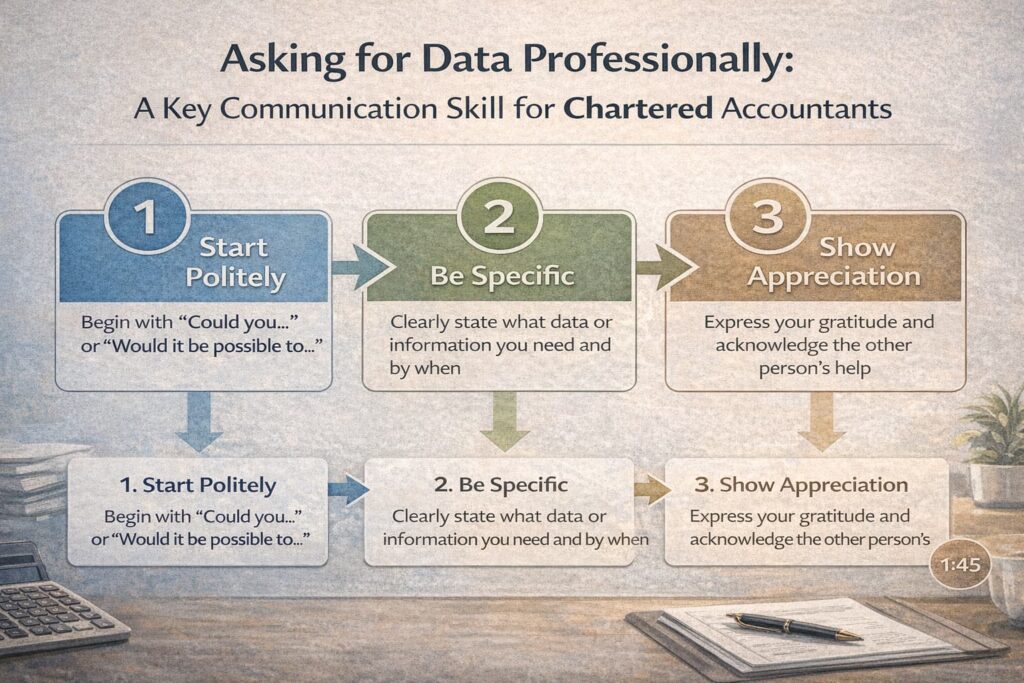
Asking for data professionally with good English
As an accountant or auditor, your job revolves around getting the right information. How you ask for it can affect the timeliness of the response. The key is to be clear, concise, and considerate of the other person’s time.
The Framework: A 3-part method that makes it easy for them to help you.
Provide Context: Briefly state what you’re working on so they understand why you need the info.
Be Specific: Clearly state exactly what you need. For example, say “the signed purchase orders from March for Vendor ABC” instead of “the file.
Explain the Impact or Deadline: Let them know why it’s important and when you need it. This creates urgency without being demanding.
Example Scripts:
- “Hope you’re having a good week. I’m working to complete the bank reconciliation for Q3, and to finalize it, I just need the final batch of invoices from Vendor X. Could you please provide them by EOD tomorrow so we can close the books on time?”
- “Hi, I’m currently preparing the asset depreciation schedule for the annual audit. I’m missing the purchase orders for the new equipment acquired in August. Could you please send them over when you get a chance?”
- “Just a quick question. While reviewing the expense reports, I noticed a few receipts were missing for the travel claims in June. To process the reimbursement, could you please upload them to the portal?
How to clearly present an audit finding using English for Chartered Accountants
This is where clarity is everything. You are often delivering news someone does not want to hear, such as an error, a control weakness, or a non-compliance issue. Your goal is to be direct and factual, not confrontational. The focus should always be on the issue, not the person.
The Framework: A 3-step process that presents the facts objectively.
State the Neutral Observation: Start with a simple, fact-based statement of what you found. Avoid any language of blame.
Explain the Potential Implication: Connect the observation to a potential risk or problem. Use cautious words like “This could…” or “This might create…”
Suggest the Next Step: Propose a clear action item or a discussion to resolve the issue. This shows you’re focused on solutions, not just problems.
Example Scripts:
- “During our review of the payroll process, we observed that the overtime for three employees in the production department wasn’t calculated according to the updated policy from May. This could create a potential payroll liability and might be something we need to correct.”
- “I have a query on the revenue recognition for the XYZ project. It looks like the revenue was booked in the March accounts, but the final deliverables were sent to the client in early April. Could we discuss the entry to ensure it meets the accounting standards for timing?”
- “While testing the accounts payable controls, we noticed that two invoices were paid without a corresponding purchase order approval in the system. Our next step is to understand if this was a one-off instance or if there’s a gap in the approval workflow we should look at.”
Your technical skills deserve to be heard.
Your deep accounting knowledge is your single greatest professional asset and what makes you a brilliant Chartered Accountant. A gap in communication confidence is a hurdle that can be overcome. Fluency is a skill built with focused, relevant practice.
You became a CA through dedicated study of the right material, and the same principle applies here. By using specialized tools and focusing on job-specific communication, you can articulate your technical expertise with confidence.
Demonstrate Your Proficiency with the Versant Test.
Also read: The remote CA in 2026: 5 Legitimate work-from-home profiles that pay global salaries.
Frequently Asked Questions
Q.1 What are the benefits of a specific course on English for Chartered Accountants compared to a general one?
A1: General courses often focus on broad grammar concepts. A specialized course teaches the specific vocabulary and business scripts you’ll actually use in audits, client meetings, and financial reporting, which is highly practical for your career.
Q.2 Can improving my English for Chartered Accountants really help me land a Big 4 job?
A2: Yes. Big 4 firms look for strong technical skills combined with communication confidence. While technical knowledge is crucial, being able to clearly articulate your findings in partner rounds and group discussions can be a deciding factor in receiving an offer.
Q.3 My accent is heavily influenced by my mother tongue. How can I improve my English for Chartered Accountants?
A3: The goal is clarity and being understood, not achieving a specific accent. The focus should be on clear pronunciation and using appropriate professional phrases. Tools that offer speaking practice can help build confidence in your delivery without trying to alter your identity.
Q.4 What are the most critical skills taught in English for Chartered Accountants?
A4: Beyond vocabulary, the most critical skills are practical ones: how to politely disagree with a senior, how to ask for missing data professionally, and how to present a complex audit finding in simple, clear terms.
Q.5 How can I practice my English for Chartered Accountants without feeling judged?
A5: Finding a private practice environment is helpful. Some platforms offer speaking practice activities where users can record themselves and get feedback privately. This allows for confidence-building without the pressure of a live audience.