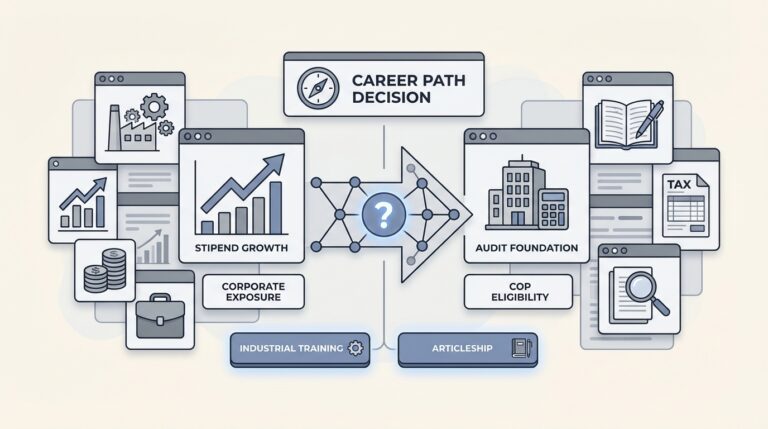
As you approach the end of your CA training, you face a significant decision: continue with a traditional articleship or transition to industrial training for the final year. This choice impacts not only your immediate stipend but also your skill development, work culture exposure, and long-term career path.
This guide moves beyond generic advice to provide a breakdown based on verified data and real-world experiences. We will examine stipend information and the practical realities of both paths to offer clarity. Resources such as specialized job listings and preparation tools can further assist you in making an informed decision.
What is industrial training for CA students?
According to the Institute of Chartered Accountants of India (ICAI), industrial training for CA students is a program that allows you to spend the final year of your practical training within a company instead of a CA firm. It provides an opportunity to understand how a business operates from the inside.
To be eligible, you must pass both groups of the CA Intermediate exam and have completed at least 12 months of your articleship. The training duration is between nine and twelve months.
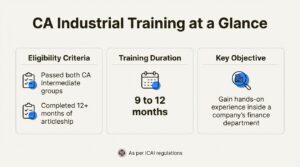
The primary goal is to provide hands-on experience in a specific industry. You become part of the team, working on financial planning, budgeting, and internal reporting rather than just auditing externally. The ICAI approves companies to ensure quality training. This includes companies across different sectors, such as Morgan Stanley and Goldman Sachs in investment banking, Flipkart in e-commerce, and Tata Steel in manufacturing.
What is a traditional CA articleship?
A CA articleship is the mandatory two-year practical training every CA student must complete under a practicing Chartered Accountant. It serves as the foundational experience of becoming a CA, where you learn the essentials in a registered firm.
The work focuses on the core domains of the profession. You will likely engage in statutory audits, handle direct and indirect taxation, and ensure client compliance. The experience is diverse, ranging from auditing a small manufacturing business one month to managing tax returns for a large service company the next.
Crucially, articleship is the only path to eligibility for a Certificate of Practice (CoP). If you plan to start your own firm or sign audit reports, this experience is essential. Industrial training does not qualify you for a CoP.
Stipend Comparison
Let’s discuss a key factor for many students considering the switch: compensation. The stipend difference between industrial training and a standard articleship can be substantial.
The ICAI minimum stipend for industrial training is ₹15,000 per month, but many top companies offer significantly more. This visual breaks down the significant stipend gap based on verified figures:
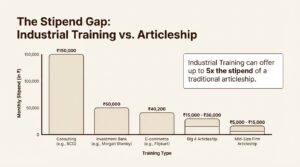
- Flipkart offers its business finance trainees ₹40,200 per month.
- Morgan Stanley has a program with a stipend of ₹50,000 per month.
- Boston Consulting Group (BCG) has reportedly offered stipends as high as ₹150,000 per month for certain roles.
In comparison, the stipend at many mid-size or small articleship firms typically ranges from ₹5,000 to ₹15,000. Big 4 firms generally offer up to ₹30,000 for trainees. The financial difference in the final year can be significant.
Here’s a table to visualize the gap:
| Training Type | Company/Firm Type | Verified Monthly Stipend Examples |
|---|---|---|
| Industrial Training | Consulting (e.g., BCG) | ~ ₹150,000 |
| Industrial Training | Investment Bank (e.g., Morgan Stanley) | ~ ₹50,000 |
| Industrial Training | E-commerce/Tech (e.g., Flipkart) | ~ ₹40,200 |
| Articleship | Big 4 Firm | ₹15,000 – ₹30,000 |
| Articleship | Mid-Size/Small Firm | ₹5,000 – ₹15,000 |
Stipends can vary based on location, company, and the specific role. Online tools, such as salary estimators, can provide real-time, verified stipend data for various industrial training roles in 2026.
Career Impact and Skill Development
While a higher stipend is attractive, this decision has long-term career implications. The basic trade-off is between deep corporate experience and a broad, practice-based foundation.
Specialized Experience vs. Broad Foundation
In industrial training, you immerse yourself in one company and industry. As an internal team member, you work on processes like Financial Planning & Analysis (FP&A), prepare MIS reports, and assist with budgeting. This is valuable if you aim for a career in corporate finance. It can lead to a Pre-Placement Offer (PPO), securing a job before your CA Final exams. Some roles also offer training in tech skills like Python, SQL, or Power BI.
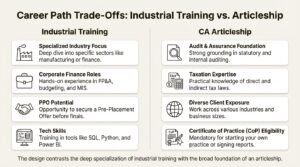
An articleship, conversely, offers breadth. You work with diverse clients across various sectors, building a strong foundation in audit and tax. This is the only path that keeps the Certificate of Practice (CoP) option available. If you aspire to sign financial statements or establish your own firm, articleship is necessary.
Understanding Corporate Culture
A high stipend and corporate environment can have drawbacks. The corporate world can be demanding, which may be challenging for a student balancing work and exam preparation.
There are online accounts from trainees who have faced work culture challenges and intense pressure. It is important to research a company’s culture before accepting an offer. A helpful tip is to connect with trainees on LinkedIn to ask about their daily experiences.
Navigating Practicalities and Myths
Transitioning to industrial training involves finding the right role, managing studies, and understanding common misconceptions.
The Myth of Study Leave
There is a common fear that corporate roles offer less study leave. In reality, this varies by company. Many large corporations have structured leave policies for CA trainees, providing clarity from the start.
By contrast, leave in some CA firms can be less predictable, depending on partner discretion or client deadlines. A structured five-day work week in a corporate role can make it easier to create a study schedule with proper discipline.
How to Find The Right Opportunities
Finding a suitable industrial training opportunity requires a strategy. Here are some approaches:
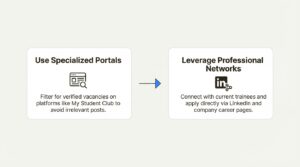
- Specialized Job Portals: Platforms dedicated to students, like My Student Club, list verified industrial training vacancies from top companies, helping you filter out irrelevant posts.
- LinkedIn and Career Pages: These are effective channels for networking and applying directly. However, competition can be high due to the large volume of applications.
Preparing for The Interview
The interview process for industrial training often includes an aptitude test, technical rounds focusing on SFM and FR concepts, and an HR round to assess cultural fit.
To build confidence, you can practice with tools like an AI Interview Bot, which simulates real interview scenarios for finance roles and provides feedback.
For a more detailed walkthrough of the process, this video provides an end-to-end guide on securing an industrial training position.