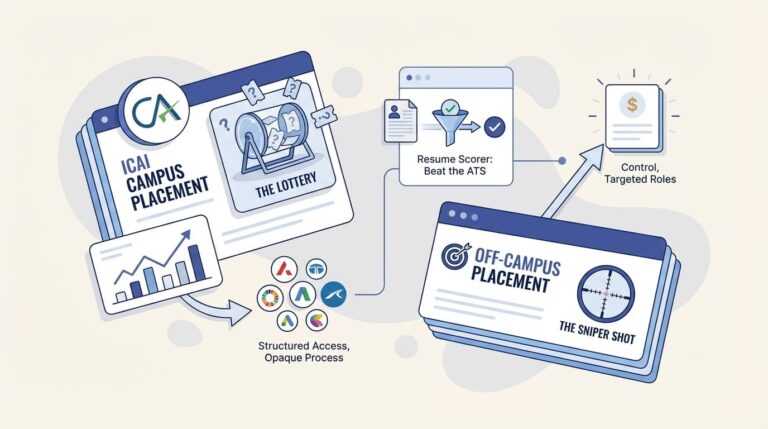
First off, congratulations. Seriously. Passing the Chartered Accountancy exams is a huge deal, and you’ve earned every bit of the celebration. But after the party ends, a new, slightly scary question pops up: “What’s next?”
All of a sudden, you’re at a fork in the road. One path is the structured, well-traveled route of the ICAI campus placement program. The other is the independent, wide-open world of the off-campus job hunt.
It’s easy to feel overwhelmed. The campus route can feel like buying a high-stakes lottery ticket. You might win big, but you have almost no say in the outcome. The off-campus search is more like a strategic sniper shot. You pick the target and line up the shot, but you’re completely on your own.
This guide is here to cut through the noise. We’re going to break down both paths with real data and experiences to help you build a smart, hybrid job search strategy that actually gets results.
ICAI Campus vs Off-Campus Placement
Before we get into the details, let’s make sure we’re on the same page. Both routes can land you a great first job, but they work on totally different principles. Understanding them is the first step to making a plan that fits your career goals and, let’s be honest, your personality.
What is ICAI campus placement?
This is the official recruitment program run twice a year by the Institute of Chartered Accountants of India & Committee for Members in Industry & Business (CMI&B). Think of it as a massive, organized job fair just for newly qualified CAs.
Its main purpose is to be a middleman, connecting fresh CAs with a huge pool of top-tier employers like the Big 4, major banks, and Public Sector Undertakings (PSUs) at specific locations across India. The whole thing, from signing up to getting interview calls, is handled through the official CMI&B portal.
What is off-campus placement?
This is you taking charge. Off-campus placement is just a catch-all term for an independent job search where you actively look for opportunities on your own terms.
The main ways to do this are probably familiar to you: building a professional network, using high-value employee referrals (we’ll get to this later), scrolling through job sites like LinkedIn, and applying directly to your dream companies’ career pages. The key thing here is that this path gives you total control over where you apply and for which roles, right from the start.
How ICAI placements work
The campus placement program is an institution for a reason. It’s a big opportunity, but it helps to go in with your eyes open. Let’s call it what it is: a game of chance where the recruiters set the rules, not you or even the ICAI.
Understanding the shortlisting process
One of the biggest myths about campus placements is that ICAI influences who gets shortlisted. It doesn’t. Its role is just to host the event. The truth is that companies set their criteria, and the institute has no say in their decisions.
So, what are they looking for? The filters are usually pretty standard but applied without mercy:
- Number of Attempts: This is often the first and toughest filter. Many top companies automatically reject candidates with more than two or three attempts, no questions asked.
- Location Preference: Companies hiring for a specific office will naturally favor candidates from that city or region.
- Articleship Experience: Your articleship firm and the type of work you did (statutory audit, tax, internal audit) play a big part in whether you fit a company’s profile.
To make things even more competitive, companies can only shortlist a maximum of 10 times the number of vacancies. If a company has 5 openings, only the top 50 candidates in their system will get an interview call. On top of that, you can only consent for four companies that shortlist you, making each choice really important. It’s a numbers game, and the odds can feel like they’re not in your favor.
Pros of the campus route
Despite the randomness, there are good reasons to sign up for campus placements.
- Access to Big Brands: Where else can you get your profile in front of dozens of industry giants at once? Companies like Deloitte, ITC, Accenture, KPMG, and ICICI Bank are regulars. It’s a huge opportunity for mass exposure.
- Structured Process: The chaos of a job hunt can be exhausting. The campus program gives you a clear timeline for applications, interviews, and offers. This structure can be a big relief when you’re just starting.
- Solid Starting Packages: The salaries are pretty good. The 61st Campus Placement Programme reported an average salary of ₹12.86 LPA, with the highest domestic offer reaching ₹29 LPA. It sets a decent baseline for your career.
Cons of the campus route
However, it’s important to manage expectations to avoid being disappointed.
- Placement isn’t guaranteed. Campus placement doesn’t find a job for everyone. Past data often shows placement rates around 57%. That means nearly half the candidates who show up might leave empty-handed. It’s a great opportunity, but it’s not a sure thing.
- The CTC can be misleading. “Cost To Company” is one of the most misleading terms in recruiting. The big, shiny number on an offer letter is often filled with things that won’t appear in your monthly bank account. Things like the employer’s PF contribution, performance-based variable pay (which is never a guarantee), and one-time joining bonuses are all included. A ₹15 LPA package might actually mean a take-home salary closer to ₹90,000 per month after all the deductions.
- Specialized roles are less common. If you’re aiming for a super-specialized, high-finance role like front-end investment banking or private equity, you probably won’t find it in the general campus pool. Those jobs are almost always saved for rank-holders or filled through other channels.
Taking control of your job search
If campus is a lottery, the off-campus search is a calculated, strategic mission. It puts you in total control, letting you aim for the exact career you want from day one. It’s more work, but the potential reward is much higher.
You choose the role, not the algorithm
This is the single biggest difference. In an off-campus search, you’re not just tossing your resume into a database and hoping for the best. You are the one doing the picking.
You get to research companies, learn about their culture, and find specific roles that actually excite you. Want to get into a niche field like SAP consulting, transaction advisory, or forensic accounting? These roles rarely have openings on campus. Off-campus, you can find them and apply directly, tailoring your application to the exact skills they need. You’re not waiting to be chosen; you’re choosing your own path.
The power of referrals
Here’s a secret most people learn too late: the best jobs are often filled before they’re ever posted online. This is the “hidden job market,” and it runs almost entirely on employee referrals.
Networking isn’t just about making small talk; it’s about building real connections with people in the industry you want to join. A referral from a current employee can land your resume right on the hiring manager’s desk, skipping the whole HR filtering mess. This is how candidates with multiple attempts, who might be automatically screened out on campus, have landed incredible offers over 12 LPA. The highest packages are often found through these inside tracks, not in the mass-hiring environment of campus placements.
The resume challenge: Beating the ATS
With great control comes great responsibility. In an off-campus search, your resume is doing all the work. Before a person ever sees it, it has to get past Applicant Tracking Systems (ATS), which are bots that scan for keywords and formatting. If your resume isn’t optimized for these systems, it gets tossed out without a second look.
In the off-campus world, your resume is your only advocate. It has to beat the bots before a human ever sees it. This is why making sure your resume is optimized is a must. Don’t apply without checking your score first with our Resume Scorer.
On vs Off Campus Placement Comparison
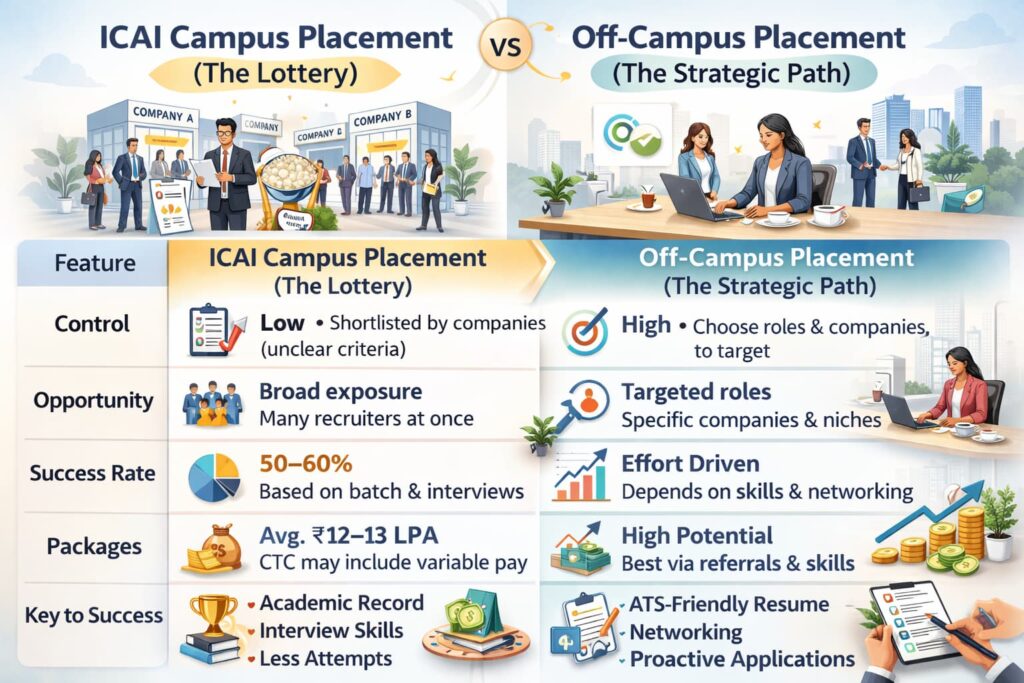
Let’s break it down into a quick summary. This infographic highlights the key differences between the two approaches:
| Feature | ICAI Campus Placement (The Lottery) | Off-Campus Placement (The Sniper Shot) |
|---|---|---|
| Control | Low; you are shortlisted by companies based on their unclear criteria. | High; you choose exactly which roles and companies to target. |
| Opportunity | Broad exposure to many large recruiters all at once. | Targeted exposure to specific, desired roles, including niche ones. |
| Success Rate | Historically around a 50-60% placement rate. | Varies based on individual effort, networking, and resume quality. |
| Packages | Good average packages (₹12-13 LPA), but CTC can be inflated. | Potential for the highest packages, often through referrals. |
| Key to Success | Strong academic record, few attempts, good interview skills. | A powerful, ATS-friendly resume, strong networking, and proactive applications. |
Using both paths
So, after all that, what’s the answer? It’s not about picking one path over the other. The smartest strategy for any newly qualified CA is to do both.
Definitely register for campus placements. Treat it as a great opportunity and a potential safety net. It gives you access to top companies and provides valuable interview experience. But don’t put all your hopes in that one basket.
At the same time, build a strong, proactive off-campus strategy. Start networking, polish your LinkedIn profile, and tailor your resume for the specific roles you want. Consider campus placements as a valuable opportunity and a strong safety net, while your primary focus, or Plan A, should be the targeted approach where you go after your dream job with focus and determination. This way, you get the best of both worlds and increase your chances of not just landing a job, but landing the right job.
Your off-campus strategy starts and ends with a resume that gets results. Before you send a single application, make sure it’s optimized to beat the bots and impress recruiters.
Check if your resume is ATS-friendly from Resume Scorer.
Also read: How to Ask Your Principal for Departmental Rotation
Frequently Asked Questions
Q.1 What is the main difference between ICAI campus and off-campus placements for a CA fresher?
A: The main difference is control. In ICAI campus placement, companies shortlist you based on their own criteria, which can feel like a lottery. With off-campus placement, you are in control, choosing which companies and specific roles you want to apply for directly.
Q.2 Which route typically offers higher salary packages: campus or off-campus?
A: While campus placements offer solid average salaries, the highest packages are often secured through off-campus placements. This is usually due to employee referrals, which can get you an inside track to top-tier jobs that aren’t advertised in the general campus pool.
Q.3 How do my CA attempts affect my chances in campus vs. off-campus placements?
A: The number of attempts is a major filtering criterion in campus placements, and having more than two or three can lead to automatic rejection by top firms. In an off-campus search, while a good record helps, a strong resume and a good referral can often help you bypass these strict filters.
Q.4 Should I focus on only one path, either campus or off-campus placement?
A: No, the best strategy is a hybrid one. You should register for campus placements to get access to big companies and gain interview experience, but also run a proactive off-campus job search at the same time. This maximizes your opportunities.
Q.5 How important is a resume for campus and off-campus placements?
A: A resume is important for both, but it’s absolutely vital for an off-campus search. Your resume must be optimized to pass through Applicant Tracking Systems (ATS) before a human ever sees it. In the off-campus world, your resume is your primary tool for getting noticed.
Q.6 Can I find niche roles like investment banking through campus placements?
A: Highly specialized roles like front-end investment banking or private equity are rarely available through the general campus placement program. These positions are typically filled off-campus through networking, referrals, or are reserved for rank-holders.