
The transfer decision keeps CA students awake at night for the wrong reasons. It’s rarely about regulations or forms. It’s about guilt, fear, and uncertainty.
You’ve probably heard some version of this: “Transfer looks like quitting on your resume.” Or maybe your principal has told you, “You’re like family here.” These emotional hooks make the decision feel impossibly heavy. But here’s what nobody tells you: there’s no published data showing that articleship transfers hurt career outcomes. None.
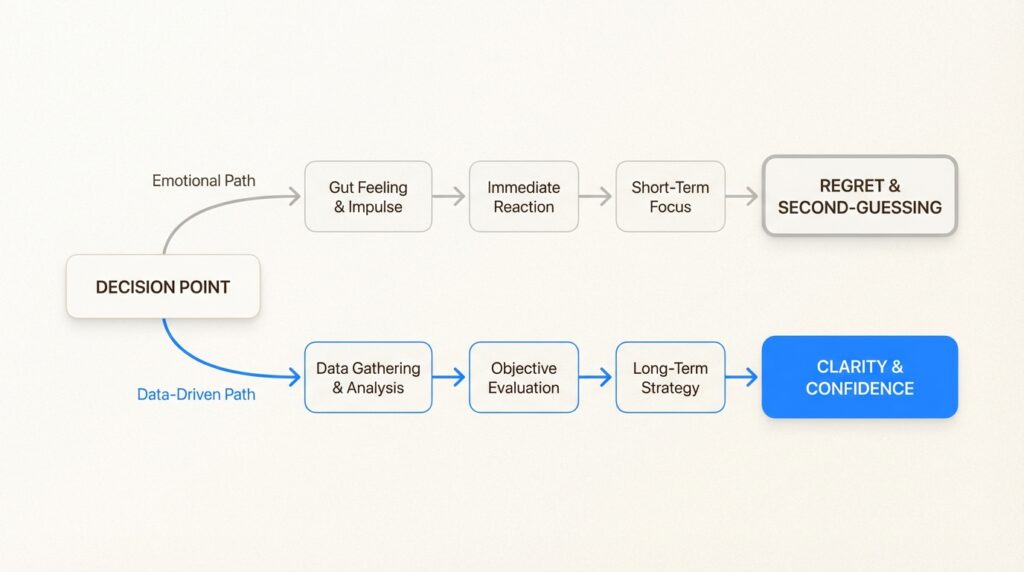
The actual problem isn’t the transfer itself. It’s that students lack objective criteria to evaluate whether their current situation is below market standard or simply uncomfortable. Discomfort and exploitation are not the same thing.
This guide provides something the SERP doesn’t offer anywhere else: a scoring framework to move your transfer decision from emotional to data-driven.
Client exposure score (0-25 points)
Client exposure determines how much real-world complexity you’re actually seeing. This isn’t about quantity of clients but quality and diversity of exposure.
Scoring criteria:
| Points | Client Profile |
|---|---|
| 20-25 | Multinational companies, listed entities, complex group structures |
| 15-19 | Large domestic corporates, multi-state operations, diverse industries |
| 10-14 | Mid-sized companies, 2-3 industries, some complexity |
| 5-9 | Small and medium enterprises, single industry focus |
| 0-4 | Minimal client interaction, primarily vouching and documentation work |
What to assess: Are you working on clients that will prepare you for the roles you want? Direct client interaction matters too. If you’re only seeing files and never meeting stakeholders, deduct 5 points from your score.
Technical skill development score (0-25 points)
Your articleship should build skills that compound over your career. This means exposure to different audit types, software systems, and documentation standards.
Scoring criteria:
| Points | Technical Exposure |
|---|---|
| 20-25 | Statutory audit, internal audit, tax audit, forensic exposure; multiple software platforms (SAP, Tally, ACL, data analytics); rigorous review process |
| 15-19 | 2-3 audit types; standard software training; regular senior review |
| 10-14 | Primarily statutory audit; Tally/basic software only; occasional review |
| 5-9 | Single audit type; minimal software exposure; limited feedback |
| 0-4 | No structured audit exposure; primarily administrative tasks |
Mentorship and guidance score (0-25 points)
Mentorship separates a training ground from a cheap labor arrangement. A principal who invests in your development creates value that extends beyond the articleship period.
Scoring criteria:
| Points | Mentorship Quality |
|---|---|
| 20-25 | Regular principal engagement; structured feedback sessions; career guidance; knowledge sharing culture |
| 15-19 | Accessible seniors; periodic feedback; some career discussion |
| 10-14 | Available when needed; feedback on major issues only |
| 5-9 | Minimal guidance; learn-by-doing environment with little support |
| 0-4 | Principal absent; no structured feedback; sink-or-swim culture |
Professional environment score (0-25 points)
This dimension covers the baseline professional standards your firm should meet. ICAI’s Regulation 67 mandates minimum stipends, but professional environment extends beyond payment.
Current ICAI minimum stipend by city tier (per month):
| City Classification | Year 1 | Year 2 | Year 3 |
|---|---|---|---|
| Population 20 lakhs+ | Rs 4,000 | Rs 5,000 | Rs 6,000 |
| Population 5-20 lakhs | Rs 3,500 | Rs 4,500 | Rs 5,500 |
| Below 5 lakhs | Rs 3,000 | Rs 4,000 | Rs 5,000 |
Scoring criteria:
| Points | Environment Quality |
|---|---|
| 20-25 | Stipend above ICAI minimum (bank credit); reasonable hours; leave policy followed; ethical practices; growth opportunities |
| 15-19 | ICAI minimum stipend; generally reasonable hours; basic leave accommodation |
| 10-14 | Minimum stipend but irregular payment timing; frequent overtime; limited leave |
| 5-9 | Below minimum or cash payment (violates Regulation 67); excessive hours; no leave |
| 0-4 | No stipend or severe underpayment; exploitative hours; toxic environment |
Important: ICAI explicitly states that stipend must be credited to bank account only, not paid in cash. If your firm pays cash, that’s a regulatory violation, not a minor inconvenience.
Decision thresholds: what your score means
| Total Score | Interpretation |
|---|---|
| 70-100 | Strong articleship. Consider staying unless specific red flags exist. |
| 50-69 | Average articleship. Evaluate weak areas, consider secondment for gaps. |
| Below 50 | Weak articleship. Transfer is objectively justified by data. |
Join the Getting Interview Ready Workshop and walk into your next interview with confidence and clarity.
ICAI articleship transfer rules
Once you’ve scored your situation, you need to understand the procedural landscape. The ICAI articleship transfer rules distinguish clearly between first-year and post-first-year transfers.
First year transfers (no restrictions)
If you’re within your first year of articleship, the process is straightforward:
- No prior ICAI approval required
- No documented reason needed
- No limit on number of transfers (this is explicitly clarified by ICAI; the “only one transfer per year” rumor is baseless)
- Direct Form 109 submission after principal agreement
The ICAI Articleship FAQ specifically addresses this myth: ICAI has clarified there is no limit on the number of times articleship transfer can be taken in the first year.
Second and third year transfers (documented reasons only)
After your first year, transfers require prior ICAI approval with documented justification. Approved reasons include:
Medical grounds:
- Minimum 3-month break from articleship
- Government hospital certificate mandatory
- Must demonstrate genuine health issue
Relocation-based reasons:
- Parent’s working transfer to city 50+ km away (with transfer order proof)
- Own relocation 50+ km due to marriage
- Principal relocates 50+ km away
Firm-based reasons (automatic per Regulation 57):
- Principal’s death
- Principal ceases practice
- Principal’s name removed from Register of Members
- Firm closure or merger
Other valid reasons:
- Irregular or non-payment of stipend (Regulation 67)
- Desire to serve abroad
Secondment as an alternative (Regulation 54)
Here’s something most students don’t know: you don’t have to choose between staying and permanent transfer.
Regulation 54 allows secondment, a temporary transfer lasting 4-12 months. This option works well when your current firm is decent overall but lacks specific exposure. For example, if you have strong mentorship but limited industry diversity, secondment lets you fill that gap without permanent termination.
When to consider secondment:
- Your Articleship Score is 50-69 (average, not poor)
- Weakness is in one specific dimension (exposure or skills)
- Principal relationship is positive and worth preserving
Form 109 process: step by step
If your score confirms that transfer is justified, here’s the execution process.
Before you file Form 109
- Score your situation (document your rationale)
- Have the principal conversation (involve parents if helpful)
- For 2nd/3rd year: Prepare documentation for ICAI approval request
- Identify potential new firms before submitting (don’t create a gap)
Filing Form 109 on the SSP portal
The ICAI SSP portal handles online submissions. Here’s the process:
- Login to eservices.icai.org with your credentials
- Navigate to Articleship tab
- Select Articleship button
- Click on Form 109
- Fill details including articleship period served and leaves taken
- Select reason for transfer (within 1 year, medical grounds, marriage, family shifting, parent transfer, stipend issues, etc.)
- Get principal’s signature (both parties must sign)
- Upload supporting documents
- Generate OTP and submit
Timeline expectations:
- First year: Immediate processing after submission
- Second/third year: 15-30 working days for ICAI approval, then Form 109
After Form 109 approval
Post-termination registration has strict deadlines:
| Form | Purpose | Deadline |
|---|---|---|
| Form 102 | Articleship deed with new principal (on stamp paper) | Within 30 days of commencement |
| Form 103 | Registration notification to ICAI | Within 30 days |
| Form 104 | New principal’s confirmation | Within 30 days |
Late filing penalties:
| Delay | Penalty |
|---|---|
| More than 30 days | Rs 500 |
| More than 60 days | Rs 1,000 |
| More than 6 months | Rs 2,000 |
| More than 12 months | Rs 10,000 |
Handling principal resistance
The regulations are clear, but the human dynamics are messy. Principal resistance is a documented pattern, and you should prepare for it.
Common resistance tactics:
- Emotional appeals: “You’re like family,” “I invested in your training”
- Delaying NOC signature or Form 109 signing
- Pressure about being “indispensable” to ongoing engagements
- Bonded agreements claiming you cannot transfer
How to respond:
Keep the conversation professional, not emotional. The goal is “this situation doesn’t meet market standards” rather than “you’re a bad principal.”
Involving parents in the discussion often helps, particularly when emotional pressure is high. In many cases, a parent’s presence shifts the dynamic from employer-employee to a broader family discussion.
Know your rights. In the first year, transfer is your legal right with no reason required. Document all communication in writing, especially if you sense resistance building.
If the principal refuses to sign Form 109:
This is a real concern. In the first year, you have the legal right to transfer regardless of principal preference. However, enforcement through ICAI can be inconsistent. Some practitioners have reported that local ICAI office handling varies, and personal relationships between principals and ICAI officials can influence outcomes.
If you face wrongful refusal, escalate to your regional ICAI office with documented communication. Be prepared for a process that may take time, but don’t let fear of friction keep you in a situation that scores below 50.
Making your articleship transfer decision
Here’s how to interpret your results:
If your score is below 50:
Transfer is objectively justified. Document your scoring rationale for your own clarity. Begin new firm search before filing Form 109 to avoid gaps. Your current situation is below market standard, and recognizing that isn’t “quitting.” It’s career optimization.
If your score is 50-69:
Consider secondment under Regulation 54 for specific exposure gaps. Have a direct conversation with your principal about improvements, framing it around specific scoring dimensions. Set a timeline (for example, 3 months) to reassess.
If your score is 70+:
Your current position is above market average. Transfer might be a lateral move rather than an improvement. Unless specific red flags exist (ethical concerns, harassment, systematic violations), staying may be optimal.
The bottom line: A low score isn’t evidence of weakness or disloyalty. It’s evidence that your current situation doesn’t meet the standards you need for career development. Data removes the guilt. Use it.
Evaluate your articleship experience with our Articleship Scorer: Uncover minute mistakes and get actionable suggestions.
Also read: Corporate treasury: The high-paying “cash” role most CAs ignore (Forex & Liquidity)
Frequently Asked Questions
Q.1 Can I transfer my articleship in the first year without giving any reason?
A1: Yes. ICAI regulations explicitly allow unlimited transfers in the first year with no documented reason required. The rumor about ‘only one transfer allowed per year’ is baseless and has been clarified by ICAI. You submit Form 109 directly after principal agreement.
Q.2 What are the new articleship transfer rules for 2026?
A2: The core articleship transfer rules remain consistent with ICAI regulations. Key points: first-year transfers require no reason or prior approval; second and third-year transfers require documented reasons (medical, relocation 50+ km, stipend violations) and prior ICAI approval before Form 109 submission.
Q.3 What is secondment under Regulation 54 and how do articleship transfer rules apply to it?
A3: Secondment is a temporary transfer lasting 4-12 months under Regulation 54. It allows you to gain specific exposure at another firm without permanent termination. This is useful when your current firm is average overall but weak in one dimension. Secondment preserves your original articleship relationship while filling exposure gaps.
Q.4 What if my principal refuses to sign Form 109 despite articleship transfer rules allowing transfer?
A4: In the first year, transfer is your legal right regardless of principal preference. Document all communication in writing. If the principal refuses, escalate to your regional ICAI office with documentation. Resolution timelines can vary, and some practitioners report inconsistency in ICAI handling, but your legal right remains valid.
Q.5 Will an articleship transfer affect my CA Final eligibility?
A5: No. Properly documented and ICAI-approved transfers have no impact on CA Final eligibility. You must ensure total training period requirements are met (2 years under new scheme, 3 years under old scheme) and registration is properly documented with Forms 102, 103, and 104 submitted within deadlines.