
You did it. The exams are over, the books are closed, and you’ve more than proven your technical skills. You know your accounting standards inside and out. But now comes the part that trips up even the sharpest candidates: the behavioral interview. It’s where you get hit with questions that feel designed to catch you off guard, like “Tell me about a conflict” or “Describe a time you failed.”
It’s no secret these questions are nerve-wracking. Technical skills get you in the door, but your answers to these questions are what get you the offer. This is where firms test your soft skills to see how you’ll handle pressure, work in a team, and fit into their culture.
For the Big 4, cultural fit is a huge deal. They know you’re smart, but they want to know if you’re someone they can eventually put in front of a client. In fact, interviews at firms like KPMG are primarily behavioral, digging into your values and how you collaborate, not just your technical knowledge.
So, how do you answer these tricky questions without sounding like a robot or, worse, incompetent? There’s a simple framework for that. Let’s break it down.
What is the STAR Method?
The STAR method is a simple technique to structure your answers for behavioral and situational interview questions. Think of it as a mini-storytelling formula. It helps you give a clear, concise, and compelling answer backed by real-world evidence, which is something what firms like EY look for when assessing candidates. This way, you stop saying vague things like “I’m a hard worker” and start proving it with a specific example.
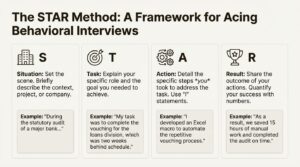
Here’s what STAR stands for:
- S – Situation: First, set the scene. Give the interviewer a little context. Where were you working? What was the project? Keep it brief, just enough to paint a picture. For example, “During the statutory audit of a major bank in my second year of articleship…”
- T – Task: What was your specific job? What goal or challenge were you up against? This part clarifies your role and the objective. For instance, “My task was to complete the vouching for the entire loans division, but we were two weeks behind schedule.”
- A – Action: This is the heart of your story. What specific steps did you personally take to handle the situation? Always use “I” statements. Don’t say “we did this”; say “I did this.” Get detailed here. Example: “I noticed the manual vouching process was repetitive, so I developed an Excel macro that automated cross-referencing invoices with payment records.”
- R – Result: What happened because of your actions? This is where you close the loop. Whenever you can, use numbers to quantify your success. What did you accomplish? What did you learn? For example, “As a result, we saved 15 hours of manual work, which allowed us to catch up and complete the audit on time. It also taught me the power of looking for process improvements, even in routine tasks.”
Answering the Conflict Question
When an interviewer asks about a difficult person, they’re not looking for office drama. They want to see how you handle professional disagreements. Can you stay calm, communicate clearly, and find a solution without making things personal? This question is a direct test of your emotional intelligence and collaboration skills. It’s especially important in team-based environments like audit, where aligning with firm values like KPMG’s “Together” principle, which encourages constructive disagreement and diverse perspectives, is key to success.
The trick is to frame the story around a professional difference of opinion, not a personality clash. Here’s how you can structure it using the STAR method.
Sample Answer Breakdown:
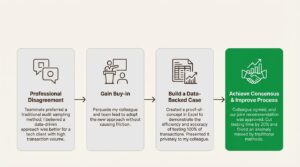
- Situation: “During a group assignment in my articleship, a teammate and I just weren’t on the same page about the audit approach for revenue recognition for a tech client. They were comfortable with the traditional sampling method we’d always used. But with the client’s huge volume of online transactions, I felt that approach was inefficient and carried a higher risk of missing material misstatements.”
- Task: “My goal was to convince my colleague, and then our team lead, that a data-driven analytical approach would be much more effective. I had to do this without causing friction or making my teammate feel like I was dismissing their experience. It was about finding a better way forward for the team and the client.”
- Action: “Instead of arguing, I decided to build a case with data. I spent a few hours creating a small proof-of-concept. I pulled a sample data set and used some advanced Excel functions to show how we could test 100% of the transactions in a fraction of the time. Then, I asked my colleague for a few minutes to chat privately. I walked them through my findings, focusing on the benefits like time savings and higher audit quality. I made sure to listen to their concerns about the complexity, acknowledging that their points were valid.”
- Result: “Because I presented a logical, data-backed argument respectfully, my colleague saw the potential. They even added a few suggestions to improve the process. We presented a unified recommendation to our team lead, who was impressed and approved a pilot of the new approach. It ended up cutting our testing time by about 20% and, more importantly, it flagged an anomaly in revenue reporting that traditional sampling would have almost certainly missed. The biggest win was that it changed how our team approached problems; we became more collaborative and evidence-based.”
Master statutory audit like a Big 4 pro? Enroll in the Statutory Audit Masterclass today!
Answering the Failure Question
This question can feel like a trap, but it’s really a test of character. Interviewers don’t expect you to be perfect. They ask this to see if you have self-awareness, if you take accountability for your actions, and if you can learn from your mistakes. Anyone can talk about their successes, but it takes maturity to discuss a failure.
The key is to choose a real but relatively minor mistake, take complete ownership of it, and then spend most of your answer talking about what you learned and how you fixed it. The focus should be on the growth, not the goof-up.
Sample Answer Breakdown:
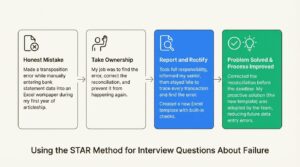
- Situation: “In my first year of articleship, I was put in charge of reconciling a client’s bank statements for an entire quarter. It was one of my first big responsibilities, and I was eager to do a good job. However, while manually entering data from a PDF statement into our Excel workpaper, I made a transposition error, swapping two digits in a large transaction.”
- Task: “Because of that one error, the reconciliation was off by a significant amount, and I couldn’t figure out why. My job was to own up to the mistake, find the source of the error, fix the reconciliation, and put a system in place to make sure it wouldn’t happen again.”
- Action: “After a few hours of getting nowhere, I knew I had to ask for help. I went to my senior, explained the situation, and took full responsibility for the discrepancy. I didn’t blame the system or the tight deadline. She appreciated the honesty. I then stayed late that evening, meticulously tracing every single transaction line by line until I finally found the transposed number. After correcting it, I created a new Excel template with built-in checks and some conditional formatting to automatically flag any large variances. I shared this new template with my team, explaining how it could help prevent similar human errors.”
- Result: “The reconciliation was corrected well before the client submission deadline. My senior was impressed with my honesty and the proactive steps I took to solve the problem. That experience taught me a huge lesson about the importance of being meticulous in audit work. It’s not just about getting the work done, but about getting it right. The template I created was adopted by the team for subsequent audits, and it helped us reduce similar data entry errors by a noticeable margin.”
5 Common Behavioral Questions for CAs
As you move through the interview process, especially with partners, the questions get deeper. They’re not just looking for an associate; they’re looking for a future leader. Their questions are designed to probe your character, work ethic, and potential. Here are some of the most common Big 4 HR interview questions you should be ready for.
Questions:
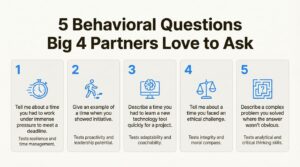
- “Tell me about a time you had to work under immense pressure to meet a deadline.”
- Why they ask: Audit season is intense. Deadlines are non-negotiable. They want to know if you can handle the stress, manage your time, and deliver high-quality work when the pressure is on. They’re testing your resilience.
- Why they ask: Audit season is intense. Deadlines are non-negotiable. They want to know if you can handle the stress, manage your time, and deliver high-quality work when the pressure is on. They’re testing your resilience.
- “Give an example of a time when you showed initiative.”
- Why they ask: Firms don’t want people who just wait to be told what to do. They want proactive problem-solvers who see an issue or an opportunity for improvement and take ownership of it. This is a huge indicator of leadership potential.
- Why they ask: Firms don’t want people who just wait to be told what to do. They want proactive problem-solvers who see an issue or an opportunity for improvement and take ownership of it. This is a huge indicator of leadership potential.
- “Describe a time you had to learn a new technology tool quickly for a project.”
- Why they ask: The accounting and finance world is changing fast. With automation becoming a huge part of the industry, they need to know you’re adaptable and can pick up new software or tools without extensive hand-holding. They’re testing if you are coachable and a quick learner.
- Why they ask: The accounting and finance world is changing fast. With automation becoming a huge part of the industry, they need to know you’re adaptable and can pick up new software or tools without extensive hand-holding. They’re testing if you are coachable and a quick learner.
- “Tell me about a time you faced an ethical challenge.”
- Why they ask: Integrity is the bedrock of the accounting profession. This is a non-negotiable. They need to know that your moral compass is strong and that you will always choose what is right over what is easy, even if it’s uncomfortable.
- Why they ask: Integrity is the bedrock of the accounting profession. This is a non-negotiable. They need to know that your moral compass is strong and that you will always choose what is right over what is easy, even if it’s uncomfortable.
- “Describe a complex problem you solved where the answer wasn’t obvious.”
- Why they ask: This is a classic situational interview question for CA candidates. Auditing and consulting are full of ambiguity. They want to see your analytical and critical thinking skills in action. How do you break down a complex problem, gather information, and come to a logical conclusion when there’s no clear roadmap?
Don’t just prepare, practice
Knowing the STAR framework is one thing, but delivering your answers smoothly is another. You can have the perfect story, but if you sound hesitant or like you’re reading a script, it won’t land with the same impact.
The goal is to have a conversation. You want your stories to flow naturally, and the only way to get there is through practice.
Knowing the theory is easy. The hard part is staying calm and articulate when you’re in the hot seat. Don’t just memorize your stories, practice speaking them out loud until they become second nature.
Use our Interview Bot to rehearse your STAR stories, get instant, unbiased feedback on your delivery, and track your confidence score. Walk into your Big 4 interview prepared not just with what to say, but how to say it.
Also read: How to crack the Versant test for Big 4: Practice tips & common mistakes (2026 edition)