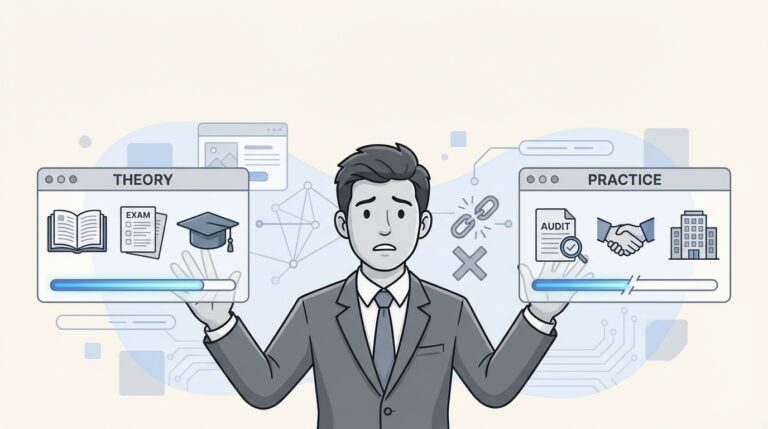
Every year, thousands of CA students face the same dilemma. Articleship demands 35-40 hours per week. CA Final exams require 12-14 hours of daily study. Something has to give, right?
So they choose what seems like the perfect shortcut: dummy articleship. Register with a CA firm on paper, skip the actual work, and use those three years to focus entirely on exams. It sounds logical and sounds smart. It sounds like career downfall.
Here’s the short version: dummy articleship might have worked in an era when verification meant making a few phone calls. Today, it’s a fast track to permanent professional damage. Modern background checks, ICAI’s digital tracking systems, and employer verification networks have made detection inevitable. And once you’re caught, the consequences follow you for decades.

What is dummy articleship?
Dummy articleship means registering under a CA proprietorship or firm “on paper” without actively participating in practical work. You get the registration letter. You get the certificate of completion. What you don’t get is any actual training.
The temptation is understandable. CA articleship requires three years of your life. During that time, you’re expected to work full-time while preparing for some of the most challenging professional exams in the world. The CA Final syllabus alone covers advanced accounting, auditing, taxation, corporate law, financial management, and strategic management. Each subject requires hundreds of hours of study.
So students rationalize: “I’ll skip the grunt work now, clear my exams with top ranks, and make up for the practical gap later.” Some even believe that theoretical excellence (scoring AIR 1 or top 10 ranks) will compensate for missing hands-on experience.
This thinking is dangerously wrong.
The articleship period isn’t just a bureaucratic requirement to check off. It’s where you learn to apply the theories you’ve studied. It’s where you develop professional judgment, client communication skills, and the ability to navigate real-world complexity that no textbook can fully capture.
How background checks work today
Ten years ago, verifying articleship meant calling the CA firm listed on your certificate and hoping someone remembered you. Today, the process is systematic, digital, and nearly impossible to fool.
Let’s break down how modern verification actually works.
ICAI’s digital tracking systems. The Institute of Chartered Accountants of India has implemented biometric attendance systems, digital workpaper tracking, and centralized registration databases. When you register for articleship, your details enter a system that tracks your progress, attendance, and work assignments. Firms that facilitate dummy articleship are increasingly flagged during ICAI inspections.
Employer verification processes. When you apply for a job at a Big Four firm, a multinational corporation, or even a mid-sized CA practice, the HR department doesn’t just glance at your certificate. They contact your articleship firm directly. They ask specific questions: What clients did you work on? What audits did you participate in? Can you provide sample workpapers?
If you did dummy articleship, you have no answers. And silence is its own confession.
Third-party background verification companies. Firms like AuthBridge, First Advantage, and HireRight conduct comprehensive background checks for major employers. They verify educational credentials, employment history, and yes, articleship details. These companies have databases of known “dummy firms” and cross-reference applications against flagged registrations.
LinkedIn and professional network cross-referencing. In the age of professional networking, inconsistencies are easy to spot. If you claim three years at a CA firm but have no colleagues who can endorse your work, no client interactions to reference, and no progressive skill development visible in your profile, questions arise.
Digital workpaper trails and audit documentation. Real articleship produces real work: audit files, tax returns, financial statements, client correspondence. When employers ask to see samples of your work (and they do), dummy articleship leaves you with nothing to show.
Real consequences: stories from the profession
The warnings aren’t theoretical. They’re written in the careers of CAs who learned the hard way.
Milind Sen, an Internal Auditor at SNB Chartered Accountants, shared a sobering case on Quora. An AIR 1 student from the November 2005 batch, someone who topped the CA Final examinations, had done articleship on a dummy basis. Despite the top rank, this person was expelled from their first job because they simply could not perform at the expected standards.
Think about that. The highest theoretical achievement in the CA curriculum wasn’t enough to compensate for three years of missing practical training.
Sen’s conclusion was direct: “Your practical approach is what differentiates you from other professionals.”
Other consequences include:
- Job offer revocations. Candidates have received offer letters from prestigious firms, only to have them rescinded when verification uncovered dummy articleship. The embarrassment is compounded by the fact that these revocations often happen after you’ve resigned from your current position.
- ICAI disciplinary actions. The Institute takes articleship violations seriously. Penalties can include debarment from practice, cancellation of membership, and public censure that becomes part of your permanent professional record.
- Permanent blacklisting from Big Four firms. Once a major firm flags you for articleship fraud, that information travels. The Big Four share certain verification data, and a blacklisting at one often means automatic rejection at others.
- Career stagnation despite clearing CA exams. Even if you slip through initial verification, the competence gap eventually shows. CAs with dummy articleship backgrounds often plateau at mid-level positions because they lack the foundational skills that real articleship develops.
Why practical training matters more than ever
Albert Einstein reportedly said: “In theory, theory and practice are the same. In practice, they are not.” This quote, referenced in discussions about dummy articleship on Taxmann.com, captures the core problem perfectly.
You can memorize every accounting standard. You can solve complex taxation problems in exam conditions. Also, you can recite audit procedures verbatim. None of it prepares you for the reality of client work.
Here’s what you miss without real articleship:
Client communication and relationship management. Textbooks don’t teach you how to explain to a client why their financial statements need adjustment. They don’t prepare you for the negotiation when a client pushes back on audit findings. They don’t show you how to build trust with skeptical business owners who see you as an obstacle rather than an advisor.
Audit documentation and evidence gathering. Exams give you clean case studies with all the information you need. Real audits involve messy records, incomplete documentation, and clients who don’t understand what you’re asking for. You learn to gather sufficient appropriate evidence through experience, not study.
Tax notice handling and compliance work. Responding to income tax notices, GST scrutiny, and regulatory inquiries requires judgment that only comes from doing the work. Each notice is different. Each requires a tailored response. Theory gives you the framework; practice gives you the judgment.
Financial reporting under pressure. Month-end closings, year-end audits, and regulatory deadlines create time pressure that exams simulate but never fully replicate. Real articleship teaches you to maintain accuracy while working quickly, to prioritize when everything seems urgent, and to deliver under constraints.
Professional skepticism development. This is perhaps the most critical skill. Auditing standards require professional skepticism, an attitude that includes a questioning mind and critical assessment of evidence. You can’t learn skepticism from books. You develop it by encountering situations where documents don’t match reality, where explanations don’t add up, where something feels wrong and you learn to trust that feeling.
The new ICAI syllabus, launched in May 2025 and developed in collaboration with the Institute of Chartered Accountants in England and Wales (ICAEW), places even greater emphasis on practical competencies. The three-year articleship training in the Advisory level is specifically designed to develop these skills progressively.
Check if your resume is ATS-friendly with our Resume Scorer.
The “recovery” myth: can you fix it later?
Some students rationalize: “Even if dummy articleship isn’t ideal, I can make up for it later with certifications and additional training.”
This is a dangerous myth.
Yes, you can pursue additional certifications like IFRS diplomas, US GAAP courses, valuation credentials, or data analytics programs. These are valuable additions to your skill set. But they don’t replace foundational training.
A certification in IFRS teaches you the standards. It doesn’t teach you how to apply them when a client’s records are a mess. A data analytics course teaches you tools. It doesn’t teach you how to explain findings to a non-technical board of directors.
The reputational risk also doesn’t disappear. Once your articleship is verified and flagged as problematic, that information stays in employment databases. Even if you build compensatory experience, the initial deception follows you.
Employers value three years of progressive responsibility because it shows you can grow, adapt, and take on increasing complexity. Certifications obtained in weeks or months don’t demonstrate the same sustained development.
Some career paths become permanently closed. If you dream of becoming an audit partner at a Big Four firm, of building a practice that handles statutory audits for major corporations, or of being trusted with complex regulatory work, dummy articleship slams those doors shut.
The opportunity cost of starting over is also severe. If you’re discovered three or five years into your career, you may need to restart articleship with a legitimate firm. That means stepping back from whatever progress you’ve made, taking a significant pay cut, and delaying your career trajectory by years.
Recovery is possible for some, but it requires exponentially more effort than doing articleship properly the first time. And even then, gaps remain.
Legitimate alternatives to dummy articleship
If you’re struggling to balance articleship and studies, there are legitimate strategies that don’t involve career suicide.
Choose firms with study-friendly cultures. Some CA firms are known for supporting articleship students’ exam preparation. They offer study leave before exams, flexible hours during preparation periods, and an understanding that your primary goal is qualification. Research firms before you join. Talk to current and former articleship students about their experiences.
Part-time articleship options (where permitted). ICAI allows certain categories of students to pursue part-time articleship under specific conditions. While this extends your articleship period, it provides more study time without sacrificing practical training entirely. Check the latest ICAI regulations to see if you qualify.
Strategic firm selection. Smaller firms often offer more flexibility than Big Four or large mid-tier practices. The work might be more varied, giving you broader exposure. The partners might be more accessible for mentoring and guidance. Don’t automatically chase the biggest name; chase the best fit for your situation.
Time management strategies from successful CAs. Thousands of CAs have cleared their exams while completing rigorous articleship. Their strategies include: early morning study before work, focused weekend sessions, efficient use of commute time, and disciplined prioritization. Learn from those who’ve succeeded under the same constraints you face.
Using articleship leave provisions effectively. ICAI provides specific leave provisions for exam preparation. Understand these provisions and use them strategically. Plan your study schedule around the leave you’re entitled to, rather than trying to cram preparation into already full days.
Balancing CA Final preparation with work responsibilities. The final year of articleship coincides with CA Final preparation. This is by design. The advanced work you’re doing in your third year should complement your advanced studies. Use your practical experience to understand theoretical concepts, and use your theoretical knowledge to improve your practical work.
Protecting your career
If you’re reading this and realizing you’re already in a dummy articleship arrangement, don’t panic. There are steps you can take to minimize damage.
Immediate steps to minimize damage. If you’re early in your articleship period, consider transferring to a legitimate firm immediately. ICAI allows transfers under certain conditions. The sooner you make the switch, the less damage control you’ll need later.
Gaining compensatory experience. If transferring isn’t possible, supplement your dummy registration with actual work experience. Seek internships, project-based roles, or contract work that gives you real exposure. Document everything: client names (with permission), work performed, skills developed.
Building a portfolio of actual work samples. Create a file of your best work: audit documentation, tax computations, financial analysis, client correspondence (anonymized). When employers ask to see what you’ve done, you’ll have something to show.
When to consider restarting articleship. If you’re more than a year into dummy articleship, seriously consider whether restarting with a legitimate firm is the better long-term choice. Yes, it delays your qualification. But it protects your career. The short-term pain is better than permanent professional damage.
Seeking mentorship from practicing CAs. Find mentors who can guide your development. Experienced CAs can provide the practical insights you’re missing, review your work, and provide references that speak to your actual abilities rather than just your registration.
Making the right choice for your CA career
The three-year articleship period isn’t just a requirement to endure. It’s an investment in your professional foundation. The skills, judgment, and relationships you build during articleship will serve you for decades.
Modern verification makes detection of dummy articleship inevitable, not optional. The systems are too sophisticated, the networks too connected, and the consequences too severe for shortcuts to work.
The short-term gain of extra study time pales in comparison to the long-term career damage. A CA qualification with compromised articleship is worth far less than one built on genuine experience. Employers know this. Clients know this. Eventually, you know this too.
Bottom line? Choose the harder right over the easier wrong. Do your articleship properly. Build your skills genuinely. Earn your qualification honestly.
Your future self, the one looking back on a successful career, will thank you for making the right choice today.
Create an ATS-friendly resume with our Resume Builder.
Also read: ERP implementation: the CA’s role in system migration
Frequently Asked Questions
Q1 What is dummy articleship, and why do CA students choose it?
A1: Dummy articleship means registering with a CA firm on paper without actually doing the work. Students choose it to free up time for CA exam preparation, believing they can compensate for missing practical training with theoretical study. However, this approach creates a competence gap that exams cannot bridge and exposes students to severe career risks in an era of sophisticated background checks.
Q2 Can dummy articleship be detected during background verification?
A2: Yes, dummy articleship is increasingly detectable through multiple channels: ICAI’s biometric attendance and digital tracking systems, direct employer verification with articleship firms, third-party background check companies like AuthBridge and First Advantage, LinkedIn cross-referencing, and requests for work samples that dummy articleship cannot produce.
Q3 What are the consequences of doing dummy articleship?
A3: Consequences include job offer revocations after verification, ICAI disciplinary actions, including potential debarment, permanent blacklisting from Big Four and major firms, career stagnation despite clearing CA exams, and reputational damage that follows you throughout your professional life. Real cases include top-ranking students being expelled from jobs due to inability to perform.
Q4 Is it possible to recover from dummy articleship and build a successful CA career?
A4: While some recovery is possible through additional certifications, compensatory internships, and portfolio building, it requires exponentially more effort than legitimate articleship and still leaves gaps. Certain career paths, particularly in statutory audit and Big Four partnership tracks, may remain permanently closed regardless of recovery efforts.
Q5 What are legitimate alternatives to dummy articleship for managing articleship and studies?
A5: Legitimate alternatives include choosing firms with study-friendly cultures, exploring part-time articleship options where permitted, selecting smaller firms that offer more flexibility, implementing time management strategies from successful CAs, using ICAI leave provisions effectively, and recognizing that articleship and CA Final preparation are designed to complement each other.