
ERP implementations don’t fail because of technology. They fail when financial logic breaks.
That statement might sound surprising if you’ve been led to believe that ERP projects are primarily IT initiatives. But the data tells a clear story. According to Gartner, 55% to 75% of ERP projects fail to meet their objectives. Other estimates put the failure rate at 50% to 60%. These failures manifest as delays, budget overruns, missing business benefits, and integration nightmares.
Here’s what most organizations get wrong: they treat ERP implementation as a technical exercise. They assemble IT teams, select software, and focus on configurations and integrations. But they leave out the people who understand how financial data actually flows through the business. The Chartered Accountant.

This guide explains why your CA belongs at the center of every system migration, what specific value they bring, and how to leverage their expertise for a successful implementation.
Why ERP failures are business failures
When an ERP project fails, the symptoms often look technical. Data doesn’t sync properly. Reports show incorrect figures. Integrations break. But if you dig deeper, you’ll usually find that the root cause has nothing to do with technology.
A manufacturing company learned this the hard way. They migrated to a new ERP without dedicated accounting oversight. Post-go-live, they discovered that inventory costs weren’t correctly aligned with financial records. Month-end reports were off by 12%. The finance team spent weeks fixing errors that could have been prevented with proper accounting involvement.
This pattern repeats across industries. The system works technically, but the financial logic is broken.
The real cost of ERP failure
ERP failures create cascading problems that extend far beyond the IT department:
- Delayed month-end and year-end closes that frustrate leadership and slow decision-making
- Revenue recognition errors that lead to misstated profits and compliance issues
- Reconciliation nightmares that consume finance team resources
- Audit findings and regulatory penalties from missing controls and inaccurate reporting
- Lost productivity as employees revert to manual workarounds
The missing piece: Financial oversight
What separates successful ERP implementations from failed ones? In most cases, it’s the presence of strong financial leadership throughout the project.
Accounting teams are the first to feel when data doesn’t reconcile. They’re the ones who notice when reports don’t line up. They catch when a month-end close suddenly takes twice as long. These aren’t technical glitches. They’re financial fractures caused by missing accounting expertise during migration.
Without the right accounting resources in place at the right time, migrations introduce risk instead of efficiency. Strong accounting staffing turns migrations into controlled transitions. Weak or understaffed accounting involvement turns them into cleanup projects.
Unique qualifications for ERP leadership
You might wonder what makes a CA specially qualified for ERP implementation leadership. After all, don’t they just handle bookkeeping and tax returns?
Not even close.
Beyond the ledger: Strategic business perspective
CA training encompasses far more than preparing financial statements. It includes deep expertise in:
- Audit and risk management – understanding how to identify and mitigate financial risks
- Regulatory compliance – knowledge of GAAP, IFRS, SOX, and industry-specific requirements
- Internal controls – designing systems that prevent errors and fraud
- Business process analysis – understanding how transactions flow through an organization
This background gives CAs a holistic view of business operations that pure technologists simply don’t have. When an IT team looks at an ERP system, they see configurations, APIs, and data structures. When a CA looks at the same system, they see how a sales transaction becomes a financial report, how inventory movements affect the balance sheet, and whether the system will pass an audit.
The bridge between finance and IT
One of the biggest challenges in ERP implementation is communication. Finance teams speak the language of debits, credits, and compliance. IT teams speak the language of databases, APIs, and configurations. These two groups often struggle to understand each other.
The CA serves as a translator. They can articulate financial requirements in terms that IT teams can implement. They can explain technical constraints to finance stakeholders in language they understand. This bridge-building role is essential for ensuring that the implemented system actually meets business needs.
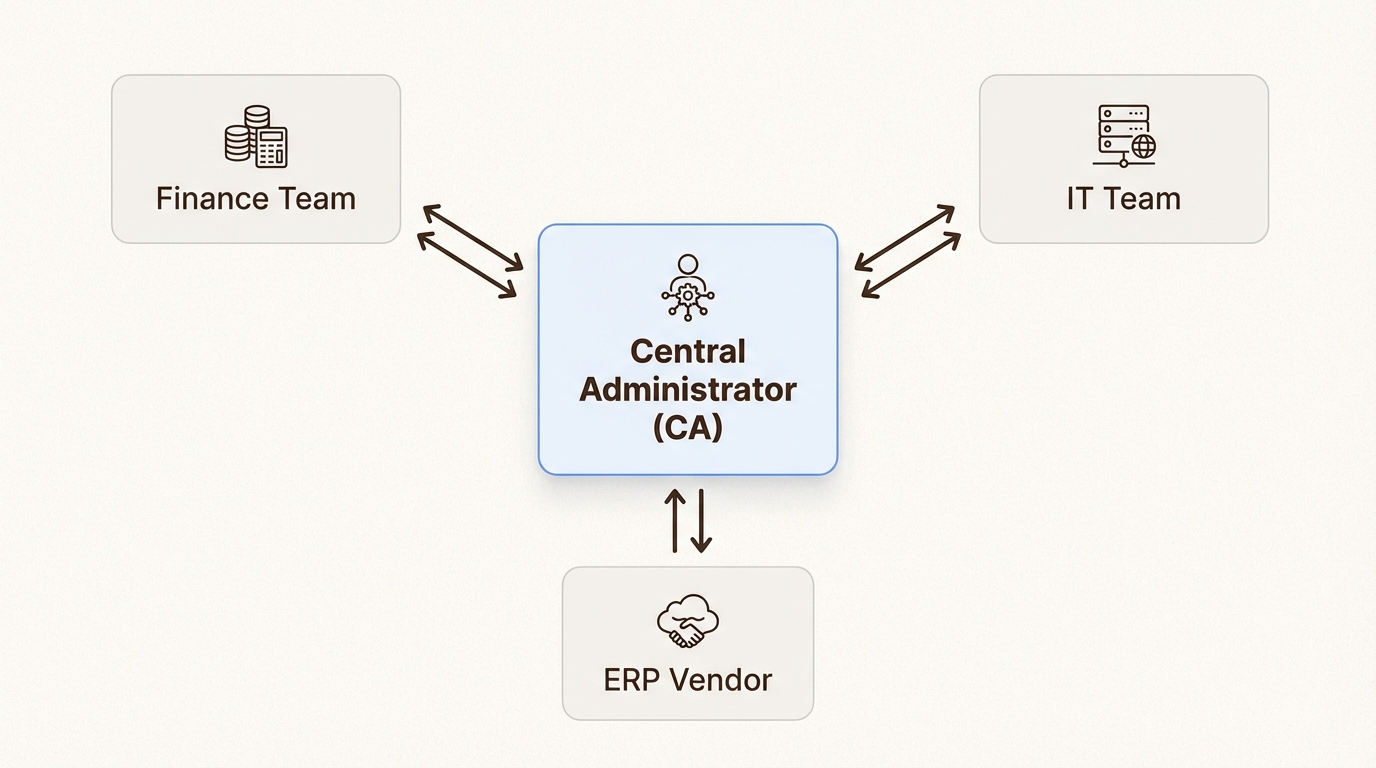
Key CA responsibilities during implementation
Throughout an ERP project, the CA handles critical functions that no other role can provide:
Data mapping and validation oversight – Ensuring that every account, transaction, and historical record from the old system aligns perfectly with the new ERP. This prevents discrepancies that cascade into incorrect financial statements.
Compliance and audit trail preservation – Confirming that the new system supports regulatory requirements, maintains proper controls, and generates reports that withstand scrutiny.
Financial reporting continuity – Verifying that income statements, balance sheets, and cash flow statements remain accurate throughout the transition.
Change management from a finance perspective – Helping colleagues understand new processes, dashboards, and reporting tools so adoption happens smoothly.
Phases that makes or breaks the project
ERP implementation isn’t a single event. It’s a journey with distinct phases, each presenting unique challenges where CA expertise proves invaluable.
Phase 1: Pre-implementation planning
The success of an ERP project is largely determined before any software is installed. During the planning phase, the CA contributes in several critical ways:
Requirements gathering – Working with stakeholders to document current processes, identify pain points, and define what the new system must accomplish. This includes mapping quote-to-cash, procure-to-pay, and record-to-report processes.
Chart of accounts design – Structuring the financial backbone of the new system. Decisions made here affect reporting capabilities for years to come.
Risk assessment – Identifying potential compliance gaps, data quality issues, and process risks before they become expensive problems.
Organizations that involve their CA from day one avoid the costly rework that plagues projects where finance is brought in late.
Phase 2: Data migration
Data migration is widely recognized as the most complex and critical phase of ERP implementation. As one expert noted, “bad data going into Odoo means bad decisions coming out.”
The CA’s role here is multifaceted:
Data cleansing and standardisation – Removing duplicates, correcting inconsistencies, and unifying formats so the ERP starts with clean, reliable data. One manufacturing firm reduced reconciliation errors by 72% after accountants standardized data before migration.
Data mapping – Determining how each field in the legacy system translates to the new ERP. This requires deep understanding of both the old and new systems’ data structures.
Phase 3: Testing and validation
Before go-live, rigorous testing is essential. The CA ensures that testing covers financial scenarios that might be overlooked by technical teams:
User acceptance testing – Simulating real-world transactions to catch errors early. This includes complex multi-step processes like taking a customer order, purchasing materials, manufacturing a product, shipping it, collecting payment, and generating financial statements.
Parallel running – Operating both old and new systems simultaneously to verify that outputs match. This is labor-intensive but catches discrepancies before they affect live operations.
Compliance validation – Confirming that all regulatory requirements are met and audit trails are intact.
Phase 4: Go-live and post-implementation
The go-live period is when theory meets reality. Even with perfect planning, issues emerge when real users start processing real transactions.
The CA provides critical support during this phase:
Month-end close support – Troubleshooting issues that arise during the first few closes, when the finance team is learning new processes while under pressure to deliver reports on time.
Continuous improvement – Evaluating process efficiency and suggesting enhancements as users gain familiarity with the system.
Strategic insight development – Once the system stabilizes, leveraging ERP data to provide business insights that weren’t possible with legacy systems.
Check if your resume is ATS-friendly with our Resume Scorer.
Common ERP migration challenges
Every ERP migration faces predictable challenges. The difference between success and failure often comes down to whether you have the right expertise to anticipate and address them.
Challenge 1: Inaccurate financial data mapping
Even small misalignments, like a miscategorized account or duplicated ledger entry, can mushroom into major reporting errors. When data flows through multiple modules, errors compound.
How the CA helps: Rigorous mapping validation and testing protocols. The CA reviews every mapping decision, tests sample transactions, and verifies that financial statements reconcile throughout the process.
Challenge 2: Compliance and audit risks
Regulatory requirements don’t pause for system migrations. Audit trails must be preserved. Controls must remain effective. Reporting must stay accurate.
How the CA helps: Built-in compliance checks from the start. The CA ensures that the new system supports GAAP or IFRS requirements, maintains SOX controls where applicable, and generates audit-ready documentation.
Challenge 3: Revenue recognition errors
Modern revenue recognition rules are complex. The system must handle multiple recognition patterns, contract modifications, and performance obligations correctly.
How the CA helps: Validation of system logic against accounting standards. The CA tests revenue scenarios to ensure the ERP applies the correct recognition rules in each situation.
Challenge 4: Delayed financial closes
One of the most common post-migration complaints is that month-end takes longer. New processes, unfamiliar interfaces, and system quirks create bottlenecks.
How the CA helps: Process optimization and team training. With proper CA involvement, organizations can actually reduce close times by up to 79% and achieve 85% improvement in reporting accuracy.
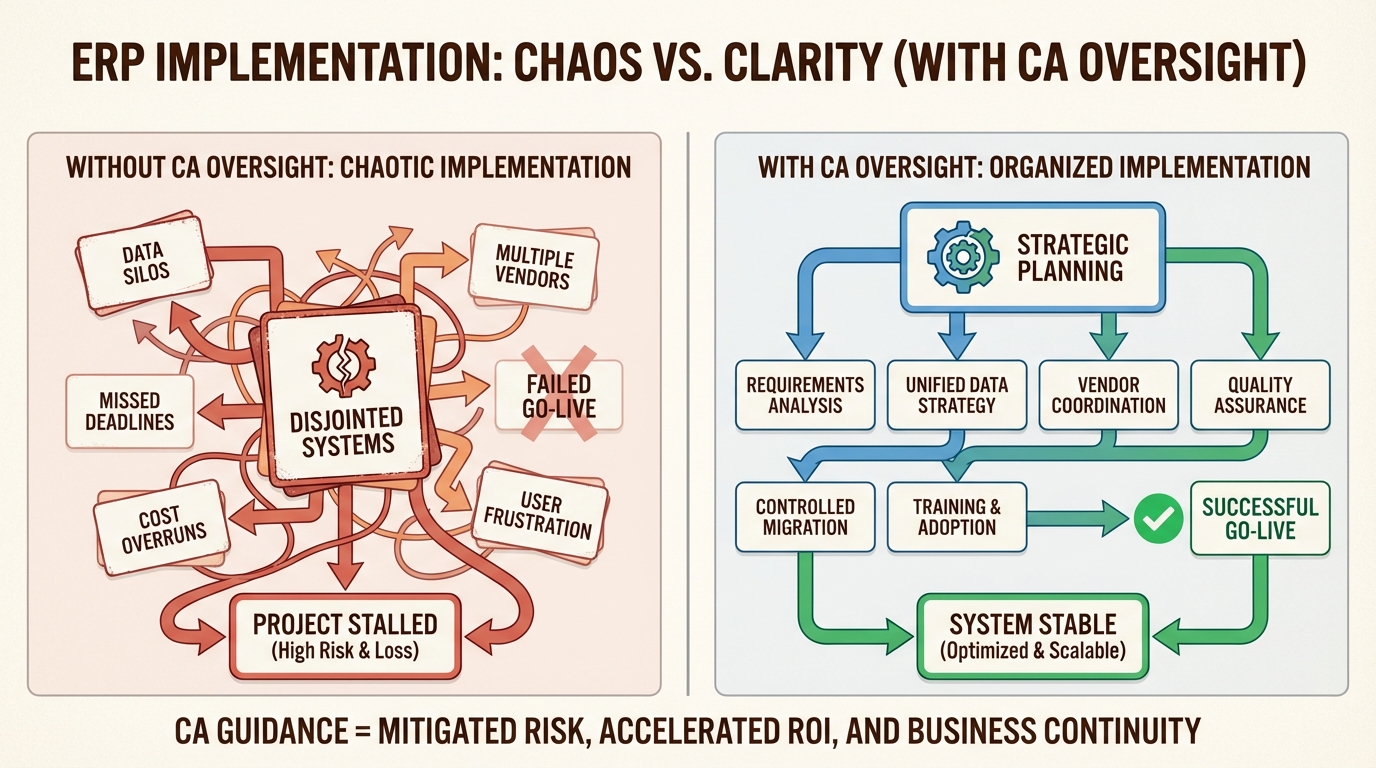
Best practices in ERP implementation
Knowing that CA involvement matters is one thing. Actually integrating them effectively is another. Here are proven practices for making the most of your CA’s expertise.
Engage early and continuously
The most common mistake is bringing in the CA only at the validation stage, when major decisions have already been made. By then, it’s often too late to catch fundamental issues without expensive rework.
Include your CA from the initial planning conversations. Maintain their involvement through requirements gathering, system selection, design, testing, and post-go-live support. Regular checkpoints ensure that financial considerations stay central to every decision.
Define clear ownership
Collaboration doesn’t mean confusion. Clarify where CA responsibilities end and IT responsibilities begin:
- CA owns: Data integrity, compliance requirements, financial process design, reporting accuracy, and control frameworks
- IT owns: System configuration, technical integration, security, infrastructure, and user access management
- Both collaborate on: Data migration, testing protocols, change management, and issue resolution
This clarity prevents gaps where critical tasks fall through the cracks, and prevents overlap where teams waste time on the same work.
Invest in training and change management
Even the best-designed ERP system fails if users don’t adopt it. The CA should lead training for finance team members, translating system capabilities into practical workflows that match how the team actually works.
Accountants who lead training improve finance team confidence, reducing post-migration errors and accelerating the realization of efficiency gains.
Document everything
ERP implementations involve thousands of decisions. Months later, when an auditor asks why something was configured a certain way, “we discussed it in a meeting” isn’t a sufficient answer.
Maintain detailed records of data mappings, validation results, process workflows, and training materials. This documentation becomes invaluable for audits, troubleshooting, and onboarding future team members.
When to bring in accounting expertise
Sometimes your internal CA team doesn’t have the bandwidth or specific expertise needed for a complex ERP migration. Recognizing this early allows you to augment your team appropriately.
Signs you need specialized ERP accounting support
- Complex multi-entity consolidations requiring sophisticated intercompany elimination and currency translation
- Industry-specific compliance requirements like government contracting regulations, healthcare billing rules, or manufacturing cost accounting standards
- Limited internal CA bandwidth where your team is already stretched handling day-to-day operations
- Tight timelines that require more hands than your internal team can provide
Options for augmenting your team
Contract CA specialists can provide expertise during peak project phases without the long-term commitment of permanent hires. They bring experience from multiple implementations and can mentor your internal team.
Offshore accounting talent offers another option, with cost savings of 30-57% compared to onshore resources while maintaining quality.
ERP-savvy accountants who understand both finance and technology are particularly valuable. They speak both languages and can navigate the technical aspects of the system while maintaining focus on financial accuracy.
Making your next ERP migration a success
ERP implementation is one of the most significant investments an organization can make. The difference between success and failure often comes down to one factor: whether you treat it as a purely technical project or as a business transformation that requires financial expertise.
Key takeaways
- ERP success requires both technical and financial expertise. IT teams configure the system, but CAs ensure it produces accurate, compliant, useful financial information.
- The CA is not optional, they’re essential. Their unique training in audit, compliance, and business process analysis fills gaps that technical teams cannot.
- Early involvement prevents expensive cleanup later. The cost of fixing data issues post-go-live far exceeds the cost of preventing them during implementation.
Action steps for your organization
If you’re planning an ERP migration, start by assessing your current readiness. Do you have CA expertise committed to the project from start to finish? Are your data quality and mapping protocols clearly defined? Have you established compliance checkpoints?
Build the right team before you start. Include CAs in vendor selection. Involve them in process design. Let them lead data migration and validation. The investment in proper accounting expertise pays dividends in reduced risk, faster closes, and accurate reporting.
Your ERP system will be the financial backbone of your organization for years to come. Make sure you have the right expertise guiding its implementation.
Create an ATS-friendly resume with our Resume Builder.
Also read: How to use AI to write variance analysis commentaries in FP&A
Frequently Asked Questions
Q1 What is the CA’s role in ERP implementation?
A1: The CA serves as the financial guardian of ERP implementation, ensuring data integrity, compliance, and accurate reporting. They bridge the gap between finance requirements and IT capabilities, oversee data migration, validate system configurations against accounting standards, and ensure the ERP supports audit requirements and regulatory compliance.
Q2 When should a CA be involved in an ERP system migration?
A2: CAs should be involved from day one of the project, starting with requirements gathering and planning. Early involvement allows CAs to influence the chart of accounts design, data mapping decisions, and process workflows before they become difficult to change. Continuous involvement through testing and go-live ensures financial accuracy throughout the transition.
Q3 How does CA involvement prevent ERP implementation failures?
A3: CA involvement prevents failures by addressing the root cause of most ERP problems: broken financial logic. CAs ensure data maps correctly between systems, validate that reports reconcile, verify compliance requirements are met, and catch errors during testing rather than after go-live. Organizations with proper CA oversight report up to 85% improvement in reporting accuracy and 79% faster month-end closes.