
After qualifying as a Chartered Accountant, you may be looking at job postings from the Big 4, such as PwC, Deloitte, EY, and KPMG. If you did your articleship at a small or mid-size firm, you might feel that the doors to these larger firms are closed.
If you’re feeling a bit of imposter syndrome when you compare your jack-of-all-trades background to the specialized experience of Big 4 trainees, you’re not alone. It’s a common fear. But your experience isn’t wrong, it’s just different.
Think of it as “breadth vs. depth”. Your articleship likely gave you a wide breadth of experience, covering areas like audit, tax, compliance, and client management. Big 4 roles, on the other hand, require depth. They need specialists focused on one specific service line. This guide will show you how to translate your broad experience into the specialized depth that can get you hired, providing a practical, step-by-step strategy to help you bridge that gap.
Big 4 vs. small firm articleship experience
Understanding the fundamental differences in training is the first step. It’s not about one being “better” than the other; they’re just two different paths that build different skills. Think of it like a chef’s training: one learns to run an entire kitchen from top to bottom, while the other masters a single, world-class station.
Imagine the Big 4 experience as working in a Michelin-starred kitchen. You become an absolute expert at one highly specialized station. Maybe you’re on sauces, or you’re the master of a specific pastry. You learn world-class, standardized methodologies, and you execute your task with precision every single time. You’re part of a huge team, and your contribution is a critical piece of a much larger, complex dish.
Now, picture the small firm experience as being a top cook in a busy, beloved local diner. You’re not just on one station; you’re a pro who does a bit of everything. You’re prepping, working the grill, plating dishes, and maybe even chatting with the regulars. You see the entire process, from raw ingredients to a happy customer, for a wide variety of meals. You gain incredible versatility, practical problem-solving skills, and a real end-to-end understanding of how the kitchen runs.
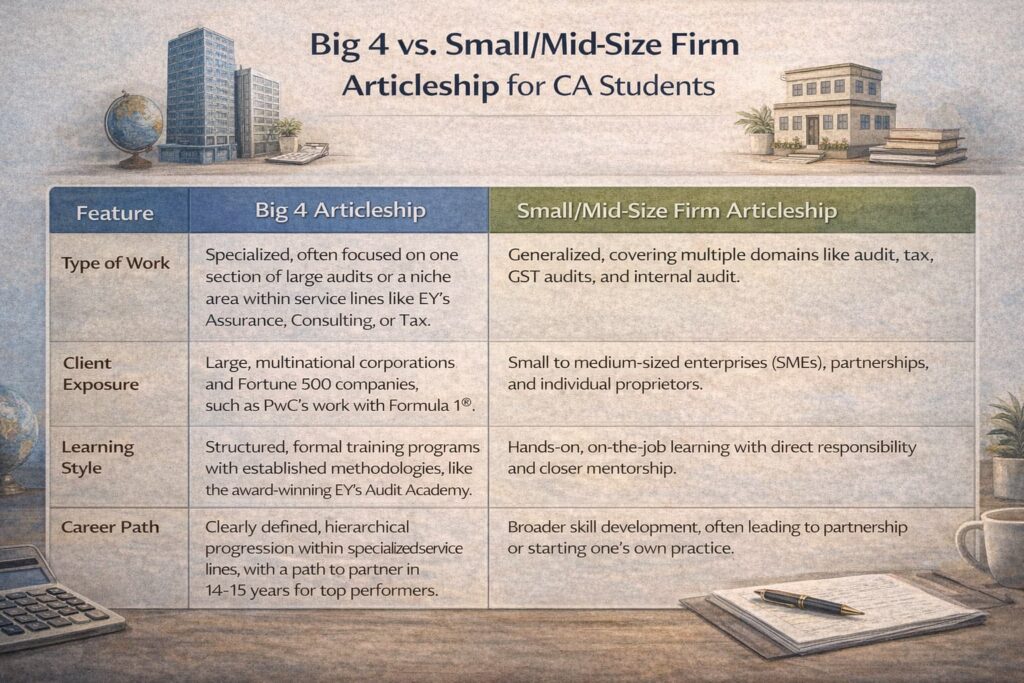
Here’s a more direct breakdown:
| Feature | Big 4 Articleship | Small/Mid-Size Firm Articleship |
|---|---|---|
| Type of Work | Specialized, often focused on one section of large audits or a niche area within service lines like EY’s Assurance, Consulting, or Tax. | Generalized, covering multiple domains like audit, tax, GST audits, and internal audit. |
| Client Exposure | Large, multinational corporations and Fortune 500 companies, such as PwC’s work with Formula 1®. | Small to medium-sized enterprises (SMEs), partnerships, and individual proprietors. |
| Learning Style | Structured, formal training programs with established methodologies, like the award-winning EY’s Audit Academy. | Hands-on, on-the-job learning with direct responsibility and closer mentorship. |
| Career Path | Clearly defined, hierarchical progression within specialized service lines, with a path to partner in 14-15 years for top performers. | Broader skill development, often leading to partnership or starting one’s own practice. |
| Key Skill Gained | Depth, process adherence, and navigating large corporate structures. | Breadth, adaptability, and end-to-end project management. |
Why specialized depth matters to the Big 4
The Big 4’s focus on specialists isn’t just a preference; it’s built into their business model. Their structure, clients, and reputation all depend on having teams of deep experts.
First, let’s talk about structure. These firms are massive, global organizations. To manage this scale, companies like EY are organized into distinct service lines: Assurance, Consulting, Strategy and Transactions, and Tax. Similarly, PwC has clear business areas like Audit, Tax, and Deals. When they post a job, they aren’t looking for a general accountant. They’re hiring to fill a specific role in one of these teams, like an ‘External Audit Senior Associate’ or a ‘Manager in Financial Risk’. A generalist, no matter how talented, takes more time to train for this specialized model. They need someone who can hit the ground running in their designated lane.
Then there are the clients. The Big 4 work with some of the largest, most complex companies in the world. These clients aren’t dealing with simple problems. They’re navigating intricate global tax laws, massive M&A deals, and industry-specific regulations. For instance, when EY helped with the CenterPoint Energy’s tax transformation, it wasn’t a job for a tax generalist. It required a team with deep, specialized knowledge of energy sector taxation and corporate restructuring. To serve these clients well, firms need experts. That’s why KPMG’s industry structure includes teams dedicated to specific sectors like Banking, Healthcare, or Technology. They need you to understand the niche challenges of their clients’ worlds.
Create an ATS-friendly resume with our Resume Builder.
Broad experience into a specialist’s resume
This is the core strategy. Your goal is not to invent experience you don’t have, but to reframe the experience you do have to meet their specific needs. You will package your “breadth” to highlight the “depth” they seek. This can be broken down into three steps.
Step 1: Conduct a forensic audit of your articleship
Before you can sell your skills, you need to know exactly what you’re selling. It’s time to go through your past work with a fine-tooth comb. Don’t just list the tasks you did; dig deeper to find the patterns, complexities, and quantifiable impacts.
Grab a notebook or open a spreadsheet and ask yourself these questions about your articleship:
- Which industry did you serve most often? Were most of your clients in manufacturing, services, tech, or banking? A pattern here is your first clue to a potential specialization.
- What type of assignment took up the most time? Was it statutory audits, internal audits, direct tax filings, or GST compliance? Where did you log the most hours?
- Did you handle any particularly complex assignments? Consider a company with multiple branches, a messy inventory system, or a complicated tax assessment. This type of complexity is a valuable addition to your resume.
By the end of this exercise, you’ll have a detailed map of your experience, not just a vague list of duties.
Step 2: Choose your specialization
Now, look at the map you just created. Based on your self-audit, you need to identify the one area where you have the most compelling story and the most impressive results. This is your specialization. From this point forward, you are a specialist in this area.
For example, perhaps your review revealed you spent three years handling a mix of tasks, but you managed the complete statutory audits for three different manufacturing clients. This becomes your specialization: Statutory Audit in the Manufacturing Sector. You are no longer a generalist; you are an audit professional with a focus on manufacturing. This single shift in perspective aligns perfectly with how the Big 4 thinks. They have industry-specific solutions and teams, and you’ve just positioned yourself as a perfect fit for one of them.
Step 3: Reframe your resume
This is the most critical step. You need to translate your experience into the language of the Big 4. Go to their careers page, find job descriptions for the roles you want, and study the keywords they use. Terms like “risk assessment,” “regulatory compliance,” “internal controls,” and “stakeholder management” need to be in your vocabulary.
Now, rewrite your resume bullets to reflect your new specialist identity. Don’t just say what you did; say what you achieved and frame it within your chosen major.
Here is a “Before and After” example to show the power of reframing:
Before (Generalist):
- “Handled statutory audits, tax filings, and ROC compliance for various clients.”
After (Specialist in Statutory Audit):
- “Led end-to-end statutory audits for clients in the manufacturing sector with turnovers up to ₹50 Cr, focusing on complex areas of inventory valuation and revenue recognition under Ind AS.”
- “Identified a 15% discrepancy in physical stock records for a key client, leading to revised financial statements and the implementation of improved internal controls for inventory management.”
See the difference? The “After” version is specific, uses Big 4 language (“internal controls”), quantifies the impact (“15% discrepancy”), and firmly plants you as a specialist. It shows you didn’t just perform a task; you understood the challenges of a specific domain and delivered real value. That’s exactly what Big 4 recruiters are looking for.
Acing the Big 4 interview
Your reframed, specialist resume can help you get an interview. The interview is your chance to prove that your small-firm experience is a genuine advantage.
Showcase your technical skills and confidence
You must be knowledgeable in your chosen area. If you’ve positioned yourself as a tax specialist, be prepared for a deep dive into the latest amendments and case laws. Being rock-solid on the technical fundamentals of your chosen niche is non-negotiable.
But just as important is your confidence. Don’t be apologetic about your background. Frame your small-firm experience as a strength. Talk about how you had to manage entire assignments solo, which built your project management skills. Mention how you handled direct client negotiations, which honed your communication and stakeholder management abilities. You developed practical, real-world problem-solving skills because there wasn’t a massive support team to fall back on. As KPMG’s interview guidance suggests, it’s crucial to “share your story” and what makes you tick. Your story is one of resilience and adaptability. Own it.
Understand the hiring process
Big 4 recruitment can feel like a marathon. It’s often a multi-stage process designed to test you from every angle. For example, KPMG’s process can include online aptitude tests, an initial HR screening, a full-blown Assessment Day with group case studies, and a final technical interview with a manager or partner.
Prepare for behavioral questions by having concrete examples ready. The best way to structure your answers is by using the STAR method:
- Situation: Briefly describe the context.
- Task: Explain what your goal or responsibility was.
- Action: Detail the specific steps you took.
- Result: Quantify the outcome of your actions.
Having a few STAR stories ready for your biggest accomplishments will help you provide clear, structured answers.
Prepare for the “why” questions
Interviewers will likely probe your experience and your motivation for switching. They want to know if you’ll fit into their culture. Be ready for questions like:
- “Tell me about the most complex audit you worked on. What made it so challenging?”
- “You have a very broad background. Why are you now focused specifically on transfer pricing?”
- “How do you think you would adapt from a role where you managed everything end-to-end to our structured, team-based methodology?”
For that last question, your answer should focus on the positives: you’re excited to learn from deep experts, contribute to a high-performing team, and apply your problem-solving skills to larger, more complex challenges. And remember, an interview is a two-way street. Make sure to ask them questions too. Asking about the team structure, training opportunities, or the types of clients you’d work with shows genuine interest and helps you decide if it’s really the right place for you.
Your articleship is a foundation, not a ceiling
A small firm articleship is not a barrier. It is a different, but equally valuable, training ground. It builds resilience, adaptability, and a holistic understanding of business that many career-long specialists may not experience. Your articleship is your foundation, not a ceiling that limits how high you can go.
The entire strategy requires a shift from thinking like a generalist to acting like a specialist. The key is to audit your experience to find your niche, choose a specialization you can confidently own, and then reframe your entire professional narrative to highlight depth, impact, and expertise. You need to start speaking the language of the firm you’re applying to.
Your diverse background gives you a unique and powerful perspective. Own it, frame it correctly, and walk into that interview with the confidence of a professional who knows exactly what they bring to the table.
Ready to find your competitive edge? Use the Articleship Scorer to analyze your background and pinpoint the specialization that will get you noticed by the Big 4. It’s the first step to bridging the gap and landing your dream job.
Also read: Cracking the 2026 Finance Excel Interview Test: 5 Formulas You Must Know
Frequently Asked Questions
Q.1 Is it really possible to get a job at a Big 4 firm after an articleship at a small firm without any connections?
A1: Absolutely. While connections can help, Big 4 firms are primarily looking for specialists who can fill specific roles. If you can successfully reframe your broad experience to highlight deep expertise in one area, your resume will stand out on its own merit.
Q.2 What is the biggest mistake candidates from small firms make when applying to the Big 4?
A2: The most common mistake is submitting a generalist resume. Listing every single task you did (audit, tax, compliance) signals that you’re a jack-of-all-trades, while they’re hiring for a master of one. You have to pick a lane and present yourself as a specialist.
Q.3 How much does my CA final score matter when applying to the Big 4?
A3: Your score is a factor, but it’s not the only one. Strong practical experience, framed correctly, can often outweigh an average academic record. Focus on demonstrating how your hands-on work in your chosen niche has prepared you for their specific challenges.
Q.4 Should I mention my small firm experience as a weakness in interviews?
A4: Never. Frame it as a unique strength. Talk about the adaptability, end-to-end project management, and direct client-facing skills you developed. These are valuable assets that many candidates from larger, more structured programs may not have.