
So, you’ve qualified as a Chartered Accountant. First off, congrats. Now comes the big question every new CA asks: “What’s next after audit?” If you’re tired of looking at last year’s numbers and want a role that’s more forward-looking and strategic, it’s time we talked about corporate treasury.
Instead of working for a bank, in treasury, you manage your company’s relationship with them. You are responsible for deciding where to invest millions in surplus cash and figuring out the smartest way to fund big projects. It offers the strategic elements of investing without sales targets often associated with roles in investment banking.
For CAs who have a real interest in financial markets, forex, and the bigger economic picture, treasury offers a stable corporate career with a huge strategic impact. The role has evolved from just guarding cash to what PwC calls a “strategic value architect,” directly shaping the financial health and future of the company.
Understanding corporate treasury
In a nutshell, the corporate treasury team manages a company’s money. While accounting is busy looking backward to make sure the books are accurate, treasury is looking forward to make sure the company has the cash it needs to operate, grow, and handle any financial storms.
Think of it this way: Accounting is the historian, carefully recording what happened. Treasury is the strategist, planning for what’s next.
This forward-looking role has become more important than ever. With unpredictable interest rates, geopolitical shifts, and volatile markets, a strong treasury function is what separates companies that thrive from those that just get by. It’s no surprise that in a recent PwC survey, both CFOs and treasurers ranked cash and liquidity management as their top priority.
The day-to-day is a mix of operational hustle, like managing daily cash balances, and high-level strategy, like hedging against currency swings or planning how to fund a new factory. It’s a dynamic field where you get to see the direct results of your decisions on the company’s bottom line.
Core responsibilities of a treasury professional
So what does a treasury professional actually do all day? The job is much more than just counting cash. The responsibilities are broad and strategic, covering the five key knowledge domains tested in the Certified Treasury Professional (CTP) exam, which is pretty much the global gold standard for the profession.
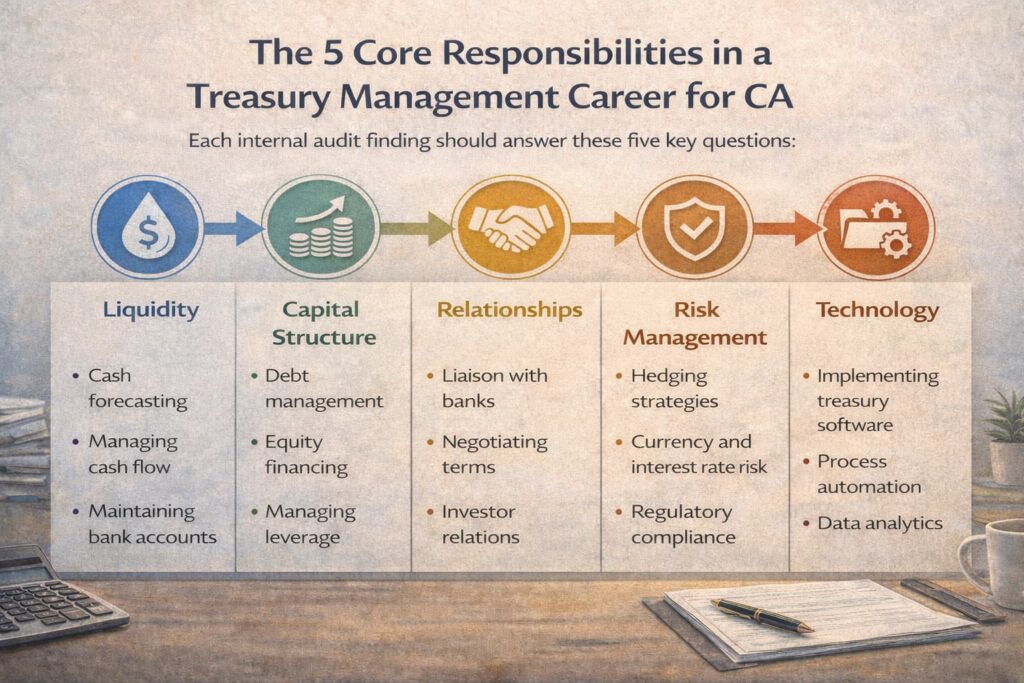
Corporate liquidity and cash management
The main goal here is simple: make sure the company has enough cash, in the right currency, in the right bank account, at exactly the right time. It sounds easy, but it’s a constant juggling act.
This involves tasks like daily cash positioning (figuring out your exact cash balance across all accounts worldwide), making decisions on short-term investing or borrowing, managing all the company’s bank accounts, and developing very detailed cash flow forecasts. The accuracy of these forecasts is what allows senior leadership to make smart, informed decisions about the business.
Capital structure and long-term investments
This is where treasury gets into the big-picture stuff. It’s all about managing the company’s long-term financial health by deciding the right mix of debt and equity and managing its investment portfolio.
Responsibilities here include managing the process of issuing corporate bonds or new shares of stock, negotiating complex loan agreements with banks, and playing a key role in the financial analysis of potential mergers, acquisitions, or divestitures. You’re directly influencing how the company finances its future growth.
Internal and external relationship management
A treasurer doesn’t work in a bubble. A huge part of the job is being the company’s primary financial contact to the outside world.
This means building and maintaining strong relationships with a whole network of external partners, including commercial and investment banks, credit rating agencies, and investment advisors. Internally, the treasury team works closely with accounting, legal, tax, and various business units to make sure the company’s financial strategy is perfectly aligned with its operational goals.
Financial and operational risk management
In today’s world, risk is everywhere. A big part of treasury’s job is to act as the company’s shield, protecting it from financial market volatility and other threats.
According to PwC, a whopping 83% of treasurers see managing foreign exchange (FX) risk as a top priority. This involves using financial instruments to hedge against swings in currency, interest rates, and commodity prices. On the operational side, it also includes putting systems in place to detect and prevent payment fraud and ensuring the company is compliant with a web of financial regulations.
Treasury technology and systems
Modern treasury runs on technology. The industry standard has shifted away from managing large sums on spreadsheets.
This domain is all about using technology to make the treasury function more efficient, secure, and insightful. It involves managing sophisticated Treasury Management Systems (TMS) and integrating them with the company’s Enterprise Resource Planning (ERP) systems. The goal is to automate routine processes, tighten security controls, and get real-time data to make faster, better decisions.
Check if your resume is ATS-friendly with our Resume Scorer.
A typical treasury management career path
The great news is that the career progression in treasury is pretty logical, and it builds perfectly on the skills you already have as a CA. While jumping straight from Internal Audit might be a bit of a stretch, a background in general accounting gives you a ton of transferable skills that make for a smooth transition.
Entry-level: Treasury accountant or treasury analyst
This is your foot in the door. The role is focused on the operational nuts and bolts of treasury, like performing daily cash reconciliations, processing payments, and pulling together cash position reports. It’s the perfect starting point for a CA because it heavily uses your analytical mindset, attention to detail, and strong Excel skills. You’ll learn the fundamentals of how money moves through a large organization.
Average Salary: In the United States, the average salary for a Treasury Accountant is around $70,655 per year. Based on current market data for March 2026, here is what you can expect in India: Entry-Level (1–3 years): ₹7 Lakhs – ₹15 Lakhs and Mid-Level (4–7 years): ₹16 Lakhs – ₹25 Lakhs.
Mid-career: Treasury manager
After a few years as an analyst, you’ll be ready to step up to a Treasury Manager role. This is where you start taking on more strategic responsibility. You’re not just reporting the numbers anymore; you’re actively managing banking relationships, designing and executing hedging strategies, and taking ownership of the company’s overall liquidity.
Average Salary: This is where the pay really starts to jump. Treasury Management roles pay, on average, $105,672 per year. Here in India, Senior/Manager (8+ years): ₹26 Lakhs – ₹45 Lakhs+ is what you can expect. That’s nearly a 50% increase from the accountant level, reflecting the added strategic value you bring.
Senior leadership: Treasurer and the path to CFO
At the top of the ladder is the Treasurer. This is a senior leadership role, setting treasury policy for the entire organization, leading huge funding initiatives like multi-billion dollar bond issuances, and acting as a key advisor to the CFO and the board of directors on all things related to capital structure and financial risk.
Path to CFO: Because the Treasurer has such deep exposure to capital markets, risk, and liquidity, which are the core financial engines of any business, it’s one of the most common and respected stepping stones to CFO.
CA qualification prepares for treasury
Your CA training has already given you a powerful foundation for a successful career in treasury. The key is learning to apply those skills in a more forward-looking, strategic context. According to the Association of Corporate Treasurers, the skills you need fall into a few key buckets where CAs already have a head start.
Leveraging your technical and business skills
The detailed knowledge from the CA qualification is a huge plus. Your deep understanding of financial analysis, internal controls, accounting principles, and financial reporting is directly applicable to core treasury tasks like cash flow forecasting, risk analysis, and managing financial covenants in loan agreements.
Furthermore, your experience interacting with different departments during audits translates perfectly to the stakeholder management side of treasury. You already know how to speak the language of finance and build relationships with banks, auditors, and credit agencies.
Enhancing your qualifications for a competitive edge
While your CA is a fantastic starting point, adding a specialized treasury qualification can make you a top-tier candidate.
- Certified Treasury Professional (CTP): This is the one to get. The CTP is the leading global credential in corporate treasury, and it signals to employers that you have a validated, solid grasp of liquidity, capital, and risk management.
- Broader Finance Qualifications: For those who want to deepen their strategic finance knowledge even further, pursuing the ACCA qualification is a great path. Specifically, the Advanced Financial Management (AFM) paper is incredibly relevant. It covers topics that are central to a senior treasury role, including advanced investment appraisal techniques, corporate reorganizations, and sophisticated treasury and risk management strategies.
Future outlook: Key trends and salary potential
The treasury function isn’t static; it’s evolving fast, thanks to new technology and an increasingly complex global economy. If you’re considering this career path, it’s important to know what’s coming.
Key trends shaping treasury
- AI and Automation: Treasury teams are finally moving beyond spreadsheets. A recent PwC report found that 74% of treasurers are either using or expanding their use of AI for things like predictive cash forecasting, automated fraud detection, and identifying anomalies in financial data.
- Data-Driven Decisions with APIs: Waiting for end-of-day bank statements is a thing of the past. Real-time data is now the standard. To get there, 65% of organizations are planning to expand their use of APIs to directly connect their TMS, ERPs, and banking platforms. This gives them an instant, up-to-the-second view of their cash positions worldwide.
- ESG and Sustainable Finance: Treasury is playing a growing role in corporate Environmental, Social, and Governance (ESG) strategies. This can involve anything from issuing green bonds to finance sustainable projects to ensuring the company’s investment portfolio aligns with its corporate sustainability goals.
Salary outlook and earning potential
The strategic importance of treasury is reflected in the compensation. As we saw, the jump from a Treasury Accountant to a Treasury Manager can mean a nearly 50% pay increase.
The demand for specialized skills is pushing salaries even higher. According to Robert Half’s 2026 salary guide, a staggering 87% of finance leaders are offering higher starting salaries to attract candidates who have expertise in high-demand areas like data analytics, financial modeling, and proficiency with major ERP software. These are all skills that are central to the modern treasury function.
Is treasury management career path for you?
If you’re a CA who enjoys the strategic side of finance, gets excited by technology, and has a keen interest in how global markets work, then a career in corporate treasury could be a really rewarding and high-impact choice.
It’s more than just a job; it’s a big shift in perspective. You move from being a scorekeeper of what the company has done to becoming a key player in shaping its financial future, directly influencing its resilience, growth, and long-term success.
Create an ATS-friendly resume with our Resume Builder.
Also read: Ind AS 116 Interview Questions: Big 4 Audit Prep Guide
Frequently Asked Questions
Q1: What is the first step in a Treasury management career path for CA?
A1: The typical first step is an entry-level role like a Treasury Accountant or Treasury Analyst. This position lets you learn the operational side of treasury, such as daily cash reconciliations and payment processing, building on the analytical skills you gained as a CA.
Q2: How does a CA qualification help in the Treasury management career path for CA?
A2: Your CA training provides a strong foundation in financial analysis, internal controls, and accounting principles. These skills are directly applicable to core treasury functions like cash flow forecasting, risk analysis, and managing banking relationships.
Q3: What is the salary potential in the Treasury management career path for a CA?
A3: The salary progression is quite strong. Here is what you can expect in India: Entry-Level (1–3 years): ₹7 Lakhs – ₹15 Lakhs, Mid-Level (4–7 years): ₹16 Lakhs – ₹25 Lakhs and Senior/Manager (8+ years): ₹26 Lakhs – ₹45 Lakhs+. Senior roles like Treasurer offer even higher earning potential, often leading to a CFO position.
Q4: Are there any additional certifications needed for a Treasury management career path for CA?
A4: While your CA is a great start, getting the Certified Treasury Professional (CTP) credential is highly recommended. It’s the global standard for the profession and shows employers you have specialized knowledge in liquidity, capital, and risk management.
Q5: What makes the Treasury management career path for CA a strategic role?
A5: Unlike traditional accounting which looks backward, treasury is forward-looking. You’ll be involved in major decisions like how to fund company growth, manage financial risks from currency fluctuations, and decide where to invest millions in surplus cash, directly impacting the company’s future.