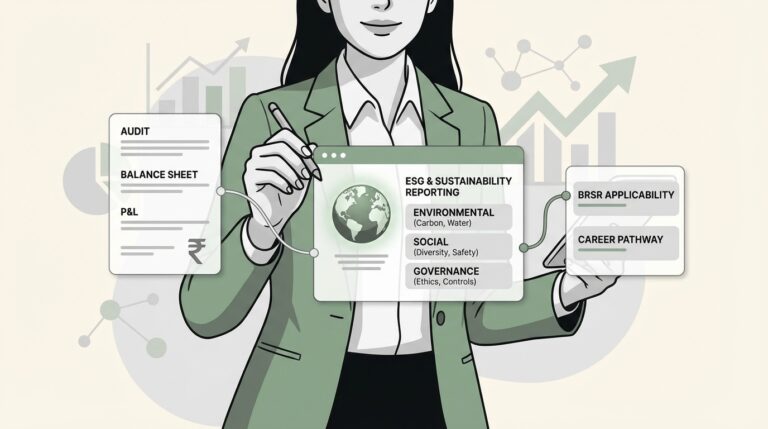
The world of auditing is changing. For years, a Chartered Accountant’s life was about the balance sheet, P&L statements, and the steady rhythm of financial reporting. This landscape is shifting. Today, investors, regulators, and customers want the full story, not just the financial highlights. They are asking tough questions about a company’s real-world impact on the planet, its people, and its principles.
This is where Environmental, Social, and Governance (ESG) reporting comes in, and it’s quickly becoming a significant area for assurance professionals. With Indian regulations like the BRSR framework is now mandatory and new global standards like IFRS S1 and S2 setting a clear baseline, this is not a passing trend. It’s a core competency for the future.
For CAs looking for a high-growth field with purpose beyond traditional tax and audit work, ESG presents a significant opportunity. This guide will walk you through why ESG is a huge career opportunity, what skills you need, and a practical roadmap to help you make the switch.
What is ESG and why is it important?
ESG can seem like a vague concept, but for accountants, it’s about applying the same rigor used for financials to non-financial data. Let’s get into what that actually means.
Demystifying ESG for accountants
Think of ESG as a second set of books you need to learn to audit. Instead of just tracking rupees, you’re now tracking carbon, water, and diversity. Here’s what that looks like, especially with the new standards in play:

- Environmental: This is about putting a number on a company’s impact on the planet. This involves measuring and reporting greenhouse gas (GHG) emissions (Scope 1, 2, and 3) using solid frameworks like the GHG Protocol Corporate Standard. It’s about quantifying climate risk and its potential financial fallout.
- Social: This covers how a company treats its people and the wider community. It involves measuring things like labor practices, employee health and safety, gender diversity ratios, and even the median wages of employees. The BRSR framework in India, for instance, requires specific disclosures on these social indicators.
- Governance: This is probably the most familiar area for a CA. It’s all about how a company is managed. It covers business ethics, executive pay, shareholder rights, and the internal controls used to manage both financial and non-financial information. Your knack for spotting weaknesses in financial controls is directly transferable here.
The mandatory shift: BRSR and new global standards
For a long time, ESG reporting was optional. Companies would publish a glossy sustainability report and call it a day. Not anymore. The move from voluntary to mandatory reporting is what makes this such a big deal for the accounting profession.
In India, the major change was SEBI’s introduction of the BRSR framework, which became mandatory for the top 1000 listed companies by market cap from the 2022-23 financial year. This isn’t a simple checklist; it’s a detailed report that demands specific disclosures across all ESG areas.
Globally, the IFRS Foundation (the same organization behind familiar accounting standards) has created a global baseline for sustainability reporting. They’ve issued IFRS S1 and IFRS S2, which are effective for reporting periods starting on or after January 1, 2024. These standards are built on existing frameworks like the Task Force on Climate-related Financial Disclosures (TCFD) and the Sustainability Accounting Standards Board (SASB), bringing a much-needed level of standardization to ESG data.
And it’s not just India and the IFRS. Europe is rolling out its Corporate Sustainability Reporting Directive (CSRD), and even in the US, states like California are passing climate disclosure laws (SB 253/261). The message is clear: this is a global shift, and every single one of these reports needs assurance. That’s where you come in.
The great skills shift for Chartered Accountants
The thought of auditing a carbon footprint might sound daunting, but the good news is you likely already have a significant portion of the skills you need. The real task isn’t learning a whole new profession; it’s about applying your existing expertise to a different kind of data.
Applying audit materiality to ESG
Let’s talk about a concept every CA knows inside and out: materiality. In a financial audit, you ask, “Would a ₹1 Crore error in revenue be big enough to mislead an investor?” It’s a judgment call.
Now, apply that same thinking to ESG. The question becomes, “Would an undisclosed risk of supply chain disruption from climate change affect the company’s long-term value?” or “Would a false report of a 20% cut in GHG emissions, when they actually went up, damage the company’s reputation and mislead investors?”
You’re still using the same core principle of figuring out what matters to stakeholders. You’re just broadening your definition of “stakeholder” beyond shareholders and “value” beyond next quarter’s profits. It’s a change in perspective, but the underlying skill is one you’ve been sharpening for years.
Transferable skills you already have
You’re not starting from zero. Here’s a quick look at the skills you use daily that are directly transferable to ESG assurance:
- Risk Assessment: You’re a pro at identifying financial risks. Assessing climate-related financial risks, like the impact of rising sea levels on coastal properties or carbon taxes on profits, is just flexing that same muscle.
- Internal Controls: You know how to design, test, and evaluate internal controls for financial reporting. The logic is the same for non-financial data. How does the company collect its waste data? What controls ensure employee safety numbers are accurate? You know exactly how to tackle these questions.
- Data Verification & Assurance: That professional skepticism you bring to every audit? It’s invaluable in the ESG world. The ability to dig into data, ask hard questions, and verify information is exactly what’s needed to make sustainability reports credible.
- Interpreting Standards: You’ve spent your career mastering complex standards like IFRS and Ind AS. Learning new ones like the GHG Protocol or SASB Standards is a familiar process. It’s just a new rulebook for your analytical skills.
To make it even clearer, here’s a side-by-side comparison:
| Traditional Financial Audit | ESG Assurance Equivalent |
|---|---|
| Auditing Financial Statements | Providing Assurance on ESG/Sustainability Reports |
| Assessing Financial Materiality | Assessing ESG/Climate Materiality |
| Verifying Revenue & Expenses | Verifying Scope 1, 2, & 3 Emissions Data |
| Testing Internal Financial Controls | Testing Controls Over Non-Financial Data Collection |
| Compliance with IFRS/GAAP | Compliance with GHG Protocol, SASB, IFRS S1/S2 |
A roadmap to an ESG career
You have the foundational skills. So, how can you make the jump? This section outlines a practical, step-by-step plan to guide your transition.
Upskilling and certification pathways
While your CA qualification is a great start, you’ll need to build some specific subject-matter knowledge. Luckily, there are plenty of resources out there to help you get up to speed.
- Certifications: If you want a structured learning path, think about a formal certification. The AICPA’s Fundamentals of ESG Certificate is a solid 9-hour course that gives you a great overview. For something more in-depth, the Fundamentals of Sustainability Accounting (FSA) Credential from the IFRS Foundation is highly respected and connects sustainability to financial performance.
- Free Resources: You don’t have to spend a lot to get started. The IFRS Foundation offers free e-learning courses to help you understand the new IFRS S1 and S2 standards. This is a must for anyone serious about this field.
- Self-Study: Don’t underestimate the power of learning on your own. Start reading the sustainability reports of companies you admire. Follow key organizations like the IFRS Foundation on LinkedIn. Listen to podcasts on sustainability and accounting. Just dive into the conversation.
Gaining practical experience
This is often the biggest sticking point. How do you get experience when you don’t have a job in the field? The trick is to start right where you are.
You don’t have to wait for the perfect ESG job to land in your lap. Take a cue from Jackie Umstead, a director at PwC. As she mentioned in the Journal of Accountancy, she moved into the space simply by raising her hand to help a client who needed attestation on their diversity, equity, and inclusion (DEI) data. She saw a need and stepped up.
You can do the same. Does your own firm have an ESG report? Volunteer for the internal team that creates it. Do you have a client struggling with BRSR reporting? Offer to help them set up their data collection. These small, internal projects are gold for building the hands-on experience you’ll need for your resume.
Networking and building your brand
Once you start learning, you need to let the market know you’re serious about ESG.
First, give your LinkedIn profile a makeover. Add your new certifications and skills. Change your headline to show your interest in sustainability assurance or ESG reporting. Write a short summary about why you’re passionate about this area and what you bring to the table.
Second, start engaging with the community. Don’t just lurk. Share articles about new regulations, comment on posts from sustainability leaders, and join relevant groups. Showing that you’re keeping up with industry trends proves your interest and helps you build a network before you even start applying for jobs.
Here’s a simple flowchart of the process:
Positioning yourself for the ESG job market
You’ve done the learning, gotten some experience, and built your brand. Now it’s time for the final step: landing that ESG role.
What top firms look for
Beyond the technical side, what are hiring managers at the Big Four and other top firms really looking for in ESG professionals? It comes down to a few key things:
- Curiosity: This field is changing so quickly that today’s knowledge might be outdated next year. Firms want people who genuinely want to keep learning and stay on top of new developments.
- Comfort with Ambiguity: Unlike financial accounting, ESG standards are still taking shape. You need to be okay working in a space where not all the rules are set in stone and be able to use professional judgment in new situations.
- Storytelling with Data: This one is huge. It’s not enough to just check the numbers. You need to be able to turn that data into a clear story that helps non-financial stakeholders understand why it matters. You’re part auditor, part translator.
- Passion: Recruiters can easily spot someone who’s just chasing a trend. They want people who are truly passionate about sustainability and believe in the purpose behind the work.
Crafting a resume that gets noticed
In 2026, most large firms use Applicant Tracking Systems (ATS) to screen resumes before a person even sees them. This means your resume has to be optimized with the right keywords to get through that first filter.
It’s important to include the terms that recruiters and their software are looking for. Sprinkle words and phrases like “ESG,” “BRSR Reporting,” “Sustainability Assurance,” “GHG Protocol,” “SASB,” “IFRS S1,” and “IFRS S2” throughout your resume, especially in your skills and experience sections.
But how do you know if you’ve hit the mark? Once you’ve added these keywords, you want to be sure your resume is actually optimized for the roles you’re targeting. This is where a tool like the Resume Scorer can be helpful. You can run your resume through it to see how well it matches up against real ESG job descriptions from top firms. It gives you quick feedback on your keywords and formatting, taking the guesswork out of getting past those initial screenings.
A new era for Chartered Accountants
The move to mandatory ESG reporting isn’t just another regulatory update; it’s one of the biggest professional opportunities for Chartered Accountants in a generation. This is not a niche field or a temporary fad. It’s the new statutory audit, and it’s here to stay.
The best part is that CAs are perfectly positioned to lead in this space.
Your core skills in assurance, internal controls, and standards-based reporting are the exact foundation needed to bring credibility to the world of sustainability. The “skills gap” everyone talks about is actually a huge opportunity for anyone willing to learn and adapt.
The demand for ESG assurance professionals is growing fast, the path to get there is clear, and the work itself is meaningful. It’s a chance to use your skills not just to audit the past, but to help shape a more sustainable future. The time to get started is now.
To position yourself as a leader in this new field, ensure your resume reflects your new expertise. You can check your score with our Resume Scorer and see how you stack up for the top ESG roles in 2026.
Also read: Internal Audit vs ERM: Risk Management for CAs
Frequently Asked Questions
Q.1 What is the first step to starting an ESG career for Chartered Accountants?
A: Start with the fundamentals. Get familiar with core frameworks like BRSR, IFRS S1, and S2. The IFRS Foundation offers free e-learning courses that are a great, no-cost way to begin building your knowledge base.
Q.2 Do I need a special certification for an ESG career for Chartered Accountants?
A: While not always required, certifications like the AICPA’s Fundamentals of ESG Certificate or the IFRS Foundation’s FSA Credential can definitely give you an edge. They show a serious commitment to the field and provide structured learning.
Q.3 How can I get practical experience for an ESG career for Chartered Accountants if my current role isn’t focused on it?
A: Look for opportunities within your current company. Volunteer for internal ESG reporting projects or offer to help clients who are just starting their BRSR journey. These internal projects are a fantastic way to build hands-on skills.
Q.4 Are the skills from traditional auditing really transferable to an ESG career for Chartered Accountants?
A: Absolutely. Your expertise in risk assessment, internal controls, data verification, and interpreting complex standards is the bedrock of ESG assurance. You’re not learning a new profession, just applying your existing skills to new types of data like carbon emissions and social metrics.
Q.5 What is the long-term outlook for an ESG career for Chartered Accountants?
A: The outlook is incredibly strong. With ESG reporting becoming mandatory worldwide (like BRSR in India and CSRD in Europe), the demand for qualified assurance professionals is skyrocketing. This isn’t a trend; it’s a fundamental shift in corporate reporting.
Q.6 How important is networking when pursuing an ESG career for Chartered Accountants?
A: It’s very important. Updating your LinkedIn profile to reflect your new skills and interests is a great start. Engaging in online discussions and following key organizations shows you’re invested in the field and helps you connect with leaders and recruiters.