
How many Sunday evenings has the thought of a mountain of bank statements waiting for you on Monday? You became a Chartered Accountant to be a strategic advisor, but you feel more like a data entry operator. Drowning in manual reconciliations and chasing clients for documents isn’t just frustrating; it’s holding your practice back.
This is where AI comes in. Think of it not as a replacement, but as the smartest, most efficient digital article you’ll ever hire. It’s the key to automating the grunt work that eats up your billable hours, freeing you to do what you do best: provide high-value advice that helps your clients grow.
But with so many tools popping up, how do you figure out which ones are genuinely useful and which are just hype? We’ve done the homework for you. This guide reviews the 5 best, most practical AI tools for CA practice in 2026, all chosen for the Indian ecosystem to help you work smarter, scale faster, and finally get your weekends back.
What are AI tools for CA practice?
Let’s clear up a common misconception right away. These AI tools aren’t trying to replace Tally or Zoho. It’s better to think of them as an intelligent layer that sits on top of your existing accounting software. While Tally is great, it lives by a simple rule: garbage in, garbage out. It needs clean, structured data to work properly, and getting that data clean has always been your job.
That’s the gap these AI tools fill. They take raw, messy, unstructured data and automatically convert it into the perfect inputs your accounting software needs.

Their main jobs usually involve tackling the most draining manual tasks:
- Reading and understanding data from dozens of different bank statement formats, messy PDFs, and sometimes even scanned, handwritten bills.
- Automatically categorizing thousands of transactions and mapping them to the correct ledgers based on rules it learns from you.
- Automating painful GST reconciliations by matching your purchase data against GSTR-2B in minutes, not days.
- Flagging strange entries, potential duplicates, and errors that a human eye might miss, so you can review them.
The whole point is to shift your team’s focus from “data entry” to “data validation and analysis.” This is a more valuable, less error-prone way to work and a critical skill for the future. It’s a move from being a historian of your client’s finances to becoming a predictor of their future, a skill we explore in our AI for Finance Masterclass.
How we chose the best AI tools for this list
To make this list actually useful, we didn’t just google “AI for CAs.” We created some strict, real-world criteria based on what an Indian firm truly needs. A flashy tool from the US is worthless if it can’t read an HDFC bank statement or understand GST.
Here’s what we looked for:
- India-First Focus: The tool had to be built for Indian compliance. This means it understands the formats of statements from Indian banks, knows what a GSTIN is, and can handle the unique details of our ecosystem. Generic global tools often fall flat here.
- Integration with Tally/Zoho: You’ve already built your practice around Tally or Zoho. We gave priority to tools that integrate smoothly with them. The goal is to improve your current workflow, not force you and your clients through a painful software change.
- True Automation, Not Just OCR: There’s a huge difference. Basic Optical Character Recognition (OCR) just pulls text from a document. Real AI uses machine learning to understand the context, learn from your corrections, and get smarter over time. If you re-categorize a transaction once, it should remember that for next time.
- Built for Firms: A good tool needs to be designed for managing a practice, not just one business. We looked for key features like a single dashboard to manage multiple clients, role-based access for your team, and solid data security with certifications like SOC 2.
A quick comparison of the top AI tools
Before we get into the nitty-gritty, here’s a quick, at-a-glance comparison of the platforms we reviewed. This table should help you quickly see which tool might be the right fit for your firm’s most urgent needs.
| Tool | Best For | Tally Integration | Key AI Feature | Starting Price |
|---|---|---|---|---|
| AI Accountant | End-to-end accounting automation for Indian firms | Yes (Direct) | Automated reconciliation & handwritten OCR | 30-day free trial, then custom |
| Vyapar TaxOne | Automating data entry from documents & WhatsApp | Yes (Direct) | AI data extraction from PDF/images | Contact for quote |
| Clear Finance Cloud | GST-heavy practices needing compliance automation | Yes (via ERP connectors) | AI-powered GST reconciliation engine | Contact for quote |
| Botkeeper | Scaling bookkeeping services with a hybrid model | Yes (via connectors) | AI categorization with human-in-the-loop review | $149/month per license |
| MindBridge | Audit firms focused on risk and anomaly detection | No (API/data import) | AI-powered analysis of 100% of transactions | Contact for quote |
The 5 best AI tools for CA practice in 2026
Now, let’s get into the details of each tool, what makes it stand out, and where it might not be the best fit.
1. AI Accountant
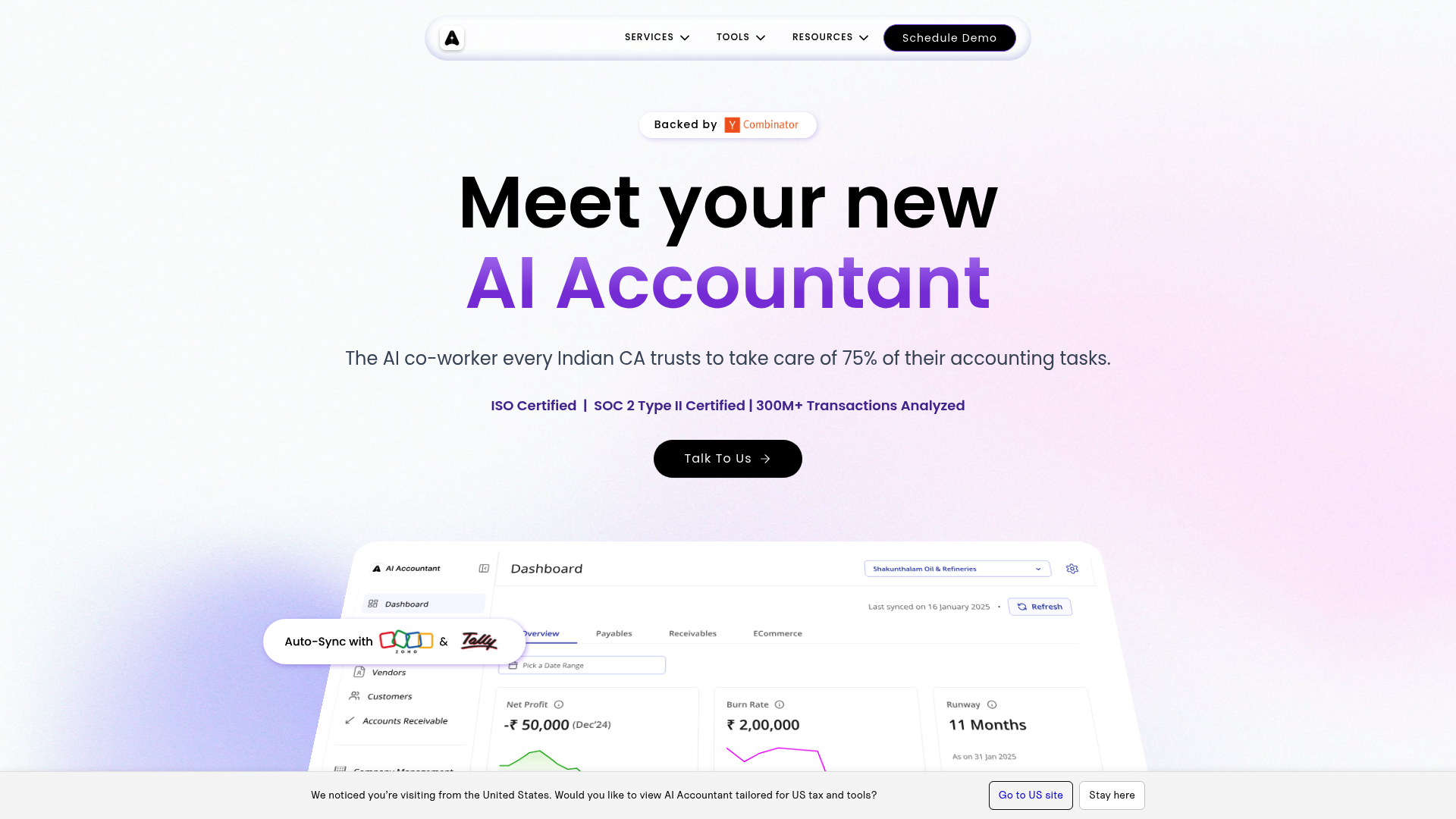
AI Accountant is a platform built from the ground up with one person in mind: the Indian CA. Its goal is to automate up to 75% of the manual accounting and bookkeeping tasks that slow down most firms. It excels at taking messy, raw data sources like bank statements, credit card bills, and vendor invoices and turning them into clean, categorized book entries.
- Pros: Its biggest strength is its deep, native understanding of the Indian financial ecosystem. The direct, one-click sync with Tally is incredibly smooth and saves hours of manual export/import work. As Vadivel of Vadivel & Co puts it, “The Tally integration has been transformative”, which says a lot. The real-time MIS dashboards are another huge benefit, letting you offer high-value advisory services without spending hours building reports in Excel. Plus, it’s ISO Certified and SOC 2 Type II Certified, so you can tell your clients their data is secure.
- Cons: It’s important to know that AI Accountant is a powerful automation layer, not a standalone accounting software. It’s designed to prepare your data perfectly for your main system. You’ll still need Tally or Zoho for final statutory filings and audits, but that’s the whole point.
- Pricing:
- Offers a generous 30-day free trial which includes a personalized onboarding call to get you set up.
- After the trial, pricing is customized based on your firm’s size and the number of clients you manage.
- Offers a generous 30-day free trial which includes a personalized onboarding call to get you set up.
- Why we included it: It tackles the single biggest headache for almost every CA firm: manual data preparation and reconciliation. Because it’s built specifically for Indian compliance and multi-client workflows, it feels less like a generic tool and more like a solution made just for you.
2. Vyapar TaxOne
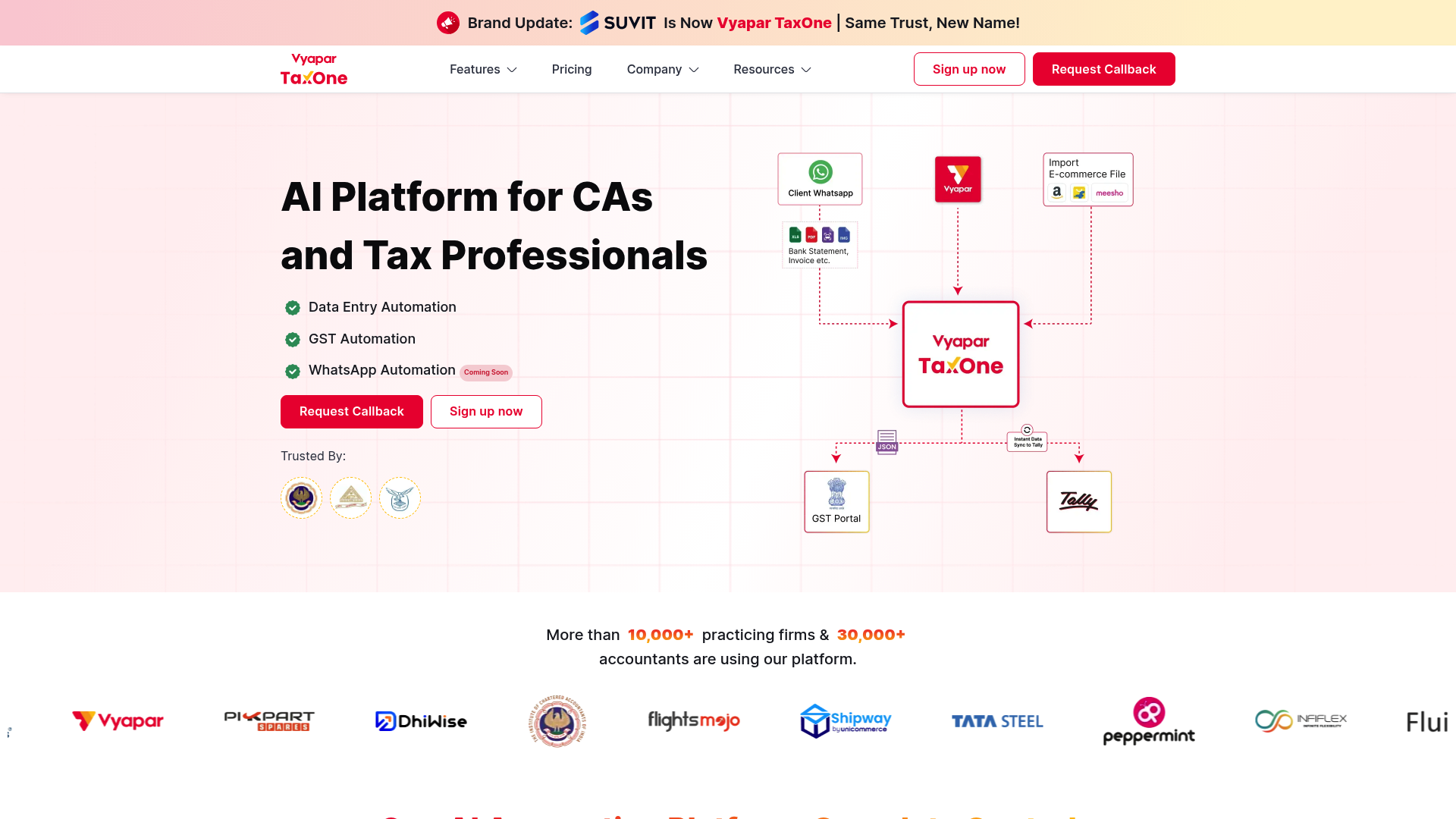
Vyapar TaxOne (formerly known as Suvit) is another great tool that focuses on solving one of the most hated tasks in accounting: data entry. It’s an AI platform made to help CAs and tax professionals automatically collect, sort, and process documents. It can handle sales invoices, purchase bills, and bank statements, often collected directly from clients via WhatsApp or its software integrations.
- Pros: The platform’s main strength is turning unstructured data from PDFs and images into accurate, Tally-ready entries, claiming to save up to 80% of your time on this task alone. A really useful feature is its ability to automatically remind clients and collect documents via WhatsApp, which cuts down on the endless follow-up calls and emails. Its OCR technology is excellent, achieving up to 99.9% accuracy and automatically capturing important details like GSTIN and HSN codes.
- Cons: Vyapar TaxOne is very focused on being the best at data entry and task automation. It’s brilliant at that, but it doesn’t have the deep financial analytics or MIS reporting that some other platforms offer. For client advisory and performance dashboards, you’ll still be relying on Tally’s own reports or exporting data to other tools.
- Pricing:
- The company does not list public pricing on its website.
- To get a quote, you’ll need to contact their sales team for a demo and a customized plan.
- The company does not list public pricing on its website.
- Why we included it: It solves a universal problem. Every single CA firm, big or small, struggles with collecting and extracting data. By creating a clean, automated starting point for all accounting and compliance work, it makes every other step in the process faster and more accurate.
3. Clear Finance Cloud

Many of us know Clear (from its earlier days as ClearTax) as a tax-filing platform, but it has grown into a full, AI-powered ecosystem called Clear Finance Cloud. For CA practices, its most powerful feature is its GST compliance engine. It uses a smart AI matching algorithm to reconcile thousands of purchase invoices against GSTR-2B data, finding mismatches in minutes, a task that could take days of manual VLOOKUPs in Excel.
- Pros: Its ability to process huge volumes of invoices quickly is a major advantage for firms managing clients with a lot of transactions. The AI-powered error detection is another big help, catching things like invalid GSTINs or calculation mistakes before you file, which could save you and your client from dealing with future notices. The platform is trusted by over 4,000 enterprises, which gives you confidence in its stability and security. It also integrates with major ERPs.
- Cons: While it’s excellent for GST and e-invoicing, it is a specialized compliance tool. If your main problem is daily bookkeeping automation, like processing bank statements or general transaction categorization, you will need to use Clear alongside another platform.
- Pricing:
- Pricing is customized based on things like the number of GSTINs you manage and your monthly invoice volume.
- You’ll need to get in touch with their sales team to request a quote.
- Pricing is customized based on things like the number of GSTINs you manage and your monthly invoice volume.
- Why we included it: GST reconciliation is a mandatory, high-volume, and recurring job for every CA firm in India. Clear offers one of the most focused and powerful automated solutions for this very specific, very important task.
4. Botkeeper
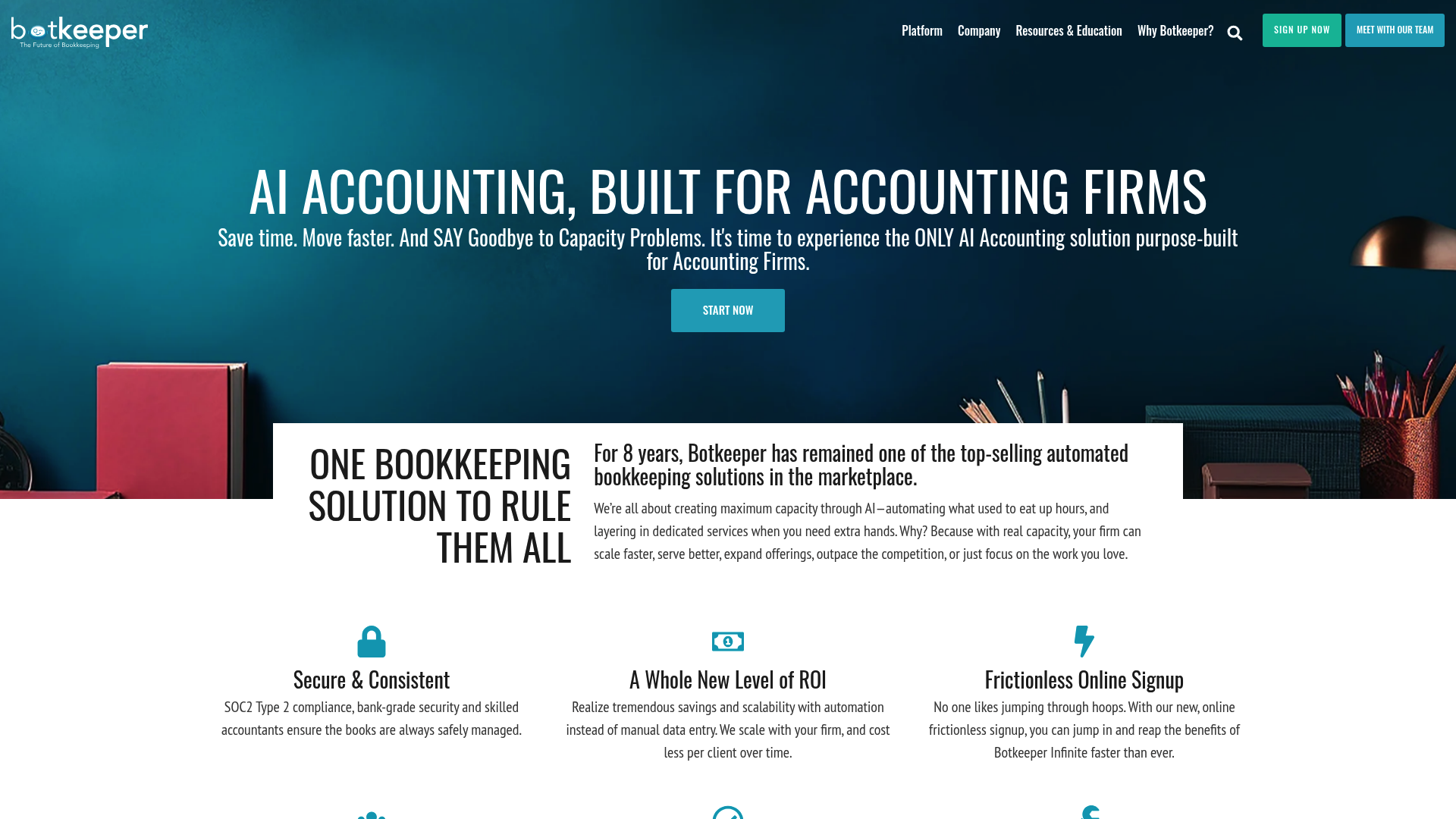
Botkeeper offers a unique approach. It’s not just software; it’s a hybrid model that combines a powerful AI platform with human supervision. This is especially appealing for firms that are a bit nervous about going “full AI.” Its Transaction Manager tool automatically categorizes transactions but is programmed to only push entries to the general ledger when its confidence level is over 98%. Anything below that gets flagged for a human expert to review, which helps maintain a high level of accuracy.
- Pros: This human-in-the-loop model provides a safety net and a layer of quality control that pure AI solutions might miss. This can be very comforting when dealing with clients who have complex or messy books. The platform is also more of an all-in-one practice management suite, with built-in tools for document management, password security, and task management, helping you centralize your firm’s work.
- Cons: Botkeeper is a global platform with a strong focus on the US and Canadian markets. This means it might need more initial setup to be perfectly tuned for Indian banking formats or compliance rules. Its pricing model is also per-license (one for each client), which can get expensive if you have a large number of very small clients.
- Pricing:
- Starts at $149 per month for a single license, with discounts available if you buy licenses in bulk.
- They also offer add-on services where you can get a dedicated bookkeeper, with plans for that starting from $1,499 per month.
- Starts at $149 per month for a single license, with discounts available if you buy licenses in bulk.
- Why we included it: Botkeeper provides a great model for how a traditional CA firm can productize and scale its bookkeeping services. It shows a clear path from a people-limited model (where growth depends on hiring more staff) to a technology-enabled one (where growth is driven by efficiency).
5. MindBridge
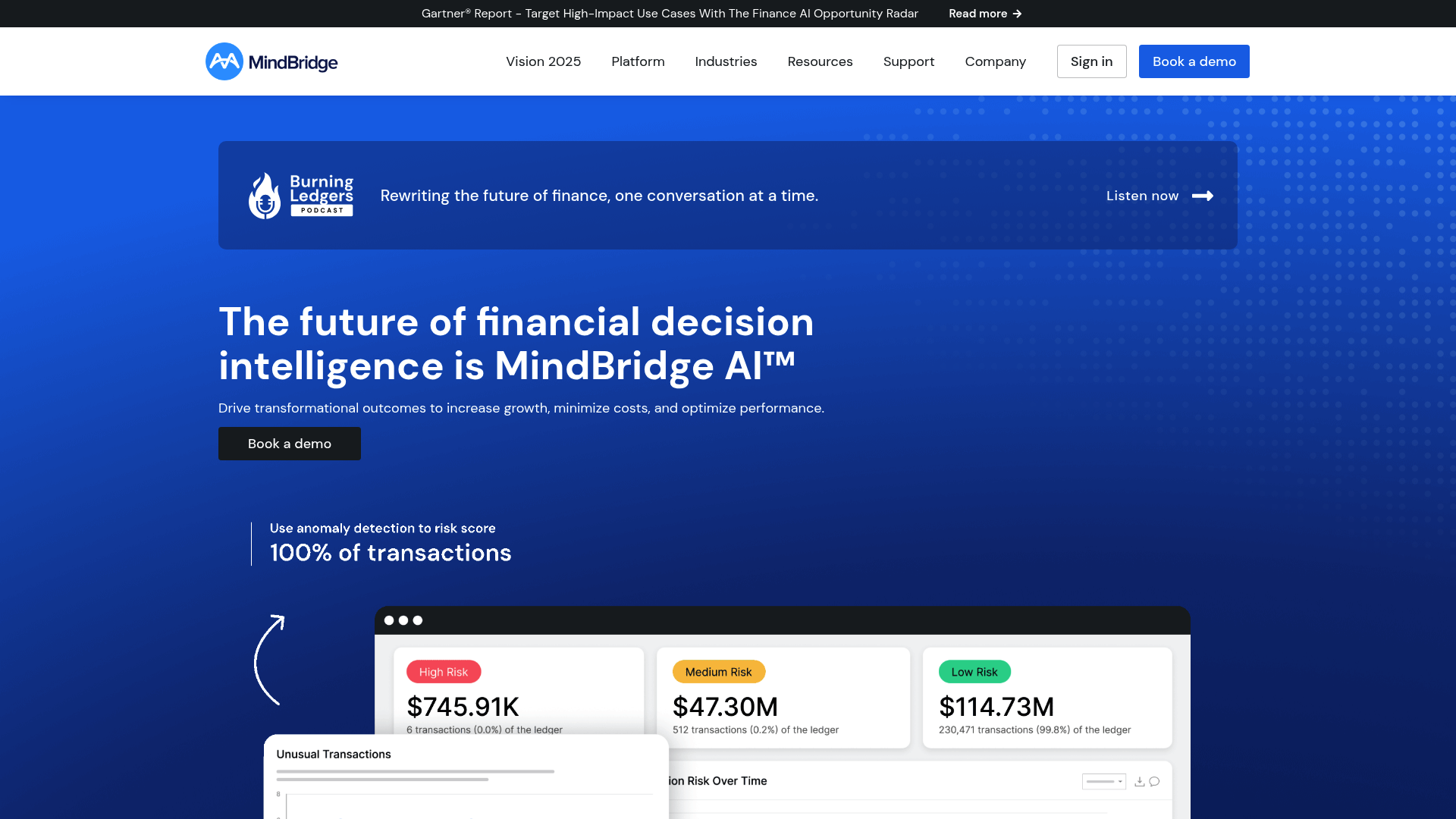
MindBridge is in a different category. Experts built this highly advanced AI platform specifically for audit and assurance services. The traditional audit process depends on sampling. MindBridge throws that idea out the window. It allows auditors to analyze 100% of a client’s financial transactions, no matter how many there are. Its “Ensemble AI” uses a mix of statistical models, machine learning, and business rules to find anomalies, unusual journal entries, and hidden patterns that could point to either error or fraud. It then gives every single transaction a risk score.
- Pros: This tool can seriously elevate the quality and depth of an audit, allowing your firm to offer a much higher level of assurance to clients and stakeholders. By automatically flagging the highest-risk areas, it helps your audit team focus their valuable expertise where it’s needed most, instead of on manual ticking and tying. It’s trusted by global giants like KPMG and Grant Thornton, which is a strong sign of its capabilities.
- Cons: Let’s be clear: this is a highly specialized, enterprise-level tool. It’s better suited for larger firms or those with a significant, dedicated audit practice. A key point for Indian firms is that it does not offer a direct Tally integration. It’s designed to connect with larger ERPs via its API, which means you’d need a solid process for extracting and preparing data from Tally to use it.
- Pricing:
- Pricing is not publicly available and is customized for each firm.
- You’ll need to schedule a consultation and demo with their sales team to get a quote.
- Pricing is not publicly available and is customized for each firm.
- Why we included it: It represents the future of audit. For firms looking to truly differentiate their assurance services and move beyond basic compliance, a tool like MindBridge is a must-have for providing deeper, data-driven insights.
Mentor’s take: How to adopt AI tools
- Start with your biggest bottleneck. Don’t get caught up in the hype of “implementing AI.” That’s not the goal. The goal is to solve a business problem. Look at your practice and be honest: where does most of your team’s time get wasted? Is it manually typing in 500 lines from one client’s bank statement every month? Is it the GSTR-2B reconciliation for another? Find that one point of maximum pain and pick a tool that solves that one problem.
- Treat this as a skill upgrade, not a software swap. This is the most important mindset shift. These tools don’t replace your team members; they replace their most boring tasks. The role of your articles and junior staff will change from manual data entry to reviewing AI-generated outputs, investigating exceptions, and analyzing the results. This requires more critical thinking and analytical skills, which is a great upskilling opportunity for them and a huge value-add for your firm.
- The real ROI is advisory. Saving 20 hours a month is great, but that’s only half the story. The real return comes from what you do with that saved time and the new data you have. With real-time dashboards from these tools, you can have proactive, strategic conversations with your clients about their cash flow, profitability, and growth.
- Make your resume AI-ready. For all the students and young professionals, knowing how to use these tools is a huge advantage in the job market. When you’re applying to a Big 4 or a top MNC, being able to say “I have hands-on experience scaling a practice using AI automation tools like AI Accountant” is so much more powerful than just listing Tally on your skills list. Before you send out your next application, make sure your resume highlights these new-age skills.
AI powers your firm’s next chapter
Adopting AI is no longer just an option for ambitious CA firms; it’s the key to scaling efficiently, increasing profitability, and moving up from being a compliance-provider to a trusted advisor. These tools act as a force multiplier for your team, handling the repetitive work so you can focus on what truly matters: providing expert advice and building strong client relationships.
The transition doesn’t have to be a massive, overwhelming project. Start small. Focus on solving one painful problem at a time. And most importantly, invest in upskilling your team to think like reviewers and analysts, not just data entry clerks. A future-ready CA practice doesn’t remove people; smart automation empowers them.
Ready to build the skills to lead an AI-powered practice? Explore our AI for Finance Masterclass and learn how to transform your firm with the right technology, strategy, and expertise.