
For years, the game plan for many ambitious Indian Chartered Accountants felt pretty set in stone: land a great, tax-free job in Dubai. It’s a path that has made a lot of sense, offering a fantastic lifestyle and solid earnings relatively close to home. But lately, a different conversation has started. A growing number of CAs are looking west, not just for a job, but for a long-term career, a better work-life balance, and a passport to the entire European Union.
If you’re curious about that new path, this guide is for you. We’re going to dive into the booming demand for CAs in the fund accounting worlds of Ireland and Luxembourg. We’ll break down what the job is really about (hint: it’s way more than bookkeeping) and explore why these two small European countries have become popular destinations for global finance careers.
What do fund accounting jobs for CA?
Let’s clear something up right away: fund accounting isn’t just glorified bookkeeping. If you think it’s about tracking simple debits and credits, you’re in for a surprise. This is a highly specialized, analytical field, making it a perfect next step for a qualified CA who wants to build deep, in-demand expertise.
The role is akin to being a financial detective for massive global investment funds. You’re not just recording transactions; you’re responsible for figuring out the precise value of complex, multi-billion dollar portfolios. To give you a clearer picture, here are the core responsibilities involved.
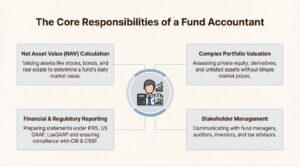
Here’s a look at what you’d actually be doing day-to-day:
- Net Asset Value (NAV) calculation: This is the core of the role. You’re the one who calculates the daily or weekly market value of a fund. This involves valuing every single asset (stocks, bonds, real estate, private company shares) and subtracting all the liabilities to arrive at the all-important NAV per share, which is what investors use to buy and sell.
- Complex portfolio valuation: We’re not talking about a simple stock portfolio. Fund accountants are tasked with valuing some seriously sophisticated financial instruments. This could be anything from private equity stakes in startups and unlisted real estate assets to complex derivatives and private debt instruments that don’t have a simple market price.
- Financial & regulatory reporting: You’ll be preparing detailed financial statements under various international standards like LuxGAAP, IFRS, and US GAAP. You’ll also handle a mountain of regulatory reporting for authorities like the Central Bank of Ireland or the CSSF in Luxembourg, ensuring the fund is compliant with all local and international laws.
- Stakeholder management: This isn’t a back-office, heads-down job. You’re constantly talking to a whole range of people: the fund managers who make the investment decisions, the auditors who check your work, the investors who want to know how their money is doing, and the tax advisors who structure the deals. Strong communication skills are a must.
It’s pretty clear why CAs are a natural fit for this. The entire CA curriculum, with its heavy focus on advanced accounting, financial management, and auditing, is basically a training ground for the analytical rigor and meticulous attention to detail that fund accounting demands. You’ve already built the foundation; this is where you apply it on a global scale.
Comparing Dubai and Europe
Dubai offers significant advantages. The tax-free salary is a huge draw, it’s relatively close to India, and there’s a massive, welcoming expat community. However, career planning involves considering the complete picture, not just the headline salary number.
A straight-up comparison is tricky because the economics are so different. For example, while you won’t pay income tax in Dubai, the cost of living in Dublin is about 23.7% higher than in Dubai (and that’s before you even factor in rent). Your weekly grocery bill could be almost 50% more expensive in Dublin.
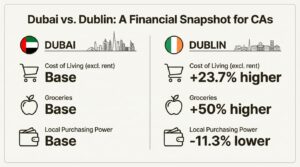
This is where a deeper analysis is useful. Despite those higher costs, the actual local purchasing power in Dublin is only about 11.3% lower than in Dubai. This means that after you account for the higher salaries and the cost of goods, the real-world difference in your lifestyle might be smaller than you think. The financial gap isn’t as wide as the tax rates suggest.
This is where the decision becomes less about a paycheck and more about strategy. The choice is really between short-term financial gain versus long-term global career mobility. A career in Europe, particularly in a specialized hub like Ireland or Luxembourg, offers a chance to build deep expertise in complex fund structures (like Private Equity and Real Estate) that are in demand everywhere. Plus, it provides a clear and established pathway to EU residency or even citizenship, opening up a world of opportunities.
Why only Ireland and Luxembourg for jobs?
So, why these two countries specifically? Because when it comes to Europe’s fund administration industry, Ireland and Luxembourg are key centers. They manage trillions of euros in assets. This has created a massive, consistent, and ever-growing demand for talented accountants who can handle the complexity.
Ireland: An English-speaking hub
Ireland offers a relatively smooth transition into Europe. As a major global hub for hedge funds and private equity funds, it is a central location for the industry. A significant advantage is that it’s an English-speaking country. This means no language barrier in the office or in your daily life, making the cultural and professional move much simpler for Indian CAs.
The work culture often emphasizes a good work-life balance and a collaborative, friendly team environment. You’ll find a lot of young professionals and a vibrant social scene, especially in Dublin. While the city is buzzing with energy, it’s worth noting that its Quality of Life Index is 159.64. This is considered high, but as we’ll see, it’s quite a bit lower than what its European counterpart offers.
In terms of skills, employers in Ireland are often looking for CAs with experience in fund administration for hedge funds, private equity, and a solid grasp of different alternative fund structures.
Luxembourg: A global fund center
Luxembourg is another major player in the fund industry. It’s the largest fund domicile in Europe and the second-largest in the entire world, right behind the United States. This makes it a global center for UCITS (the kind of funds most retail investors buy) and a major hub in the world of Alternative Investment Funds (AIFs).
Working in Luxembourg means you’re getting exposure to a truly international environment. Your colleagues and clients will be from all over the world. A key differentiator is the quality of life. Luxembourg boasts a Very High Quality of Life Index of 212.35, which is significantly higher than Dublin’s. This score is driven by things like a much higher safety index, lower pollution, and shorter average commute times (helped by the fact that all public transport in the entire country is free!).
The skills in demand here often include a deep knowledge of LuxGAAP/IFRS and experience dealing with the Special Purpose Vehicles (SPVs) and holding companies that are common in cross-border investment structures. While speaking French or German is a plus, English is the primary language of business in the financial sector.
A side-by-side comparison
To make it even clearer, here’s a simple table breaking down the key differences for a CA thinking about making the move.
| Feature | Ireland (Dublin) | Luxembourg (Luxembourg City) |
|---|---|---|
| Primary Fund Types | Hedge Funds, Private Equity, ETFs | UCITS, Alternative Investment Funds (AIFs) |
| Business Language | English | English, French, German |
| Quality of Life Index | High (159.64) | Very High (212.35) |
| Purchasing Power | Lower (Index: 128.50) | Higher (Index: 156.51) |
| Unique Perk | English-speaking, strong US/UK ties | Free nationwide public transport |
| Lifestyle | Vibrant social scene, friendly culture | Cosmopolitan, very high standard of living |
Salaries and purchasing power
A common mistake is converting a tax-free Dubai salary into Euros and comparing it directly to a European salary, as it can be misleading. The true value of what you earn comes down to three things: your net salary (after taxes), your local purchasing power (what that net salary can actually buy you), and the quality of life you get in return.
Let’s look at some benchmarks.
- In Dublin, the median salary for a Fund Accountant is around €34,150 per year.
- In Luxembourg, the median salary for a Fund Accountant is significantly higher at €53,000 per year. Senior roles there can fetch a median salary of around €64,000.
The impact on purchasing power becomes clear when comparing net salaries. The cost of living, especially rent, is pretty similar between Dublin and Luxembourg City. But because the salaries in Luxembourg are so much higher, it leads to a massive difference in your financial well-being. According to Numbeo, the average monthly net salary in Luxembourg (after their high taxes) is €4,451, compared to just €3,630 in Dublin.
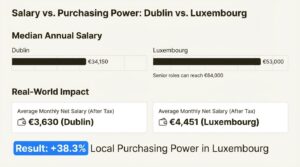
This translates to a 38.3% higher local purchasing power in Luxembourg compared to Ireland. In simple terms, your paycheck goes almost 40% further in Luxembourg, allowing for a higher standard of living, more savings, and more disposable income.
Comparing salaries, taxes, rent, and purchasing power across three different countries can feel overwhelming. How do you actually figure out what a €64,000 salary in Luxembourg means for your lifestyle compared to your current package in Dubai?
Planning your move
For Indian CAs who are thinking globally, Ireland and Luxembourg represent a significant opportunity. This can be a strategic career move that offers deep professional growth in the world’s most sophisticated financial markets, long-term stability, and a high quality of life.
It may require a shift in mindset. You have to start viewing your career as a long-term investment. The skills and experience you gain in Europe’s top fund centers are globally recognized and incredibly valuable. Working in Luxembourg or Dublin doesn’t just open doors in Europe; it opens doors worldwide.
The first steps include tailoring your CV to highlight the most relevant skills for these markets, like your experience with IFRS, complex audits, and financial reporting. Then, begin researching the visa sponsorship process for each country, as many large financial institutions are actively recruiting and sponsoring talent from abroad.
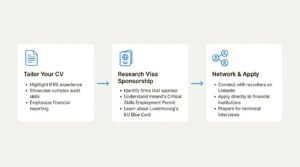
Ultimately, the choice between sticking to the traditional path in Dubai or venturing into Europe is about defining what you want from your career and your life. It’s about weighing your personal and professional priorities for the long term. Luxembourg clearly offers superior purchasing power and an unbeatable quality of life, while Ireland provides a culturally seamless, English-speaking transition into the heart of European finance.
Ready to see what your skills are worth? Use our Salary Estimator to compare your earning potential and take the first step towards your career.
Frequently Asked Questions
Q.1 What skills are most in-demand for fund accounting jobs for a CA in Ireland/Luxembourg?
A: Employers are primarily looking for a strong understanding of international accounting standards like IFRS, US GAAP, or LuxGAAP. Experience with complex financial instruments, alternative investments (like private equity or real estate), and financial reporting for regulated entities is highly valued.
Q.2 Do I need to speak French or German for a fund accounting job in Luxembourg?
A: Not necessarily. English is the primary language of business in the financial sectors of both countries. While knowing French or German is a definite advantage for daily life and integration in Luxembourg, it’s not a strict requirement for most roles in fund accounting.
Q.3 Is visa sponsorship common for these roles?
A: Yes, due to the high demand for skilled accountants, many large financial institutions and fund administrators in both Ireland and Luxembourg actively recruit and sponsor visas for qualified CAs from non-EU countries like India.
Q.4 How does the career progression compare to other finance roles?
A: Career progression is quite structured. You typically start as a Fund Accountant and can move up to Senior Fund Accountant, Manager, and Director levels. The specialized experience you gain in complex, globally recognized fund structures can open doors to opportunities worldwide, not just within Europe.
Q.6 What is the biggest difference in work culture between working in Europe and Dubai?
A: The most significant difference is the emphasis on work-life balance. European work cultures, particularly in Ireland and Luxembourg, generally respect standard working hours and paid time off more strictly. This often contrasts with the potentially more demanding, “always-on” work culture that can be found in major financial hubs in the Middle East.
Also read: Top 7 R2R Interview Questions for 2026 (And How They Lead to an Sap FICO Career)