So, you’ve made it through the first few hurdles for a role at Deloitte or another top firm. First off, congrats! That’s a big deal. But now you’re staring down the next challenge: the Versant test. It’s totally normal to feel stressed. You might be worried that your accent isn’t perfect or that you’ll trip over your words when the pressure is on.
But here’s the thing. The Versant test isn’t just about your English skills. It’s graded by an AI, which makes it as much a technical test as a language one. The secret to a great score isn’t about sounding like a native speaker; it’s about understanding how the system listens and giving it exactly what it wants to hear.
That’s where this guide comes in. We’re going to walk through five practical, tech-focused hacks to help you work with the AI, not against it. We’ll cover everything from microphone basics and speaking clearly to simple strategies for the test’s trickiest sections. Forget about being perfect. Let’s focus on technique and confidence.
What is the Versant test and how does it work?
Before we jump into the hacks, let’s get on the same page about what this test is. The Versant English Test, developed by Pearson, is a short, automated assessment that’s over in about 17 minutes. Big companies like Deloitte use it to screen candidates’ communication skills quickly and consistently. It’s not designed to trick you; it’s just trying to measure how well you can communicate in a professional setting.
The AI scores you on four main things:
- Sentence Mastery: How well you handle English grammar.
- Vocabulary: The range of words you know and can use correctly.
- Fluency: Your speaking rhythm and pace, without weird pauses.
- Pronunciation: How clearly you form your words and sounds.
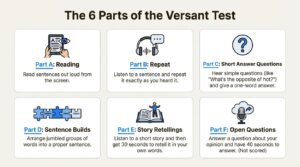
To check these skills, the test is split into six parts, which you can read about in the official test guide. Here’s a quick look:
- Part A: Reading: You read sentences out loud from the screen.
- Part B: Repeat: You listen to a sentence and repeat it exactly as you heard it.
- Part C: Short Answer Questions: You hear simple questions (like “What’s the opposite of hot?”) and give a one-word answer.
- Part D: Sentence Builds: You get a few jumbled groups of words and have to arrange them into a proper sentence.
- Part E: Story Retellings: You listen to a short story and then get 30 seconds to retell it in your own words.
- Part F: Open Questions: You’ll be asked a question about your opinion and have 40 seconds to answer. The good news? This part isn’t scored, so you can just relax and speak naturally.
Since an AI is grading you, stuff like your pacing, audio clarity, and even your microphone can make a huge difference. That’s why our hacks focus on these technical details; they’re often the easiest way to give your score a boost.
5 quick tips to boost your Deloitte Versant test
Ready for the good stuff? These five tips are all about getting the hang of the test’s format and technology. Think of it less like an exam and more like a performance where you know exactly what the critic (the AI) wants.
Hack 1: Master your microphone discipline
This might sound basic, but it’s probably the most important hack here. The Versant AI is really sensitive to audio quality. If your sound is full of static, background noise, or sudden volume changes, the system will have a hard time understanding you, and your score will suffer, even if your English is perfect.
Pearson’s own best practices make it clear you need to get this right. Here’s how:
- Use a proper headset. Forget the built-in laptop mic or your earbuds. A head-mounted USB headset with a microphone boom is your best bet. It keeps the mic a consistent distance from your mouth and helps filter out room noise. Built-in mics are known for picking up keyboard clicks, fan sounds, and echoes, all of which can throw off the AI.
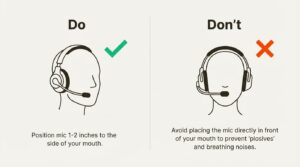
- Position the mic correctly. Don’t put the microphone right in front of your mouth. Instead, place it about an inch or two (2-5 centimeters) to the side. This simple move stops the AI from hearing harsh popping sounds, called “plosives,” when you say words with “p” or “b.” It also prevents your breathing from creating static.
- Speak at a consistent volume. A lot of people let their voice fade at the end of a sentence. In a normal chat, that’s fine. To the Versant AI, it can sound like you’re not fluent or confident. Try to keep your volume steady from the start of the sentence to the very end.
Hack 2: Speak clearly, not quickly
When we get nervous, we tend to speed up. It’s a common mistake on the Versant test, where people think talking faster makes them sound more fluent. With this AI, it’s the other way around. The fluency score isn’t about speed; it’s about rhythm, clear phrasing, and speaking at a natural, steady pace.
This is where the “robot voice” idea comes in. No, you don’t need to sound like a monotone machine, but you should aim to speak a little slower and more deliberately than you would with a friend. This gives the AI clean, easy-to-process audio.
Focus on enunciation. Make an effort to pronounce the beginning and end of every single word. The AI uses these phonetic cues to measure both your pronunciation and sentence mastery. When words blend together, the system can get confused. For example, say “going to” instead of “gonna,” and “want to” instead of “wanna.”
Think of it this way: a steady, measured pace sounds confident to the AI. Rushed, mumbled speech just sounds jumbled. Take a breath, slow down, and give each word the space it needs.
Hack 3: Don’t self-correct or hesitate
This is a big one, and it goes against every instinct you have. In a normal conversation, if you misspeak, you’d probably say, “Oops, I mean…” and fix it. On the Versant test, that’s one of the worst things you can do.
The scoring algorithm often penalizes hesitations, filler words (like “uhm,” “er,” and “ah”), and self-corrections more than the original small mistake. Why? Because these interruptions break your speech flow, which is a major red flag for the fluency score.
So, what should you do? If you mispronounce a word or skip one, just keep going. Act like it never happened and finish the sentence. The AI is much more likely to forgive a minor pronunciation error than a three-second pause while you fix it. Powering through shows confidence and keeps your rhythm intact.
The same rule applies when you need a moment to think. Instead of filling the silence with an “uhm,” just take a quiet, one-second pause. A moment of silence is processed much better by the AI than a filler word.
Hack 4: Use the keyword technique for story retelling
The Story Retelling section (Part E) is where many people feel the most pressure. You have to listen to a short story, remember the key details, and then summarize it in just 30 seconds. Trying to memorize the story word-for-word is a recipe for disaster.
Instead, use the keyword technique. As you listen, don’t try to catch everything. Just focus on identifying 3-4 key pieces of information. These usually answer the classic questions:
- Who? Who is the main character? (e.g., “The woman,” “The two brothers”).
- What happened? What is the main action? (e.g., “She missed her flight,” “They started a business”).
- Where? What is the location? (e.g., “At the airport,” “In their garage”).
- Result? What was the outcome? (e.g., “She had to rebook,” “They became successful”).
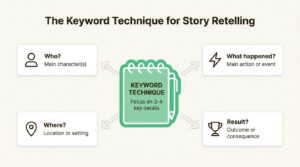
Once the story ends, you have 30 seconds to speak. Don’t panic. Just use your keywords to build a few simple sentences. Your goal is a short, accurate summary, not a novel. A summary that hits the main points clearly will always score better than a long, rambling one where you get tangled up and start to hesitate.
Hack 5: Practice the repeat sentence section (Part B) precisely
Part B seems simple: hear a sentence, repeat it. But this is a direct test of your auditory memory and Sentence Mastery, and it’s easy to lose points by being imprecise. The AI is listening for an exact match.
The trick is to repeat the sentence exactly as you hear it. You can’t paraphrase, change the verb tense, or skip small words. The AI will notice if you say “the car” when the audio said “a car,” or if you say “he walks” when it said “he walked.” These tiny changes might not matter in a real chat, but they matter to the scoring algorithm.
For longer sentences, don’t try to memorize them as one long string of words. Instead, listen for the natural pauses in the speaker’s voice. They often break sentences into smaller, logical chunks. Try to remember the sentence in these 2-3 chunks. It’s much easier for your brain to hold onto “Joe waited for the train / but the train was late” than trying to recall all nine words at once.
Like any skill, this gets easier with practice. The more you do it, the better your short-term auditory memory gets.
Putting it into practice: Sample questions
Let’s make this real. Here are a couple of examples from “Part B: Repeat” so you can see how to apply these hacks. Imagine you hear the following prompts.
Example 1 (Audio prompt): “Mary and Samantha took the bus to the airport.”
- How to apply the hacks: After the prompt finishes, take a silent half-second breath. Don’t rush. Speak clearly, making sure to pronounce “and” and “the.” Repeat every word exactly. Your delivery should be steady and confident.
Example 2 (Audio prompt): “Joe waited for the train, but the train was late.”
- How to apply the hacks: Notice the slight pause in the audio after “train.” That’s your cue to remember it in two parts: “Joe waited for the train” and “but the train was late.” When you repeat it, keep that natural rhythm. Don’t speed up or blend the two parts. Again, focus on saying every single word.
Getting a feel for the rhythm and precision needed for this section is a great way to practice and build your confidence.
Will you pass? Apply these tips on a practice test
Reading about tips is one thing, but the best way to get comfortable is through practice. A mock test is your best friend here. It helps you get used to the timing, the question formats, and the pressure of speaking into a microphone against a clock. This is a solid tip for any communication test for Big 4 firms, not just Deloitte.
For a more dynamic look at these strategies, watching a video walkthrough can be very effective. It helps to hear the tone and pacing that the AI prefers, which can be hard to grasp from text alone. The video below provides some excellent tips and examples to help you prepare.