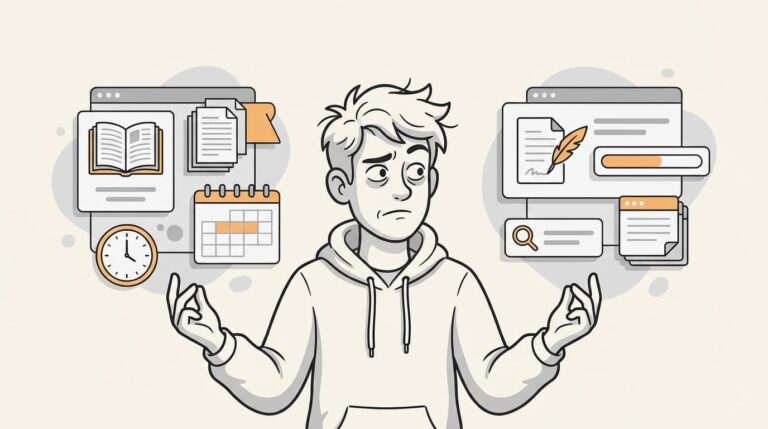
You’re sitting in the library at 11 PM, surrounded by empty coffee cups and half-finished notes. Your final exams are in two weeks, but your senior article (or thesis, or capstone project) is also due before the semester ends. Every time you try to focus on one, the other screams for attention. Welcome to the 3rd year slump.
If this feels familiar, you’re not alone. The 3rd year slump is a documented phenomenon that hits undergraduate juniors harder than any other academic year. Unlike high school seniors who’ve already secured college admissions, or graduate students who’ve passed their qualifying exams, 3rd year students face a unique pressure cooker: high-stakes final exams happening at the exact same time as major independent research projects.

What is the 3rd year slump?
The “slump” phenomenon isn’t new. Researchers have studied senioritis in high school students and the notorious 3rd-4th year slump in PhD programs. But undergraduate juniors occupy a unique, often overlooked middle ground.
According to research from Johns Hopkins Medicine, the 3rd year slump typically sets in after students complete their structured coursework and transition to independent research. Sound familiar? For undergraduates, junior year is precisely when general education requirements give way to major-specific courses, independent studies, and yes, that looming senior article or thesis.
Here’s why the 3rd year slump hits differently:
No clear finish line. High school seniors have graduation. Grad students have dissertation defense. But 3rd year students? You’re in the middle of a marathon with no mile markers. The end feels impossibly far away.
The dual deadline trap. Unlike other academic years, you’re juggling two completely different types of pressure: the immediate, high-stakes crunch of final exams alongside the slow-burn, long-term demands of a major writing project.
The identity shift. Junior year is when you transition from “student taking classes” to “scholar producing original work.” That shift is exciting but exhausting.
A study at UC Berkeley found that nearly half of STEM PhD students experience depression during this middle period of their programs. While undergraduate research is less intense, the psychological patterns are strikingly similar: isolation, loss of structure, and the overwhelming feeling that your work will never be good enough.
Recognizing the warning signs
The 3rd year slump doesn’t announce itself with a flashing sign. It creeps in gradually, disguised as normal stress until you’re already underwater. Recognizing the warning signs early can mean the difference between a challenging semester and a full-blown crisis.
Common symptoms to watch for:
- The “treadmill feeling.” You’re working constantly but never feel like you’re making progress. Every step forward seems to reveal two more steps needed.
- Sleep disruption. Either you can’t fall asleep because your brain won’t shut off, or you’re sleeping 10+ hours and still exhausted.
- Procrastination that feels different. This isn’t the “I’d rather watch Netflix” procrastination you had freshman year. This is paralysis. You stare at your document and literally cannot make yourself type.
- Loss of interest in your topic. You chose this major for a reason, but now you can’t remember why. Everything feels meaningless.
- Social withdrawal. You cancel plans, stop responding to texts, and isolate yourself because socializing feels like another item on an impossible to-do list.
Here’s the key distinction: some stress is productive. Feeling nervous before an exam or energized by a deadline is normal. But when stress becomes constant, unrelenting, and starts affecting your sleep, appetite, or relationships, it’s crossed into unhealthy territory.
Ask yourself these questions:
- Have I felt hopeless about my work for more than two weeks?
- Am I using alcohol or other substances to cope with stress?
- Have I stopped activities I used to enjoy?
- Do I feel like my friends and family would be better off without me?
If you answered yes to any of these, especially the last one, please reach out to your campus counseling center. According to EBSCO Research, academic slumps can trigger or worsen mental health conditions, and seeking help is a sign of strength, not weakness.
Time management strategies
Let’s get practical. You can’t eliminate the dual pressure of finals and your senior article, but you can manage it strategically. The key is treating these two demands as separate systems rather than one overwhelming blob of work.
The two-track system
Instead of trying to “balance” both simultaneously (which usually means doing both poorly), try alternating focus days:
Exam Focus Days: Dedicate entire days to exam prep. No article work allowed. Use active recall, practice problems, and study groups.
Article Focus Days: Dedicate entire days to writing and research. No exam studying allowed. Use the Pomodoro technique: 25 minutes writing, 5 minutes break.
This approach works because it eliminates the cognitive cost of constant context-switching. Every time you switch between exam prep and article writing, you lose 15-20 minutes of productive time getting your brain back into gear.
Block scheduling
Within your focus days, use time blocking:
| Time Block | Activity Type | Why It Works |
|---|---|---|
| 8-10 AM | Deep work (hardest tasks) | Your brain is freshest |
| 10-12 PM | Medium-focus tasks | Momentum from morning |
| 12-1 PM | Break (actual break) | Food, movement, social contact |
| 1-3 PM | Administrative tasks | Lower cognitive demand |
| 3-5 PM | Review and planning | Consolidate learning |
| Evening | Personal time | Non-negotiable rest |
The priority matrix
Not all tasks are created equal. Use this framework:
Urgent + Important: Do these first (tomorrow’s exam, article deadline this week)
Important + Not Urgent: Schedule these (article sections due next month, concepts for future exams)
Urgent + Not Important: Delegate or minimize (emails, non-essential meetings)
Neither Urgent nor Important: Eliminate (scrolling social media, reorganizing your desk again)
Breaking large projects into chunks
Your senior article feels overwhelming because you’re viewing it as a 50-page mountain. Instead, break it down:
- Today’s goal: Write 500 words on Section 2.3
- This week’s goal: Complete literature review section
- This month’s goal: Submit rough draft to advisor
Each small win triggers dopamine, which motivates you for the next task. String enough of these together, and you have a completed article.
Building in buffer time
Here’s a hard truth: things will go wrong. You’ll get sick. Your advisor will request major revisions. A family emergency will demand your attention. Build 20% buffer time into every deadline. If your article is due May 1st, plan to finish by April 20th. This buffer isn’t slacking; it’s intelligent project management.
Protecting your mental health
You cannot pour from an empty cup. This isn’t self-help fluff; it’s neuroscience. Sleep deprivation reduces cognitive performance by 25-50%. Chronic stress shrinks your hippocampus, the brain region responsible for memory formation. Taking care of your mental health isn’t indulgent; it’s essential for academic success.
Sleep as a productivity tool
All-nighters are a false economy. Research consistently shows that sleep-deprived students perform worse on exams, even when they’ve studied more material. During sleep, your brain consolidates memories and clears metabolic waste. Skipping sleep to study is like trying to fill a leaky bucket.
Practical sleep hygiene:
- Same bedtime and wake time every day (yes, even weekends)
- No screens 30 minutes before bed
- If you can’t sleep, get up and do something boring until you’re tired
- Caffeine cutoff at 2 PM
Movement breaks
You don’t need a gym membership. Five minutes of movement every hour improves circulation, reduces eye strain, and resets your attention span. Walk around the library. Do stretches at your desk. Dance to one song. Your brain will thank you.
Brief mindfulness practices
Meditation doesn’t require sitting cross-legged for an hour. Try these micro-practices:
- The 4-7-8 breath: Inhale for 4 counts, hold for 7, exhale for 8. Repeat 4 times. This activates your parasympathetic nervous system, reducing stress in under a minute.
- Body scan: Close your eyes and mentally scan from your toes to your head, noticing tension without trying to change it. Takes 2 minutes.
- Gratitude pause: Before opening your laptop, name three things you’re grateful for. Research shows this simple practice reduces cortisol levels.
When to seek professional help
There’s no shame in needing support. Consider reaching out if:
- You’ve felt depressed or anxious for more than two weeks
- You’re having thoughts of self-harm
- Your sleep or appetite has changed dramatically
- You’re using substances to cope
- You’re isolating from friends and family
Building your support system
You don’t have to do this alone. In fact, you shouldn’t. Research emphasizes that social connection is one of the strongest protective factors against academic burnout.
Academic support
Your advisor/committee: They’re not just there to grade your final product. Schedule regular check-ins, even brief ones. Come with specific questions. If you’re struggling, be honest. Most professors would rather know early and help than discover problems at the deadline.
Writing centers: Most universities have free writing support. They won’t write your article for you (that would be academic dishonesty), but they can help with structure, clarity, and citation formatting.
Study groups: For exam prep, nothing beats active recall with peers. Teaching concepts to others is one of the most effective learning strategies. Form a group, assign topics, and teach each other.
Peer support
Find your people. Other 3rd year students are going through exactly what you’re experiencing. Consider:
- Starting a thesis writing group that meets weekly
- Creating a group chat for venting and encouragement
- Meeting for coffee (not to work, just to connect)
Communicating with professors
If you’re struggling with competing demands, communicate early and professionally:
“Dear Professor [Name], I’m writing to let you know that I’m facing competing deadlines this semester with my senior article and final exams. I’m committed to doing quality work in your course. Would it be possible to discuss strategies for managing these overlapping commitments?”
Most professors appreciate proactive communication and will work with you if you approach them respectfully and early.
Family and friends
Your non-academic support system matters too. Let them know what you need:
- “I need to vent for 10 minutes without advice”
- “Can you check in on me next week?”
- “I need a study break dinner this weekend”
Be specific about what would help. People want to support you but may not know how.
End-of-semester action plan
You’ve made it this far. Now let’s get you across the finish line.
The final push strategy
In the last two weeks before deadlines:
- Audit your remaining work. Make a complete list of everything that still needs to happen.
- Assign each task to a specific day. If it doesn’t have a time slot, it won’t happen.
- Protect your sleep. No all-nighters. Performance degrades so significantly that you’d be better off sleeping.
- Batch similar tasks. Do all your citations at once. Write all your introductions at once. Context switching kills efficiency.
- Done is better than perfect. Your article doesn’t need to win a Pulitzer. It needs to be complete and competent. You can revise later; you can’t submit what you haven’t written.
Celebrating small wins
Your brain needs positive reinforcement. After completing each significant task, take a moment to acknowledge it:
- Cross it off your list dramatically
- Text a friend
- Get a small treat
- Take a 10-minute walk
These micro-celebrations maintain motivation through the final stretch.
Breaking the cycle for next semester
Once this semester ends, reflect on what worked and what didn’t:
- Which time management strategies helped?
- When did you feel most productive?
- What would you do differently?
Use these insights to set up systems for next semester. The 3rd year slump is real, but it doesn’t have to define your entire junior year.
The transition to senior year
Here’s the good news: senior year gets better. You’ll have more control over your schedule. Your major requirements will be nearly complete. And that senior article you’re struggling with now? It becomes the foundation for your post-graduation plans, whether that’s graduate school, job applications, or simply the satisfaction of completing substantial original work.
The skills you’re building now, managing competing priorities, pushing through difficulty, asking for help when you need it, these aren’t just academic skills. They’re life skills. You’re not just surviving the 3rd year slump; you’re developing resilience that will serve you long after graduation.
You’ve got this. One task at a time, one day at a time, one breath at a time. The finish line is closer than it looks.
Frequently Asked Questions
Q1 Is the 3rd year slump a real thing or just something students made up?
A1: The 3rd year slump is absolutely real and well-documented in academic research. Studies from Johns Hopkins, UC Berkeley, and the PLOS ECR Community have documented similar phenomena across undergraduate and graduate programs. It typically occurs when students transition from structured coursework to independent research.
Q2 How do I balance final exams with senior article responsibilities without burning out?
A2: Use the Two-Track System: alternate dedicated focus days between exam prep and article work rather than trying to do both simultaneously. This eliminates the cognitive cost of constant context-switching. Also, build 20% buffer time into all deadlines and protect your sleep, no matter how tempting all-nighters seem.
Q3 When should I seek help for academic stress during my 3rd year?
A3: Seek help if you’ve felt depressed or anxious for more than two weeks, if your sleep or appetite has changed dramatically, if you’re having thoughts of self-harm, or if you’re using substances to cope. Remember, seeking help is a sign of strength, not weakness.
Q4 What are the warning signs that I’m heading toward burnout with my senior article and finals?
A4: Watch for the ‘treadmill feeling’ (working constantly without progress), sleep disruption, paralysis-level procrastination, loss of interest in your topic, and social withdrawal. Distinguish between productive stress (feeling energized by deadlines) and harmful stress (constant, unrelenting anxiety affecting daily functioning).